
Food safety is essential for businesses involved in food manufacturing, processing, packaging, storage, and distribution. Maintaining safe products requires proper planning, effective procedures, regular monitoring, and a well-organized Food Safety Management System (FSMS). ISO 22000 provides an internationally recognized framework to identify hazards, control risks, and ensure food safety throughout the supply chain.
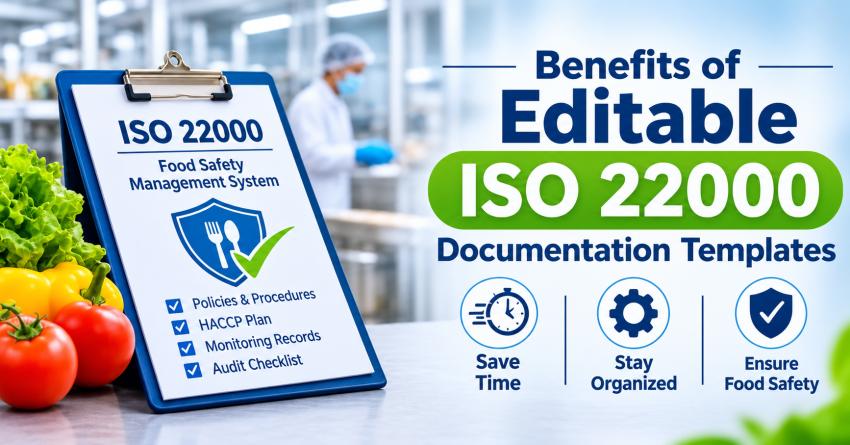
Preparing the required documents can be time-consuming. Editable templates provide ready-made formats that businesses can customize according to their requirements. Using suitable ISO 22000 Documentation templates helps maintain consistency and simplifies FSMS implementation. Here are six important benefits of using editable templates.
1. Simplify Document Preparation and Save Time
Preparing food safety documents from scratch requires considerable effort. Editable templates provide structured formats for manuals, procedures, standard operating procedures (SOPs), forms, and records. Businesses can customize existing documents, reduce administrative work, and focus more on implementing effective food safety practices.
2. Customize Documents for Business Needs
Every food business has different products, processes, facilities, and operational risks. Editable templates allow organizations to update company information, employee responsibilities, production processes, and food safety controls. This ensures documentation reflects actual business activities and supports effective FSMS implementation.
3. Maintain Complete and Organized FSMS Records
A well-managed FSMS requires properly maintained documents. Editable templates help organizations prepare essential records, including:
- Food safety manuals and policies.
- Standard operating procedures (SOPs).
- HACCP documents and hazard assessments.
- Monitoring and audit records.
Organized records improve communication between departments, help employees understand their responsibilities, and make important information easier to access whenever required.
4. Improve Internal Audits and Certification Preparation
Internal audits help organizations evaluate food safety procedures and identify nonconformities. Ready-made checklists, inspection forms, and reporting formats simplify audit preparation. Organized documentation also helps businesses demonstrate their food safety practices during certification audits. However, certification requires effective implementation, employee awareness, and continuous monitoring, not documentation alone.
5. Reduce Documentation Costs and Administrative Efforts
Developing an FSMS independently may require additional time, resources, and professional assistance. Editable templates offer a cost-effective starting point, particularly for small and medium-sized businesses. Organizations can reduce repetitive work, use existing formats, and allocate more resources to improving food safety activities and operational controls.
6. Support Continuous Improvement
Food safety procedures must be reviewed regularly to remain effective. Changes in products, equipment, processes, and employee responsibilities may require document updates. Editable templates make revisions easier, helping organizations maintain relevant procedures, record corrective actions, and improve food safety practices. Regular reviews also ensure that documentation remains aligned with current business operations.
Conclusion
Editable templates simplify ISO 22000 documentation, improve recordkeeping, support internal audits, and reduce administrative efforts. By selecting suitable templates and customizing them according to business operations, organizations can strengthen their Food Safety Management System, maintain consistent food safety practices, and work towards ISO 22000 certification.