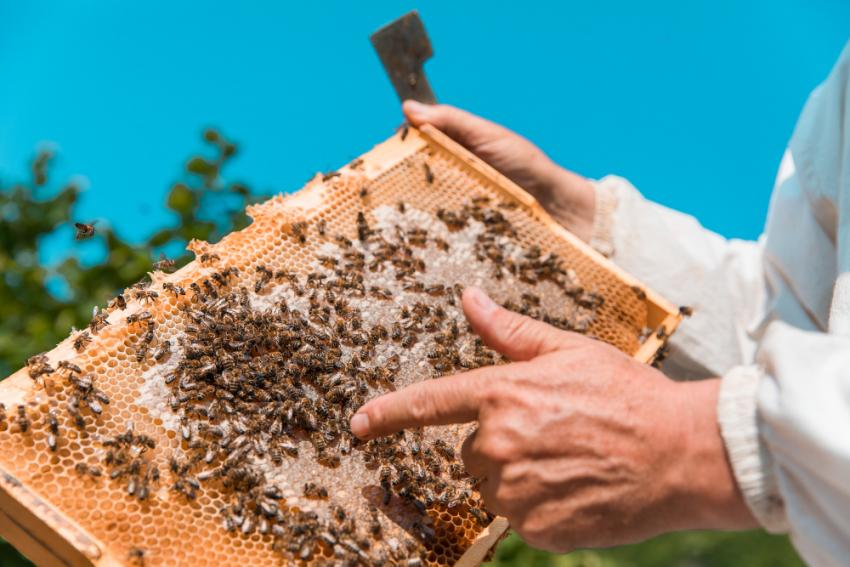
A Katy homeowner who finds bees has five options: leave them alone, spray them, call a general pest control company, call a beekeeper, or call a bee removal specialist. Anyone searching for bee removal Katy TX is really asking which of those fits the situation. The right pick depends on the answers to six questions. Asking them in a fixed order keeps a hurried choice from turning into a costly one.
Each answer points toward a different kind of help. The questions run from identification to relocation, and they apply whether the bees are in a tree, on a fence or inside a wall. Some answers settle the choice at once. Others only narrow it, so keep a note of each one as you go.
Question 1: Are these bees or wasps?
Identification comes first because every later answer depends on it. Honey bees are fuzzy and golden-brown, with a rounded body. Wasps and yellow jackets look smooth and shiny, with a narrow waist and bright yellow and black markings.
Two other insects get mistaken for honey bees. Carpenter bees are large and glossy, and they drill neat round holes in wood trim and fascia boards. Bumble bees are round and very fuzzy, and they often nest in the ground or in a hollow space.
What each answer points to:
Honey bees point to a beekeeper or a bee specialist, because honey bees are worth saving.
Yellow jackets and wasps point to pest control or a specialist, because wasps are not relocated.
Carpenter bees point to a repair-minded service, because the damage is in the wood.
An unclear answer points to a photo taken from a safe distance, shared with a professional who can identify the insect.
Never move closer to a nest just to get a better look. A zoom lens is enough.
Question 2: A swarm or an established colony?
A swarm is a temporary cluster of thousands of worker bees resting on a branch, fence or similar surface. It usually stays only a short while as scout bees look for a permanent home. The cluster is open and visible, and there is no comb inside it.
An established colony looks different. Bees fly in and out of one spot all day, often through a crack, a vent or a gap in siding. That steady traffic means the bees have built comb and stored honey somewhere out of sight.
The difference matters because swarms are the easiest case. No structure has to be opened, so the job is short and usually costs less. Many beekeepers collect swarms, although availability varies by day and by season. A settled colony is a bigger decision, and the next questions decide how big.
If it is a swarm, the best first move is often to wait and watch from a distance. The bees may leave on their own soon. If they stay, or if they sit where people walk, call someone who handles swarms.
Question 3: Is anyone allergic, or is the spot near a door or play area?
This question can override the first two. A harmless swarm in a back corner of a large yard is one thing. The same swarm beside the front door is another.
Ask three things. Does anyone in the household have a known allergy to stings? Is the colony or cluster within a few steps of a door, a patio or a play area? Do pets or children use that part of the yard?
What each answer points to:
A yes to any of them means leaving the bees alone is no longer a good option.
A yes to any of them also rules out spraying it yourself, because an angry colony is the very thing to avoid.
A yes to any of them means a professional should handle it soon, and a same-day call is reasonable.
If someone has trouble breathing, facial swelling or dizziness after a sting, call emergency services right away. Do not wait to see how the reaction develops.
Question 4: Is the nest inside a structure?
A colony inside a wall, soffit, chimney or attic needs a different kind of help than one hanging in a tree. The bees are protected, the comb is hidden, and the only way to reach it is to open something.
Honey makes this more serious than it sounds. A colony can store many pounds of honey and wax in a wall. If the bees die and the comb stays, the wax can soften in Texas heat, and the honey can seep into drywall and draw other insects. That is a general risk of leaving old comb in place, and it is one reason many people want the comb removed, not just the bees.
Locating the colony is the first task. Some companies use thermal imaging to find colonies behind drywall and siding, so the cut is small and in the right place. Raul The Bees Guy is one Katy-based bee and wasp removal service that lists thermal imaging, free inspections and written estimates on its site.
For homeowners comparing bee removal Katy TX choices, a few questions help screen any provider. Will they find the colony before cutting? Will they remove the comb? Will the price be confirmed in writing before work begins? A wall colony is a job of hours, not minutes, so a quote that implies a quick spray and a short visit deserves a follow-up question.
What each answer points to:
A visible, open nest points to nearly any of the five options, depending on the species.
A hidden colony in a structure points to a specialist or a beekeeper who does structural work.
A hidden colony also rules out DIY, since sealing the hole traps bees that may chew into the house.
Question 5: Who will repair what gets opened?
Removing a colony from a wall leaves a hole. Someone has to close it, and someone has to seal the entry point so the next swarm does not move in. Many removal jobs go wrong at this point, because the bee work ends and the repair work has no owner.
Before hiring anyone, ask a plain question: who patches the drywall, the siding or the soffit, and is that cost in the quote? Some providers rebuild what they open. Others remove the bees and hand back a hole, leaving the homeowner to find a carpenter.
Neither approach is wrong if it is stated up front.
Also ask what happens if bees return. A colony that was removed but not sealed out can be replaced within a season, because the scent of old comb attracts scouts. A written guarantee, with a return visit included, is a sign the provider plans for that.
What each answer points to:
If repairs are included, compare the quotes as complete jobs.
If repairs are not included, add a carpenter's cost to the quote.
If the provider does not say, ask before booking anything.
Question 6: Can the bees be relocated alive?
Honey bees are valuable pollinators, and many homeowners prefer that the colony be saved. Live relocation means a beekeeper takes the bees, and often the comb, to an apiary. It is possible when the colony can be reached safely and the nest location allows careful work.
Not every site allows it. A colony deep in a chimney or in an awkward crawl space may be too hard to reach alive. A colony that has turned defensive may also be too risky to move. Providers confirm this at inspection, not over the phone.
Relocation also sorts out the options. Some beekeepers take swarms but may not open walls or repair anything. A removal specialist can do the cutting, the removal and the repair, and may arrange for the bees to go to a beekeeper. A general pest control company will usually treat the colony in place, which is a legitimate approach but does not save the bees.
If saving the bees matters, ask each provider the same direct question: where do the bees go?
Putting the six answers together
Run the questions in order and write down each answer. Then match the pattern to an option:
Leave them alone when the insects are honey bees in a swarm, nobody is allergic, the spot is far from doors and play areas, and the cluster is likely to move on its own soon.
Skip DIY spraying when the nest is inside a structure, anyone is allergic, children play nearby, or the species is unclear. Spraying a colony in a wall also leaves the comb behind.
Call general pest control when the insects are wasps or yellow jackets in an open location, and no one in the household needs the bees saved.
Call a beekeeper when it is a honey bee swarm in an easy spot, such as a low branch or fence, and no repairs are needed.
Call a bee removal specialist when the colony is in a wall, roof or chimney, the location is near people, repairs are needed, or relocation needs to be confirmed at inspection.
Some situations match two options. A honey bee swarm near a front door fits both a beekeeper and a specialist. In that case, speed settles it. Whoever can arrive sooner and handle the location safely is the better first call.
A plain rule for the next time bees show up
When bees appear, do not start with a phone book or a spray can. Start with the first question and work down. Most Katy homeowners will find that two or three answers settle the choice, and the rest only confirm it.
For anyone weighing bee removal Katy TX against waiting it out, the deciding factors are usually location, allergy risk and whether anything has to be rebuilt. Four things shape the price in most cases: where the hive is, the species, the colony size and how easy it is to reach. A good provider explains all four before work starts.
Written details protect the homeowner on any job. Ask for the price, the repair plan and the return-visit terms on paper. Raul The Bees Guy, based in Katy, publishes a free inspection and estimate process, which gives readers one concrete example of the level of detail worth asking for. With the six answers in hand, the call takes a few minutes, and the right type of help usually becomes obvious.