

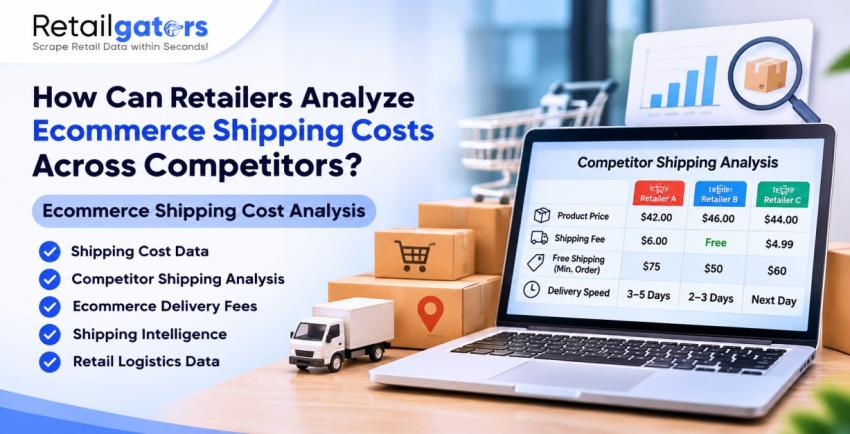
This is why Ecommerce Shipping Cost Analysis is becoming an important part of competitive research for retailers that want to understand how their offers compare with the market.
For shoppers, shipping is often viewed as part of the total price rather than a completely separate expense. A retailer offering a lower product price may still appear more expensive if its delivery charge is significantly higher than competitors. On the other hand, free shipping can improve the perceived value of a product even when the listed product price is slightly higher. By examining shipping cost data alongside product prices, promotions, availability, and delivery conditions, retailers can build a much more realistic picture of their competitive position.
Why Ecommerce Shipping Costs Matter More Than the Product Price Alone
Online shoppers rarely evaluate a product based only on its listed price. They consider the complete cost of receiving the order, including shipping fees, service charges, taxes where applicable, minimum-order requirements, and the value of the delivery promise. Two retailers can therefore sell the same product at nearly identical prices while presenting completely different offers at checkout.
This makes shipping a competitive variable rather than simply an operational expense. If one retailer consistently offers free delivery while another adds a noticeable delivery fee, the second retailer may lose conversions even when its product price is lower. Similarly, a retailer offering same-day or next-day delivery may justify a higher overall cost because customers place a value on speed and convenience.
For this reason, retailers should evaluate shipping alongside other forms of market intelligence. RetailGators’ price intelligence data approach, for example, considers broader ecommerce signals such as pricing, promotions, availability, and shipping costs rather than treating the product price as an isolated number.
What Should Retailers Include in Ecommerce Shipping Cost Analysis?
A useful shipping comparison needs more than a single delivery-fee number. Retailers should define the fields they want to compare before collecting information from competitors. The exact fields will depend on the product category, destination, marketplace, and customer journey, but several data points are commonly useful.
The first is the base shipping cost displayed for a particular product or order. This provides the starting point for understanding how much a customer is expected to pay for standard delivery. However, the base fee should always be viewed together with the order value because many retailers change shipping charges according to basket size.
The second important factor is the free-shipping threshold. A retailer might advertise free delivery but require customers to spend $50, $75, or another minimum amount before the charge disappears. Comparing these thresholds can reveal how competitors encourage customers to increase their basket size.
Retailers should also examine delivery speed and shipping options. Standard, expedited, same-day, and next-day options can carry very different costs. Delivery speed can therefore help explain why one competitor has a higher delivery charge than another and whether the additional cost is associated with a meaningful service advantage.
Other useful fields include regional delivery charges, minimum order values, membership-based shipping benefits, promotional delivery offers, delivery availability, estimated delivery windows, and product-level shipping differences. Where publicly visible, these signals can be combined into a structured dataset for deeper comparison.
Compare the Total Customer Cost, Not Just the Shipping Fee
One of the easiest mistakes in competitor shipping analysis is to compare delivery fees without considering the underlying product price. Suppose Retailer A sells an item for $42 and charges $6 for shipping, while Retailer B sells the same item for $46 with free delivery. Looking only at the shipping fee makes Retailer B appear more expensive from a product perspective, but the customer's final merchandise-plus-shipping cost tells a different story.
This is why retailers should calculate an effective customer cost for comparable products. A simple model can combine the product price, shipping fee, applicable visible service charges, and promotional adjustments to estimate what a shopper is likely to pay under the same purchasing conditions.
The analysis becomes even more valuable when it is performed across multiple basket values. A competitor may be more expensive for a $20 order but cheaper for a $100 order because of its free-shipping threshold. Understanding these differences can help retailers identify where their own shipping strategy is competitive and where customers may encounter price friction.
Build a Consistent Competitor Shipping Dataset
Reliable comparison starts with consistent data. If one competitor's shipping information is captured for a New York ZIP code and another competitor's information is captured for a different location, the resulting comparison may not be meaningful. Location can influence delivery fees, availability, delivery speed, and even whether a shipping option is offered.
Retailers should therefore define a consistent methodology for collecting and organizing shipping information. The same products, comparable quantities, destination areas, customer conditions, and observation periods should be used whenever possible. Historical records are also valuable because shipping policies can change during holidays, promotional periods, peak seasons, and major sales events.
A structured product data scraping service can support this type of analysis by organizing product, pricing, availability, seller, and related fields into consistent datasets. RetailGators describes support for standardized fields, validation, scheduled updates, and cross-retailer product matching, which are particularly useful when comparisons involve large catalogs.
Match Comparable Products Before Comparing Shipping
Shipping analysis becomes unreliable when retailers compare products that are not genuinely equivalent. A competitor may sell a 12-pack while another retailer sells a six-pack, or one listing may represent a premium version while another represents a standard model. The difference in final cost may then be attributed incorrectly to shipping.
Product matching is therefore an important step before calculating competitive shipping differences. Product identifiers such as SKU, UPC, GTIN, EAN, brand, model, size, pack quantity, and product attributes can help determine whether two listings should be treated as comparable.
This is particularly important for large catalogs where the same product may appear under different titles or descriptions. A standardized product dataset allows retailers to separate actual shipping differences from differences caused by product configuration.
Analyze Shipping Costs by Geography
A national average can hide important regional differences. A retailer may offer inexpensive shipping in one metropolitan area but charge substantially more in another region because of fulfillment infrastructure, warehouse distance, carrier availability, or service coverage.
Geographic analysis can help retailers understand these differences. Shipping costs can be compared by ZIP code, city, state, region, or another appropriate geographic level depending on the available data and business objective.
For example, a retailer serving customers across the United States may discover that a competitor has particularly strong delivery pricing in high-volume urban markets but weaker coverage in rural areas. That insight can influence fulfillment decisions, promotional targeting, and regional pricing strategy.
The same principle applies internationally. Cross-border retailers may need to consider currencies, regional catalogs, delivery timelines, import-related charges where visible, and differences in local shipping policies.
Track Shipping Changes Over Time
A single snapshot provides limited insight into competitive behavior. Shipping costs can change frequently, especially around holidays, promotional campaigns, product launches, and peak shopping periods. A retailer that captures shipping information continuously can identify these changes rather than relying on occasional manual checks.
Historical data makes it possible to answer questions such as whether a competitor regularly reduces shipping charges during major shopping events, whether free shipping becomes more common during certain seasons, or whether delivery fees increase when demand rises.
This type of monitoring can be combined with broader price monitoring services to examine product price changes, discounts, promotions, regional variations, and historical pricing patterns alongside delivery-related changes. RetailGators' price monitoring offering specifically emphasizes historical analysis, competitor benchmarking, promotional monitoring, and regional pricing intelligence.
Look Beyond Shipping Fees to Delivery Value
The cheapest delivery option is not always the most competitive one. Customers may accept a higher delivery cost when the estimated arrival time is significantly faster or when the retailer provides greater flexibility.
For this reason, competitor shipping analysis should consider delivery value rather than simply ranking retailers from cheapest to most expensive. Important signals can include estimated delivery dates, same-day availability, next-day options, pickup alternatives, order minimums, membership benefits, and the visibility of delivery promises during the shopping journey.
For example, a retailer charging $7 for next-day delivery may be competing against a retailer offering $3 standard delivery. The second retailer has the lower fee, but the first may still appeal to customers who need the product urgently. Understanding this difference helps retailers avoid making pricing decisions based solely on the lowest observed number.
Use Delivery Data to Understand Customer Experience
Shipping costs also provide clues about the overall customer experience. Unexpected fees appearing late in checkout can create friction, while transparent delivery pricing can make an offer easier to understand. A retailer can therefore use competitive shipping data to study how different businesses structure their delivery propositions.
This analysis can reveal patterns in free-shipping promotions, order thresholds, delivery guarantees, and location-specific offers. When these patterns are combined with product and pricing data, retailers can understand how competitors build their overall value proposition rather than simply comparing individual prices.
For delivery-heavy categories such as grocery and food, the analysis becomes even more detailed because fees, minimum orders, location availability, promotions, and delivery timing can change quickly. RetailGators' food and delivery data intelligence solutions include publicly visible delivery fees, service charges, minimum orders, offers, availability, and location-specific signals where available.
How Retailers Can Turn Shipping Data Into Competitive Insights
Once shipping information has been standardized, retailers can calculate several useful metrics. The first is the average shipping cost for comparable products or orders. This provides a basic benchmark against competitors.
The second is the shipping cost gap, which shows how much more or less a retailer charges compared with selected competitors. This can be calculated by product, category, region, order value, or delivery speed.
Another useful metric is the free-shipping threshold gap. If a retailer offers free shipping at a significantly higher basket value than its main competitors, that difference may represent an opportunity to test a lower threshold or introduce a targeted free-shipping promotion.
Retailers can also monitor the frequency of shipping promotions, changes in delivery fees, regional availability, and differences between standard and expedited services. Over time, these metrics can form a practical shipping intelligence dashboard that helps pricing, merchandising, ecommerce, and logistics teams work from the same information.
Combine Shipping Intelligence With Price and Inventory Data
Shipping does not operate independently from pricing and inventory. A retailer may lower product prices but increase delivery charges, or offer free shipping only for products that are widely available in regional fulfillment centers. Without looking at the surrounding data, it can be difficult to understand why a competitor's final offer is changing.
Combining shipping cost data with product prices, discounts, stock availability, seller information, and promotions creates a more complete competitive picture. RetailGators' product data workflows support fields such as pricing, availability, sellers, promotions, product attributes, and other structured information that can be used for competitive analysis.
This broader approach is especially useful for marketplaces where multiple sellers may offer the same product with different shipping conditions. eBay, for example, exposes shipping details alongside product, seller, pricing, and availability information, allowing businesses to evaluate the overall competitiveness of individual listings rather than comparing product prices alone.
Use Automation for Large-Scale Shipping Analysis
Manual research may work when a retailer wants to check a few competitors and a small number of products. It becomes much harder when thousands of SKUs, multiple regions, and frequent updates are involved. By the time a large spreadsheet is manually updated, some of the information may already have changed.
Automated data collection can reduce this problem by creating repeatable workflows for selected sources and fields. Data can be collected on a defined schedule, validated, standardized, and delivered into spreadsheets, databases, dashboards, or other analytics systems.
The goal is not simply to collect more information. The goal is to create a dependable dataset that allows teams to compare like-for-like offers and identify meaningful changes. RetailGators supports scheduled and near-real-time product data updates for suitable sources, along with structured delivery through APIs, CSV, JSON, Excel, and other formats.
A Practical Framework for Ecommerce Shipping Cost Analysis
Retailers can start with a simple framework rather than trying to monitor every possible shipping variable immediately. First, identify the competitors and products that have the greatest influence on customer decisions. Next, define a consistent set of fields covering product price, shipping fee, free-shipping threshold, delivery speed, availability, location, and promotional conditions.
The next step is to match comparable products and standardize the collected information. After that, calculate total customer cost and shipping cost differences across competitors. Historical records should then be maintained so that changes can be analyzed over time instead of viewed as isolated events.
Finally, connect the resulting insights to pricing, merchandising, ecommerce, and logistics decisions. If the analysis shows that competitors consistently win on delivery cost in a specific region, for example, the retailer can investigate fulfillment options or targeted shipping promotions instead of simply lowering product prices.
Final Thoughts
Ecommerce Shipping Cost Analysis gives retailers a clearer understanding of what customers actually experience when comparing competing online offers. Product price remains important, but it is only one part of the final purchasing decision. Shipping fees, free-delivery thresholds, delivery speed, regional availability, and promotional conditions can significantly change the perceived value of an offer.
Retailers that combine shipping cost data, product information, pricing, inventory, and promotional signals can move beyond simple competitor price comparisons. They can understand how competitors structure their complete ecommerce proposition and identify practical opportunities to improve their own customer experience.
The most valuable approach is consistent and ongoing rather than occasional. By monitoring comparable products, standardizing data, maintaining historical records, and evaluating shipping alongside other retail intelligence signals, businesses can make better-informed decisions about pricing, fulfillment, promotions, and customer value.
Frequently Asked Questions
1. What is Ecommerce Shipping Cost Analysis?
Ecommerce Shipping Cost Analysis is the process of comparing delivery fees, free-shipping thresholds, delivery speeds, and related costs across competing online retailers.
2. Why should retailers compare shipping costs with product prices?
Product price alone does not show the customer's final cost. Combining product and shipping prices helps retailers understand the complete competitive offer more accurately.
3. What shipping data should retailers monitor?
Useful fields include shipping fees, free-shipping thresholds, delivery speed, regional availability, minimum order values, delivery options, and promotional shipping offers.
4. How can retailers compare shipping costs across different locations?
Retailers can collect shipping information using consistent destination locations or geographic segments and then compare fees, delivery availability, and estimated delivery times across those locations.
5. Can shipping data be analyzed alongside competitor pricing?
Yes. Combining shipping information with competitor prices, discounts, inventory, promotions, and product data provides a broader view of competitive positioning.
6. How frequently should ecommerce shipping costs be monitored?
The ideal frequency depends on the category and market. Fast-changing categories may require frequent monitoring, while slower-moving categories may be suitable for daily or weekly updates.