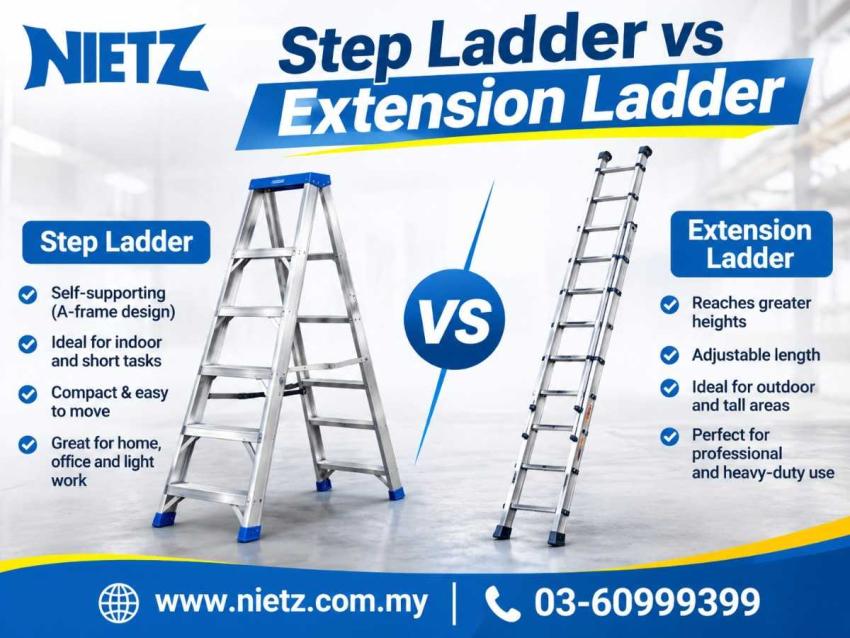
A step ladder is a self-supporting A-frame unit ideal for low- to medium-height tasks, whereas an extension ladder leans against a wall and reaches much higher. Selecting the correct ladder is a function of your working height, support surfaces available and the task at hand. If you use the wrong kind, you are more likely to fall and you will be less efficient.
Choosing the right ladder isn’t merely a matter of convenience - it has a direct bearing on your safety on the job. If you are a homeowner fixing a ceiling fan, a facility manager overseeing building maintenance, or a construction worker tackling multi-storey work, knowing which ladder fits which situation can prevent accidents and save time.
What Is a Step Ladder?
A step ladder is a self-supporting ladder consisting of two sides joined by a hinge in the form of an inverted "V". It is self supporting and very versatile for indoor use and does not need a wall or anything.
Single sided ladder — Steps are on only one side. One side is the user climbing on a face, the other is a support frame. Often used in confined spaces.
Double sided ladder — Steps on both sides so two people can climb at the same time or the user can access from either side. Frequently used in retail, warehouses and open floor areas.
Step ladders are generally used for work at heights between 0.6 meters and around 3.6 meters. They are good for indoor maintenance, painting, shelving and light installation work.
What Is an Extension Ladder?
An extension ladder is not self-supporting and consists of two or more sections which slide to increase the overall length. It has to be at the correct angle (usually 75 degrees or the 1-in-4 rule; for every 4m of height, the base is 1m out from a wall) against a solid surface – a wall, roofline or structure.
Extension ladders are intended for use outdoors and in construction settings and can extend from 3 meters to over 12 meters in height depending on the model. They are the preferred choice for:
Roof access and gutter cleaning
Exterior painting on two or three-storey buildings
Electrical and telecom work on poles or high facades
Construction site tasks requiring elevated access
How to Choose the Right Ladder for Your Task
The correct choice comes down to three practical questions: How high do you need to reach? Is there a wall or structure to lean against? And where are you working — indoors or outdoors?
Use a Step Ladder When:
You are working indoors without a suitable leaning surface nearby
The task requires you to move frequently and reposition quickly
Working height is under 3.5 metres
You need a double sided ladder for collaborative tasks or access from both sides
The floor is flat and stable — tile, concrete, or sealed surfaces
Use an Extension Ladder When:
You are working on a roof, upper floor, or tall exterior wall
The task requires a working height above 4 metres
A solid, stable surface is available to lean the ladder against
You are doing outdoor work such as painting, guttering, or façade maintenance
Ladder Safety: What Malaysian Regulations Say
In Malaysia, the use of ladder in the workplace is governed by Occupational Safety and Health Act 1994 (OSHA 1994) and further governed by the guidelines from the Department of Occupational Safety and Health (DOSH). Employers and workers must ensure that all portable ladders are inspected before use, are properly rated for load capacity, and are used only for their intended purpose.
Key safety practices backed by DOSH guidelines include:
Always have three points of contact (two hands, one foot or two feet, one hand)
Do not exceed the maximum load rating of the ladder including tools and equipment
Before each use check the ladder for cracks, bent rungs or damaged feet.
Place extension ladders at the correct angle of 75 degrees
Do not use a stepladder instead of an extension ladder leaning against a wall
Falls from ladders are still among the top causes of injuries in the construction industry in Malaysia. The DOSH has repeatedly highlighted falls from height as one of the main causes of fatalities in the construction industry, thus making it important to choose and use the right ladder.
Common Mistakes Buyers Make When Choosing a Ladder
Even experienced workers get this wrong. Here are the most frequent missteps:
Underestimating working height: Buying a step ladder that is too short and then overreaching — a leading cause of falls.
Using a step ladder outdoors on uneven ground: Step ladders need a flat, firm base. On loose or sloped terrain, they become unstable quickly.
Leaning a step ladder against a wall: Step ladders are not designed for this. This defeats the structural design and can cause collapse.
Ignoring load ratings: Every ladder has a duty rating. Exceeding it — even briefly — risks structural failure.
Choosing based on price alone: A cheaper ladder with a lower duty rating may not handle the user's weight plus tools and materials.
Which Ladder Material Should You Choose?
Both step ladders and extension ladders are available in aluminium, fibreglass, and steel. Each material suits different conditions:
Aluminium: Lightweight and corrosion-resistant. Best for general use and frequent repositioning.
Fibreglass: Non-conductive, making it essential for electrical work. Heavier but significantly safer around live circuits.
Steel: Heavy-duty and durable. Suited for industrial environments but not ideal for portability.
For electricians and facilities teams working near electrical panels or wiring, fibreglass is the only safe choice — aluminium conducts electricity and poses a serious electrocution risk.
The Right Ladder for the Right Job
There is no universal ladder. A step ladder will not get you on the roof, and an extension ladder is impractical for changing an office light fitting. Matching the ladder to the task — based on height, environment, and frequency of use — is the most important decision before any job begins.
If you are sourcing ladders for home use, construction projects, or facility management in Malaysia, NIETZ offers a wide range of ladders suited to different working heights and applications. Exploring the right specifications before purchasing will always serve you better than buying on assumption.
Frequently Asked Questions
What is the main difference between a step ladder and an extension ladder?
A step ladder is self-supporting, and is suitable for indoor tasks at low to medium heights. An extension ladder requires a leaning surface, and is intended to reach greater heights outdoors. The right one depends on your working height and if you have a stable support surface .
Can I use a step ladder outdoors?
Yes, but only on flat, hard and stable ground. Step ladders are not suitable for uneven ground, inclines or where the feet cannot sit level. For outdoor jobs over 3.5 meters, an extension ladder is the safer and better choice.
What is the difference between a single sided and double sided ladder?
A single sided ladder only has steps on one side and uses the opposite side as a support frame, making it perfect for confined spaces. A double sided ladder has rungs on both sides. You can climb up from either side and two people can use it at the same time.
How do I know what height ladder I need?
Measure how high you need to reach and subtract about half a meter – this is the height you need for your ladder to stand on. Choose a ladder with a maximum standing height greater than the height you need to work at. Overreaching is one of the leading causes of ladder falls.
Are there safety regulations for ladder use in Malaysia?
Yes. In the Malaysian workplace ladder safety is governed by the Occupational Safety and Health Act 1994 (OSHA 1994) and DOSH guidelines. These involve pre-use inspections, proper load ratings, correct set-up angles for extension ladders, and three-point contact at all times while climbing.
Which ladder material is safest for electrical work?
Because fiberglass ladders do not conduct electricity, they are the safest choice for electrical work. Aluminum ladders are electrical conductors and should never be used around live wires, electrical panels or overhead power lines. This holds true for both step ladders and extension ladders used in electrical maintenance.