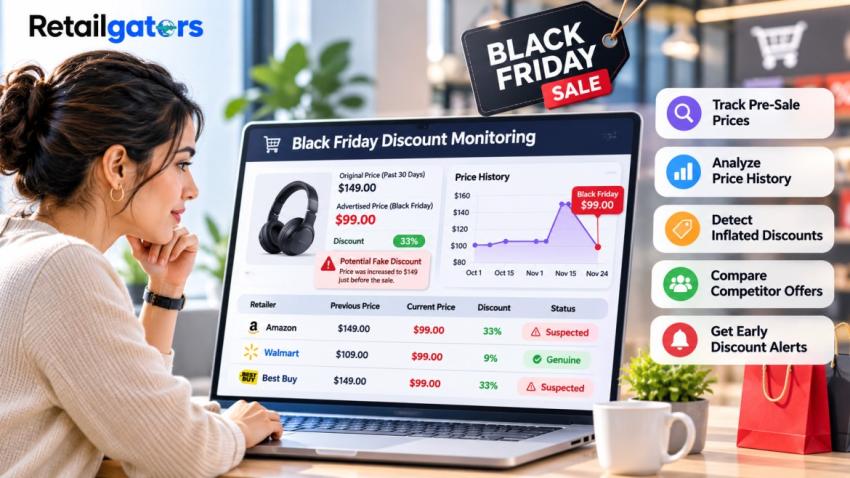
A Black Friday promotion can look impressive on a product page: “40% off,” “was $199, now $119,” or “limited-time deal.” But a large discount percentage does not automatically mean the customer is receiving a genuine reduction from a meaningful previous price. A retailer may increase a reference price shortly before the event, change a product bundle, switch variants, or introduce a temporary offer that makes the advertised saving difficult to interpret. For brands, these situations are more than a presentation issue. They can distort market pricing, create pressure on other retailers to match the offer, and make it harder to understand what competitors are actually doing.
That is why Black Friday Discount Monitoring should begin before Black Friday campaigns go live. The goal is to establish a reliable price baseline, follow price movements in the weeks leading up to the event, and compare the final promotional price with historical observations rather than trusting the discount percentage displayed on a retailer page. When brands combine Black Friday price tracking with product matching, historical data, promotion monitoring, and competitor analysis, they can spot unusual pricing patterns early and investigate them before the promotional rush begins.
What Makes a Black Friday Discount Look “Fake”?
Not every questionable discount is deliberately misleading. An apparent discount can result from several pricing practices that make the advertised saving look larger than the customer's actual economic benefit. A retailer might raise the regular price shortly before Black Friday and then return the product to its previous level with a large “discount.” Another listing may use a manufacturer's suggested retail price as its reference point even though the product has rarely sold near that amount. Bundles and different pack sizes can create a similar problem when a promotional price is compared with a non-equivalent product.
For brands, the important point is that the percentage shown on the page is only one data point. A meaningful assessment requires price history. If a product has been selling around 149forseveralweeksandsuddenlyappearsas“99, 40% off from $165,” the historical record gives the brand a reason to investigate the reference price. Monitoring cannot, by itself, prove that a retailer intentionally created a false discount, but it can identify unusual patterns that deserve review. This distinction matters because the purpose of monitoring is to surface evidence and anomalies, not automatically label a retailer's pricing behavior as misleading.
Why Brands Should Build a Price Baseline Before Black Friday
The best time to detect an unusual Black Friday promotion is before the promotion starts. Once the event is live, teams are often dealing with hundreds of price changes, inventory movements, marketplace sellers, and promotional messages at the same time. Without a baseline, it becomes difficult to tell whether a Black Friday price is genuinely lower or simply being compared with a newly changed reference price.
A useful baseline can include the observed selling price, list or reference price where available, discount percentage, promotion type, product availability, seller, product variant, and observation timestamp. Tracking these fields over several weeks allows brands to see normal pricing behavior before the promotional period. The right historical window depends on the category and product, but the principle is consistent: compare Black Friday offers with actual observed history rather than relying only on the price displayed on the day.
This approach also gives pricing teams context when competitors change prices repeatedly before the event. A retailer that gradually reduces a product from $159 to $149 to $139 before Black Friday is behaving differently from one that moves from $159 to $99 overnight. Both may display a similar promotional message, but their underlying pricing patterns are not the same. Historical data makes that difference visible.
How Black Friday Discount Monitoring Works
Black Friday Discount Monitoring combines automated price collection with historical comparison and promotion analysis. Brands first identify the products and retailers that matter most, then collect pricing information at regular intervals before and during the promotional period. The collected data can include product identifiers, current prices, reference prices, discounts, coupons, promotional messages, availability, sellers, product variants, and timestamps.
The next step is product matching. This is often overlooked, but it is essential. A brand cannot accurately compare a Black Friday offer if one retailer is selling a single unit and another is selling a two-pack, or if the promotional listing refers to a different model. Once comparable products are matched, the system can compare current promotional pricing with historical observations and flag unusual movements.
For larger retail programs, Black Friday price tracking can be part of a broader pricing and market monitoring workflow that follows competitor prices, promotions, availability, and market changes. The benefit is not simply having more data; it is having enough consistent history to interpret what the data means.
What Signals Should Brands Watch Before Black Friday?
A good monitoring program looks beyond the headline discount. One of the strongest signals is a sudden change in the reference price. If a retailer's advertised “was” price moves upward shortly before the promotion, the brand may want to review the product's historical pricing record. A second signal is a large discount percentage that does not correspond with a meaningful change from the product's recent selling price.
Promotional mechanics also matter. Coupons, member offers, bundle deals, cashback, and limited-time discounts can change the effective customer price without necessarily changing the standard product price. Brands should capture enough information to distinguish these situations. Product availability is another useful signal because a heavily discounted product that quickly becomes unavailable tells a different story from a promotion that remains active with healthy inventory.
Seller changes are particularly important on marketplaces. If a product's price suddenly drops and a new seller appears, the event may need to be investigated differently from a price change made by the retailer or an authorized seller. Historical seller and pricing data can help teams identify these patterns rather than treating every price movement as the same event.
How Black Friday Pricing Can Be Compared With Historical Prices
One of the most useful ways to evaluate Black Friday pricing is to compare the promotional price with several historical reference points instead of relying on a single “was” price. A brand might examine the recent selling price, the typical observed price range, the lowest and highest prices recorded during the baseline period, and the timing of previous promotions.
For example, imagine a product normally sells between $95 and $105 for several weeks. Just before Black Friday, the listed reference price changes to $140, followed by a promotion showing the product at $99. The displayed percentage discount may appear significant, but the historical data tells a different story: the customer-facing price has barely changed from its normal level. That does not automatically establish that the promotion violates a policy or regulation, but it gives the brand a clear reason to investigate how the reference price is being presented.
Historical comparisons are also useful for legitimate promotions. If a product consistently sells at $129 and drops to $79 during a verified Black Friday campaign, the data can demonstrate that the reduction is meaningful relative to the product's recent pricing history.
Why Competitor Discount Analysis Matters During Black Friday
Black Friday pricing does not happen in isolation. Retailers watch competitors, adjust promotions, and respond to market conditions throughout the event. That makes competitor discount analysis useful for understanding whether a price change is unique to one retailer or part of a broader market movement.
Suppose Brand A sees a competitor advertise a product at $89 while most other retailers remain around $109. The first question should not necessarily be whether Brand A should match $89. The pricing team should determine whether the competitor's price is part of a genuine Black Friday promotion, whether it is supported by inventory, whether the product is identical, and whether other retailers are responding. Looking at the broader market can prevent a business from making an unnecessary price reduction based on a single outlier.
This is where retailer price monitoring can complement Black Friday analysis. Tracking prices across retail channels gives brands a wider view of competitive movements and helps distinguish an isolated pricing anomaly from a market-wide promotion.
Detecting Suspicious Discount Patterns Before the Campaign Launches
Historical comparison makes several unusual patterns easier to identify. One example is a reference-price increase shortly before Black Friday. Another is a product that shows a very high discount percentage but has remained close to the promotional price for most of the monitoring period. A third is a competitor that repeatedly changes its price shortly before promotional events and then returns to its earlier level afterward.
These patterns should be treated as signals for investigation rather than automatic proof of misconduct. A brand may discover that a price change was caused by a legitimate product update, a different seller, a new bundle, or an approved promotion. The value of monitoring is that the team has the evidence needed to ask the right questions and compare the change with the relevant product and pricing history.
Automated rules can help prioritize these cases. For example, a system can flag products where the reference price changes sharply, the promotional price falls outside a historical range, or a competitor's discount is significantly different from the category pattern. Human review can then determine whether the event requires action.
How Real-Time Monitoring Helps Once Black Friday Starts
Pre-event monitoring establishes the baseline, but Black Friday itself is highly dynamic. Prices can change rapidly, inventory can disappear, promotions can be extended, and sellers can adjust their offers during the event. A snapshot taken in the morning may not represent what customers see later that day.
For fast-moving categories, discount monitoring can provide more frequent visibility into price and promotion changes. Live or scheduled crawling can help teams identify when a monitored product changes price, when a promotion appears or disappears, or when availability shifts. The appropriate frequency depends on product volatility, retailer coverage, and the brand's monitoring objectives.
The important distinction is between monitoring for information and monitoring for automatic conclusions. A price alert tells the team that something changed. It does not explain why it changed. Product matching, historical data, seller information, and promotional context are what turn that alert into useful business intelligence.
How MAP Monitoring Can Add Another Layer of Pricing Protection
For brands that maintain Minimum Advertised Price policies, Black Friday can create additional channel-management challenges. A retailer may advertise an aggressive promotion that falls below the brand's established threshold, while another retailer remains compliant. These situations can affect channel relationships and create pressure for other sellers to respond.
A separate MAP Monitoring Service can help brands monitor advertised prices against defined MAP requirements. MAP monitoring and Black Friday discount monitoring serve different purposes, but they can complement each other. One focuses on promotional and historical pricing behavior around the event, while the other evaluates advertised pricing against the brand's MAP policy.
Brands should still review their own policies and applicable legal and commercial requirements before deciding how a particular promotion should be treated. Monitoring provides visibility and evidence; it does not determine legal compliance or retailer intent.
Turning Black Friday Pricing Data Into Action
The most useful Black Friday monitoring programs are designed around decisions rather than data volume. A brand might want to know which competitors changed prices, which products experienced unusual reference-price movements, which promotions were active, and whether pricing differences were isolated or widespread. Those questions determine what data needs to be collected.
Once the event begins, teams can prioritize alerts based on product importance, pricing deviation, competitor impact, and historical behavior. A strategic product with an unusual price movement may deserve immediate review, while a low-priority SKU with a minor change may simply be recorded for later analysis.
After Black Friday, the same historical dataset becomes useful for evaluating what happened. Brands can compare promotional depth, timing, duration, competitor behavior, and price recovery patterns. This creates a stronger foundation for the next major promotional period instead of starting again with a blank spreadsheet.
What Brands Should Look for in a Black Friday Monitoring Workflow
A practical monitoring workflow should provide reliable product matching, consistent price history, appropriate crawl frequency, promotion visibility, seller information where relevant, and clear timestamps. It should also make it easy to distinguish current prices from historical observations and regular prices from promotional conditions.
Scalability matters as well. A process that works for 50 products may become difficult when a brand needs to monitor several thousand SKUs across multiple retailers. Data collection needs to remain consistent as the product catalog and retailer list expand. This is one reason automated ecommerce data collection is often more practical than relying on manual checks during a high-volume shopping event.
The final consideration is usability. Pricing teams should not have to interpret thousands of raw records to find a handful of meaningful issues. Dashboards, structured reports, alerts, and historical comparisons can help teams focus on the pricing changes that actually require investigation.
Final Takeaway
Brands cannot reliably identify fake Black Friday discounts by looking only at the discount percentage displayed on a retailer's product page. The more useful approach is to establish a historical price baseline, monitor reference and selling prices before the event, match comparable products accurately, and follow promotions and competitor movements as they develop.
Black Friday Discount Monitoring gives brands a structured way to detect unusual pricing patterns before and during the promotional period. Combined with Black Friday price tracking, discount monitoring, and competitor discount analysis, it helps pricing and channel teams understand whether a promotion represents a genuine market reduction or a pricing change that deserves closer review.
The goal is not to label every unusual discount as fake. It is to give brands enough reliable historical and competitive data to identify anomalies early, investigate them with context, and protect the quality of their pricing strategy throughout one of the most important retail periods of the year.
FAQs
What is Black Friday Discount Monitoring?
Black Friday Discount Monitoring is the process of tracking product prices, reference prices, discounts, promotions, availability, and competitor pricing before and during Black Friday. It helps brands identify unusual pricing patterns and investigate potentially misleading discount claims.
How can brands detect fake Black Friday discounts?
Brands can compare advertised promotional prices with historical selling prices and reference-price changes. A sudden increase in the reference price before a promotion or a large discount that does not reflect a meaningful historical reduction can be flagged for review.
Why is Black Friday price tracking important before the sale begins?
Pre-event price tracking establishes a baseline for normal product pricing. Without historical data, it is difficult to determine whether a Black Friday discount represents a genuine reduction or simply compares the promotional price with a recently changed reference price.
What data should brands monitor for Black Friday pricing?
Brands can monitor current and historical prices, list or reference prices, discount percentages, coupons, promotions, product identifiers, variants, availability, sellers, and timestamps. The exact fields depend on the brand's products and monitoring objectives.
Can automated discount monitoring detect suspicious promotions?
Automated monitoring can identify unusual price movements, reference-price changes, large deviations from historical pricing, and other predefined signals. However, these alerts should normally be reviewed in context because a pricing anomaly does not automatically prove that a promotion is misleading.
How does competitor discount analysis help brands during Black Friday?
Competitor discount analysis shows whether a pricing change is isolated or part of a broader market movement. It helps brands compare promotional depth, timing, product availability, and competitor behavior before deciding whether a pricing response is appropriate.