

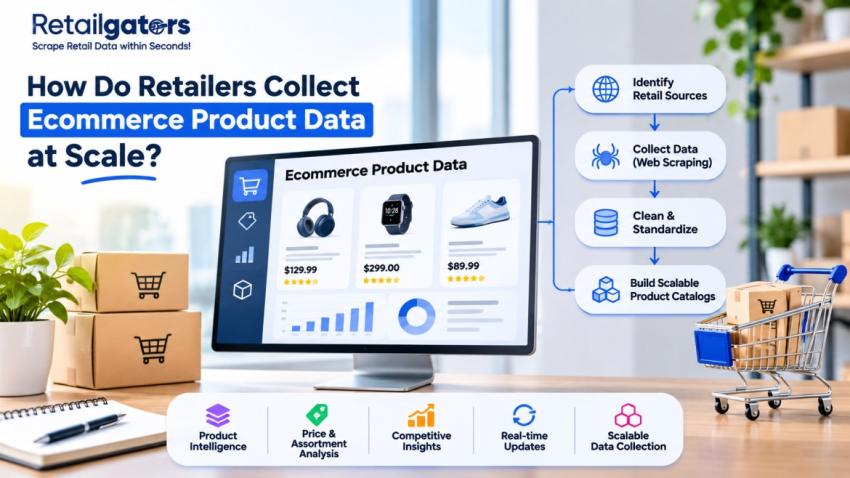
A retailer managing 50 products can usually keep track of product names, prices, descriptions, images, and availability without much difficulty. The situation changes completely when the catalog grows to thousands or millions of products across multiple retailers, marketplaces, brands, and regions. Product information changes constantly, new products appear, old listings disappear, prices move, stock status changes, and the same item may be presented differently on different websites. At that scale, copying information into spreadsheets is no longer a practical way to maintain a reliable product catalog.
This is why Ecommerce Product Data has become an important part of retail intelligence. Retailers and brands collect product information not simply to build databases, but to understand what is being sold, how products are positioned, how competitors structure their catalogs, and where changes are happening in the market. Effective ecommerce data collection brings product information from different sources into a structured format so it can be compared, analyzed, updated, and connected with other business systems. The challenge is doing that consistently when the volume of products and sources keeps increasing.
What Is Ecommerce Product Data?
Ecommerce Product Data refers to the information associated with products listed on ecommerce websites, marketplaces, retailer websites, and other digital commerce channels. Depending on the business objective, this can include product names, brands, categories, SKUs, UPCs, descriptions, specifications, prices, discounts, images, ratings, reviews, availability, seller information, product variants, and other attributes.
The important point is that product data is rarely static. A retailer can change a product title, update specifications, introduce a new variant, modify a price, or mark an item as unavailable without making a major announcement. A brand monitoring competitors therefore needs more than a one-time product dataset. It needs a process that captures changes over time and keeps the information organized. This is where structured E-commerce & Retail Data Extraction Services can fit into a broader retail data strategy, particularly when product information needs to be collected from multiple ecommerce sources.
Why Do Retailers Need Product Data at Scale?
Retailers use product data for many different reasons, and the requirement is rarely limited to simply knowing what products are available. A category manager may need to compare assortment across competitors, while a pricing team may need current product prices. A marketplace seller may want to identify products that are gaining visibility, and a market research team may need to analyze product positioning across an entire category.
At a larger scale, the challenge becomes consistency. Suppose a retailer wants to compare 10,000 products across five competing ecommerce websites. The team needs to determine which products correspond to one another, normalize different product attributes, capture changes at regular intervals, and maintain historical records. Even small inconsistencies can affect the analysis. A different pack size, variant, product identifier, or unit of measurement can make two apparently similar listings unsuitable for direct comparison.
That is why product data collection should be treated as a structured process rather than a simple download task. The quality of the final insight depends heavily on how accurately the underlying product information has been collected, matched, cleaned, and maintained.
What Product Information Do Retailers Usually Collect?
The exact dataset depends on the business objective, but most large-scale ecommerce projects start with core catalog information and then add fields that support a particular analysis. Product name, brand, category, SKU, product ID, description, specifications, pack size, variant, price, discount, availability, rating, review count, and seller information are common examples.
The value increases when these fields are connected. A product price by itself tells a retailer only what an item costs at a particular moment. Price combined with availability, seller, promotion, product variant, and historical observations can reveal much more about competitive positioning and market behavior.
How Ecommerce Data Scraping Supports Large Product Catalogs
When retailers need product information from large numbers of ecommerce pages, manual collection quickly becomes inefficient. Ecommerce data scraping provides a way to collect structured product information from selected online sources according to defined business requirements. Instead of asking a team member to visit each product page and copy information, an automated workflow can collect the required fields in a consistent format.
For example, a retailer tracking a competitor's electronics category may need product titles, brands, specifications, prices, discounts, availability, ratings, and product URLs. A structured eCommerce Data Scraping workflow can be designed around those fields and the sources being monitored. The resulting data can then be cleaned and prepared for analysis, reporting, dashboards, or internal databases.
The important distinction is between collecting more data and collecting the right data. A large dataset filled with unnecessary fields does not automatically create better intelligence. The collection process should be designed around the questions the business wants to answer.
Product Matching Is One of the Hardest Parts of Large-Scale Collection
Collecting product pages is only one part of the problem. Retailers also need to know whether two listings actually represent the same product. Different websites may use different titles, descriptions, SKUs, product IDs, pack sizes, or naming conventions for an identical item.
Consider a beverage listed as a single 12-ounce bottle on one website and as a six-pack on another. A simple name-based comparison could incorrectly treat them as equivalent. Similar issues occur with clothing sizes, color variants, electronics bundles, replacement parts, and multipack products. Accurate product matching therefore becomes essential when the data is being used for competitor comparison, assortment analysis, or pricing intelligence.
For product catalogs that depend heavily on standardized identifiers, UPC Product Scraping can be particularly relevant. UPCs and other product identifiers can provide a stronger foundation for matching products across different retail sources, although the appropriate matching method still depends on the catalog and data available.
How Retailers Keep Product Data Consistent
Raw ecommerce information often arrives in different formats. One retailer may describe a product's dimensions in inches while another uses centimeters. One source may separate color and size into individual fields, while another combines them into the product title. Even category structures can vary considerably between websites.
Data standardization brings these different formats into a consistent structure. Retailers may normalize product names, categories, units, attributes, variants, and identifiers so the information can be compared across sources. Duplicate records can also be identified, missing values can be flagged, and historical changes can be stored rather than overwritten.
This step is often underestimated. A clean-looking dataset is not necessarily an accurate dataset. Retailers need rules for handling duplicates, missing fields, discontinued products, changing URLs, and product variations. The objective is to create a dataset that remains useful when new products and new sources are added.
How Retailers Collect Product Data at Enterprise Scale
As the number of sources increases, the underlying collection infrastructure becomes just as important as the data itself. An enterprise retailer may need to monitor thousands of pages across different websites while maintaining consistent schedules, handling changes in website structures, and delivering data to several internal teams.
This is where Enterprise Web Scraping can support larger data collection requirements. Enterprise-level workflows are generally designed around scalability, source management, data processing, monitoring, and delivery rather than treating every website as a separate manual project.
The same principle applies to infrastructure. A business that expands from a few sources to a much larger retail network needs an approach that can accommodate changing volumes. Cloud-Based Web Scraping can be relevant when organizations need scalable infrastructure for recurring data collection across multiple sources. The exact setup depends on the number of products, frequency of collection, sources, and downstream systems involved.
Why Historical Ecommerce Product Data Matters
A current product catalog provides a snapshot, but historical data tells a story. Retailers can compare how product assortment changes over time, identify when competitors introduce new products, observe products disappearing from a category, and track changes in product positioning.
Historical retail product data can also support trend analysis. For example, a category manager may notice that a competitor gradually expands from a small number of products into several related subcategories. That change could indicate a broader assortment strategy. Similarly, repeated changes in product availability may reveal patterns that are difficult to recognize from a single data collection exercise.
Maintaining historical records also prevents businesses from losing context. If yesterday's product price or description is simply overwritten by today's value, the organization loses the ability to understand what changed and when it changed. For competitive intelligence, that historical layer can be extremely useful.
How Web Crawling and Automation Improve Product Data Collection
Large-scale product collection is rarely a single extraction task. Retailers usually need recurring processes that discover pages, collect information, process records, identify changes, and deliver updated datasets. That makes automation an important part of the overall workflow.
A broader Web Crawling & Automation approach can help organize recurring collection across large numbers of pages and sources. Crawling and product extraction serve different roles: crawling helps discover and navigate relevant pages, while extraction focuses on turning page information into structured fields.
For organizations that want product data to flow directly into internal applications, analytics platforms, or databases, Web Scraping API Services can provide another delivery approach. APIs can be useful when teams need structured data to feed existing systems rather than relying entirely on manual file transfers.
Turning Ecommerce Product Data Into Product Intelligence
Collecting data is not the final objective. The bigger opportunity is turning product records into product intelligence that can support business decisions.
A retailer can use product data to compare competitor assortments, identify missing products, monitor new launches, understand category changes, analyze pricing, and evaluate product availability. A brand can use the same information to understand how its products are represented across different retailers and whether competitors are expanding into related categories.
For example, imagine a retailer notices that three competitors have recently added similar products to a category where its own assortment has remained unchanged. Looking at the product data over several months can help the category team determine whether this is a short-term change or a broader shift in the market. The insight comes from analyzing the dataset, not simply from collecting it.
Common Challenges When Collecting Ecommerce Product Data at Scale
Large-scale collection comes with practical challenges. Websites change their layouts, product URLs may be updated, categories can be reorganized, and some products may appear differently depending on the selected variant or location. Data volumes can also become substantial when a business monitors thousands of products across multiple sources on a recurring schedule.
Product matching remains another major challenge, particularly when retailers use different identifiers and naming conventions. Data quality also needs continuous attention because missing fields, duplicate records, inconsistent attributes, and discontinued products can affect downstream analysis.
These challenges are why a scalable ecommerce data collection workflow needs monitoring and maintenance rather than being treated as a one-time technical exercise. The process should account for changes in both the source websites and the business requirements.
What Should Retailers Consider Before Building a Product Data Workflow?
The first question should be what the business actually wants to achieve. A retailer looking for competitive assortment intelligence may require different fields and collection frequency from a pricing team monitoring product prices. Defining the business objective first makes it easier to determine which sources, fields, identifiers, and update schedules are necessary.
Next, retailers should consider product matching, data quality, scalability, historical storage, delivery format, and integration requirements. It is also useful to decide whether the final data will be consumed through spreadsheets, databases, dashboards, APIs, or internal analytics systems.
The strongest workflows are usually designed around a clear connection between source data and business decisions. When product collection, standardization, historical tracking, and analytics work together, Ecommerce Product Data becomes much more than a catalog of products. It becomes an ongoing source of retail intelligence.
How RetailGators Can Help With Ecommerce Product Data Collection
RetailGators provides ecommerce and retail data solutions for businesses that need structured product and marketplace information at scale. The appropriate workflow can be built around the sources, product categories, fields, identifiers, update frequency, and delivery requirements of the business.
For retailers and brands, the objective is to create a dependable flow of product information that can support assortment analysis, competitive research, pricing intelligence, product monitoring, and broader retail analytics. Instead of collecting product information manually and repeatedly rebuilding spreadsheets, businesses can develop a structured process that keeps relevant data organized and available for analysis.
The right approach depends on the business use case. A focused product dataset may be enough for one project, while a large retail organization may need recurring collection, historical storage, product matching, automation, and API-based delivery. Defining those requirements early helps create a more useful and sustainable data workflow.
Conclusion
Collecting Ecommerce Product Data at scale is not simply a matter of gathering product pages. Retailers need to identify the right sources, collect relevant fields, match products accurately, standardize information, maintain historical records, and deliver the data in a format that teams can actually use.
With structured product data collection, retailers can gain visibility into assortment changes, competitor activity, pricing, availability, and emerging market opportunities. Ecommerce data scraping can support the collection process, while crawling, automation, product matching, and APIs can help turn that process into a repeatable data workflow.
The real advantage comes when collected data moves beyond a spreadsheet and becomes part of everyday decision-making. When product information is consistently updated and connected to analytics, retailers can use it to understand their market more clearly, respond to competitive changes, and build stronger product and assortment strategies.