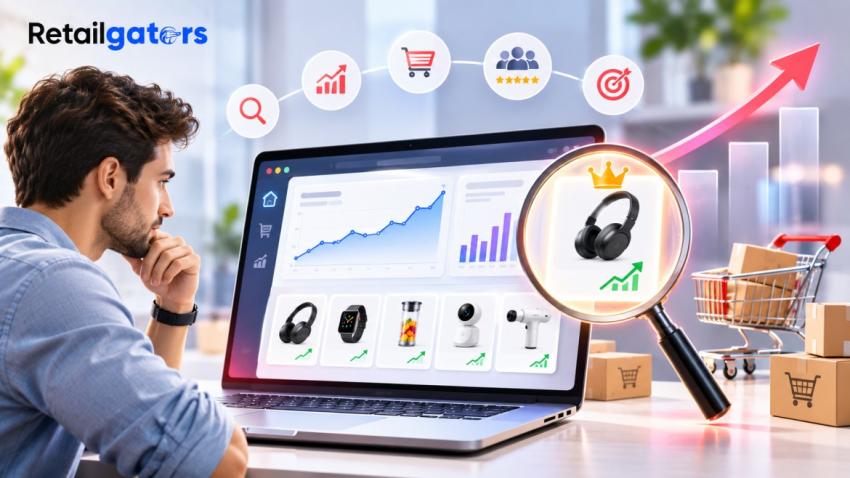
Effective Winning Product Research is not about guessing the next viral product or following every social media trend. It is about collecting different market signals and determining whether they point toward a genuine opportunity. Search interest, product listings, reviews, assortment changes, pricing, marketplace activity, customer preferences, and availability can all provide clues. When these signals are studied together, brands can identify products worth investigating before competition becomes crowded.
What Does Winning Product Research Actually Mean?
Winning Product Research is the process of identifying products with potential demand by studying market signals before making a product launch, sourcing, or assortment decision. The word "winning" does not mean that every product identified will become a bestseller. There is no reliable method for guaranteeing that outcome. Instead, the objective is to find products that show enough evidence of growing interest, manageable competition, and commercial potential to justify deeper research.
A strong research process looks beyond a product's current sales performance. A product might have modest sales today but show increasing search interest, growing review activity, expanding marketplace visibility, and more retailers adding it to their catalogs. Those signals may indicate that customer interest is developing. On the other hand, a product with high current sales but falling interest and heavy competition may be less attractive for a new entrant. The difference is understanding the direction of the market, not just its current size.
Why Brands Need to Identify Products Before They Become Mainstream
Entering a category after everyone has already identified the opportunity can make the economics much harder. More sellers usually mean more competition for advertising visibility, marketplace rankings, customers, and supplier capacity. Brands may also find that established competitors have already built reviews, content, distribution, and brand recognition around the product.
Early research gives product teams more time to evaluate an opportunity properly. They can investigate suppliers, compare product variations, study customer complaints, estimate potential margins, and decide whether the product fits their existing portfolio. A retailer may also discover that the opportunity is not the product itself but a better version of it. For example, repeated complaints about poor durability, inconvenient packaging, limited sizing, or missing features can reveal a gap that a new product could address.
This is where product trend analysis becomes more useful than simply creating a list of trending products. The goal is to determine whether an apparent trend has enough supporting signals to deserve attention. A temporary spike caused by a seasonal event should be treated differently from a gradual increase that continues across several months and marketplaces.
The Signals That Reveal an Emerging Product Opportunity
No single data point can reliably identify a winning product. The stronger approach is to look for several independent signals pointing in the same direction. Search activity can indicate that consumers are becoming interested in a product, while marketplace listings can show whether sellers are responding to that interest. Review growth can provide evidence that products are actually reaching customers, and assortment changes can indicate that retailers are beginning to pay attention.
For example, imagine a brand researching reusable travel containers. Search activity around the category is increasing, several new product variations are appearing across marketplaces, and customer reviews repeatedly mention the need for leak-proof designs and better organization. At the same time, the category is not yet saturated with highly differentiated products. None of these observations alone proves that the category will take off, but together they create a stronger reason to investigate.
Brands can strengthen this analysis by comparing the same signals across different channels. If a product appears to be gaining interest on one marketplace but has little visibility elsewhere, that difference may indicate either an emerging opportunity or a platform-specific effect. Historical data helps separate the two.
How Product Trend Analysis Helps Separate Real Trends From Hype
Product trend analysis becomes difficult when every sudden increase in attention is treated as a long-term opportunity. Consumer interest can rise because of a holiday, influencer mention, news event, seasonal need, or temporary promotion. If a brand reacts to every spike, it can end up investing in products whose demand disappears just as quickly as it appeared.
By the time sales data clearly shows that a product is popular, the easiest opportunity may already be gone. That is why brands increasingly look for signals that appear before a product becomes an obvious bestseller.
A better approach is to study trend direction and persistence. Look at whether product listings are increasing, whether customer reviews continue to grow, whether related keywords are expanding, and whether interest is spreading into adjacent categories. It is also useful to examine product variations. If customers initially search for one narrow product but gradually begin searching for different sizes, features, or use cases, the market may be developing beyond a single trend.
For example, a sudden increase in searches for a particular type of outdoor accessory may be seasonal. But if the same category continues to attract new listings, reviews, related searches, and retailer assortment expansion after the initial period, it deserves a closer look. Trend analysis is therefore less about predicting the future with certainty and more about improving the quality of the decision.
Using Ecommerce Product Research to Find Gaps Competitors Have Missed
Ecommerce product research becomes particularly valuable when the goal is to find opportunities rather than simply copy existing bestsellers. Brands can study competitor catalogs to understand which products are widely available, which variations are missing, and where customer needs are not being fully addressed.
One useful method is to compare product attributes across competing listings. Suppose several sellers offer similar travel backpacks, but most lack a specific laptop compartment, waterproof material, or size suitable for a particular customer segment. If reviews repeatedly mention those limitations, the gap becomes more interesting. The opportunity is not necessarily to launch another generic backpack; it may be to create a product designed around the unmet requirement.
Brands can use structured ecommerce data scraping to collect product titles, categories, specifications, variants, reviews, ratings, pricing, promotions, and availability from relevant retail sources. That information can make large-scale product research more systematic and easier to compare across competitors.
Customer Reviews Can Reveal the Product People Want Next
Sales data tells you what people bought. Reviews can help explain what they liked, what disappointed them, and what they still wish the product could do. For brands searching for the next opportunity, that distinction matters.
A repeated complaint across hundreds of reviews can be more useful than a single positive rating. Customers might consistently mention that a product breaks easily, lacks a certain feature, is difficult to clean, arrives in excessive packaging, or does not come in a preferred size. When the same issue appears across multiple competing products, it can represent an opportunity for differentiation.
This type of research also helps prevent a common mistake: entering a growing category without understanding why customers buy. A product may have strong demand but poor customer satisfaction. Rather than copying the existing products, a brand can investigate whether improving the weakest part of the customer experience creates a stronger proposition.
RetailGators' product intelligence services are designed around structured product information such as product names, descriptions, ratings, reviews, SKUs, and competitor data, which can support this type of market and product research.
Product Demand Analysis: Is the Interest Strong Enough?
Finding an interesting product is only the beginning. The next question is whether there is enough evidence of demand to justify investment. Product demand analysis should therefore combine several indicators rather than relying on a single popularity measure.
Search interest can show what customers are looking for. Listing growth can show how quickly sellers are responding. Review activity can provide another indication that products are reaching buyers. Availability patterns may reveal whether certain products are frequently unavailable, while pricing can show whether sellers are competing aggressively or maintaining healthy price levels.
The relationship between these signals matters. A product with rising interest but very few reviews may still be early-stage. A product with rising interest, growing listings, expanding variations, increasing reviews, and relatively stable pricing may present a different opportunity. The analysis does not need to produce a perfect forecast. Its purpose is to rank opportunities based on evidence so teams know where to spend their research time.
Market Opportunity Analysis Should Include Competition
A product can have strong demand and still be a poor opportunity if the competitive environment is too difficult. That is why market opportunity analysis should consider both demand and competition.
Brands should examine the number of comparable products, how established the leading brands are, pricing ranges, review depth, product differentiation, promotional activity, and marketplace visibility. They should also look at whether competitors are expanding into the category or abandoning certain products. A shrinking assortment can sometimes indicate weak demand, but it can also create an opening if existing products fail to meet customer expectations.
Competitive benchmarking can make this evaluation more structured. RetailGators' competitive benchmarking solutions are positioned around comparing business and competitor performance and identifying performance gaps using market data. For product research, the same principle applies: compare the opportunity against the competitive conditions before committing resources.
Price and Promotion Data Can Change the Opportunity
A product may look attractive from a demand perspective but become much less appealing once pricing is considered. If competitors are already selling similar products at very low prices, a new entrant may struggle to achieve a sustainable margin unless it has a clear cost or product advantage.
Pricing should therefore be evaluated alongside demand. Look at the current price range, discount frequency, promotional depth, and how prices have moved historically. A product that sells consistently without heavy discounting may indicate a different market structure from one where competitors constantly reduce prices to generate sales.
This is where retail pricing intelligence can complement product research. RetailGators describes its pricing intelligence approach as combining competitor pricing, demand patterns, promotional insights, and market trends to support pricing decisions. For a brand evaluating a new product, these signals can help determine whether the opportunity has room for a workable price position rather than simply high customer interest.
Why Marketplace Data Makes Product Research More Reliable
A product can look promising when viewed through one channel and much less attractive when viewed across the broader market. Marketplace data helps brands compare product availability, pricing, seller activity, assortment, reviews, and category movement across different retail environments.
This broader view is particularly useful when researching products that are still developing. If a product is appearing across several marketplaces and its assortment is gradually expanding, the signal may be stronger than if it exists only on one platform. Likewise, differences between marketplaces can reveal where competition is already intense and where the category is less developed.
RetailGators' marketplace intelligence offering focuses on product availability, pricing, inventory, demand changes, and competitive visibility across multiple retail platforms. For product research, this type of cross-market view can help brands identify opportunities that are difficult to see from a single marketplace.
A Practical Framework for Finding Potential Winning Products
A useful product research workflow can start with a broad list of emerging categories and then progressively narrow the options. First, identify products showing signs of increasing customer interest. Next, examine product listings, reviews, pricing, availability, and competitor activity. Then compare the category against your own capabilities: sourcing, manufacturing, logistics, brand positioning, distribution, and target customer.
The next step is validation. Do not ask only, "Is this product trending?" Ask harder questions: Is the demand persistent? Who is buying it? What problem does it solve? What are customers complaining about? How crowded is the category? Can the product be differentiated? Is there enough price room after costs? Are competitors increasing their assortment? Does the opportunity fit the brand?
This process turns product discovery into a decision framework rather than a trend hunt. A promising product should survive several layers of analysis before the business invests heavily in sourcing or launch activity.
How Automated Data Collection Supports Winning Product Research
Research becomes increasingly difficult when brands monitor thousands of products across multiple retailers and marketplaces. Manually collecting product listings, prices, reviews, availability, and assortment changes can produce useful snapshots, but it is difficult to maintain consistently.
Automated data collection can create recurring datasets that make historical comparison possible. Instead of asking what the market looks like today, analysts can examine how products, categories, prices, reviews, and assortments have changed over time. That historical perspective is especially valuable for identifying products that are gradually gaining momentum rather than those experiencing a short-lived spike.
RetailGators provides ecommerce data collection and structured retail intelligence services covering product, pricing, inventory, seller, promotion, review, and marketplace information. Its ecommerce data workflows can be configured around sources, fields, collection frequency, and delivery requirements, making them relevant to large-scale product and market research use cases.
What Brands Should Remember Before Launching a Trending Product
The biggest mistake in product research is confusing attention with opportunity. A product can attract enormous attention and still be difficult to commercialize because of weak margins, intense competition, unreliable supply, low repeat purchase potential, or poor differentiation.
A better approach is to look for convergence. When customer interest is increasing, product assortment is expanding, reviews reveal an unresolved need, competition is still manageable, and pricing leaves room for a viable offer, the opportunity becomes more interesting. None of these signals guarantees success, but together they provide a much stronger basis for deciding what to investigate next.
Winning products are often found by noticing small changes before they become obvious. The brands that do this well are not necessarily the ones that predict every trend correctly. They are the ones that build a repeatable research process, monitor the market consistently, and know how to distinguish a meaningful signal from temporary noise.
Conclusion
Winning Product Research is less about finding a guaranteed bestseller and more about finding promising opportunities early enough to investigate them properly. Brands can combine product trend analysis, customer reviews, search interest, assortment changes, pricing, availability, and competitive activity to understand whether a product is gaining real momentum.
The strongest research processes also look beyond a single marketplace or a single data point. Product demand analysis becomes more useful when historical and competitive information is added, while market opportunity analysis helps determine whether demand can translate into a commercially viable product.
For brands that want to discover emerging opportunities before they become crowded, structured ecommerce data can turn scattered market signals into a repeatable research workflow. The earlier those signals are identified and validated, the more time a business has to decide whether the opportunity deserves investment.
FAQs
What is Winning Product Research?
Winning Product Research is the process of identifying products with potential by analyzing demand, customer interest, competition, pricing, reviews, product availability, and market trends. It does not guarantee a bestseller; it helps businesses make better-informed product decisions.
How can brands identify emerging product trends?
Brands can monitor search interest, new product listings, review activity, category changes, marketplace assortment, pricing movements, and customer feedback. When several signals move in the same direction over time, the trend becomes more worthy of investigation.
What is product trend analysis used for?
Product trend analysis helps businesses understand how interest in products and categories changes over time. It can support product development, assortment planning, sourcing decisions, inventory planning, and marketing strategy.
How does product demand analysis help brands?
Product demand analysis combines different market signals to determine whether customer interest appears strong, growing, seasonal, or temporary. It helps brands prioritize products that deserve deeper commercial and competitive evaluation.
Why is competitor data important when researching new products?
A product may have strong demand but still be difficult to enter if the market is crowded with established brands and aggressive pricing. Competitor data helps businesses evaluate product differentiation, pricing, assortment, reviews, promotions, and marketplace positioning before committing resources.
Can ecommerce data scraping help with winning product research?
Yes. Structured ecommerce data can help brands monitor product listings, prices, reviews, ratings, availability, categories, and competitor activity across selected retail sources. Historical collection also makes it possible to identify changes and emerging patterns rather than relying on a single market snapshot.