Cloud computing has changed how organizations manage information security, share responsibilities, and protect business data. With the publication of ISO/IEC 27017:2026, organizations and auditors need to review their existing cloud security audit checklists to ensure they reflect the revised framework. Updating these checklists helps auditors evaluate security controls more effectively and identify gaps in cloud service management.
Why Should Organizations Update Their ISO 27017 Audit Checklists?
The new edition, ISO/IEC 27017:2026, replaces ISO/IEC 27017:2015 and introduces a technically revised approach to cloud security controls. The changes include modifications to the title and scope, a revised control structure, and the merging, removal, and introduction of controls.
Using an outdated checklist may result in incomplete audit coverage or missed control requirements. Therefore, organizations should review their existing audit tools and align them with the latest ISO/IEC 27017:2026 requirements.
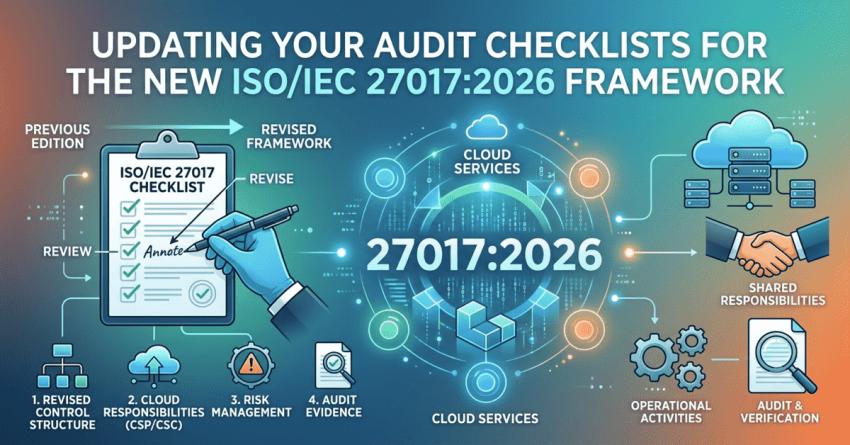
Updating an ISO 27017:2026 audit checklist requires more than changing the edition year. Auditors should examine the revised framework and consider the following areas:
1. Review the Revised Control Structure
Compare the previous and current editions to identify merged, removed, and newly introduced controls. Update checklist questions to reflect the revised control taxonomy and associated attributes. This comparison helps maintain appropriate audit coverage without carrying forward irrelevant questions.
2. Evaluate Cloud Service Responsibilities
Cloud security involves shared responsibilities between Cloud Service Providers (CSPs) and Cloud Service Customers (CSCs). Review checklist questions to determine whether each party has clearly defined security responsibilities, access controls, and operational activities.
3. Assess Cloud Security Risk Management
Include questions that examine how organizations identify, evaluate, and address information security risks associated with cloud services. Auditors should verify whether risk assessments consider cloud infrastructure, service relationships, data handling, and relevant security responsibilities.
4. Verify Audit Evidence and Documentation
A useful ISO 27017 cloud security controls checklist should help auditors collect objective evidence. Include questions covering security policies, access management records, supplier agreements, risk assessment results, incident records, and other applicable documented information.
5. Update Audit Questions and Reporting Methods
Revise checklist questions to make them clear, relevant, and suitable for the organization's cloud environment. Ensure that audit findings, nonconformities, and corrective actions can be recorded consistently.
How to Prepare an Effective ISO 27017:2026 Audit Checklist
Preparing an effective audit checklist requires an understanding of the revised cloud security controls and audit requirements. ISO 27017:2026 Lead Auditor Training helps professionals develop the knowledge needed to review controls, collect audit evidence, identify gaps, and evaluate cloud security practices.
When updating audit checklists, auditors should consider revised control requirements, cloud service provider and customer responsibilities, risk assessment, evidence collection, and nonconformity reporting.
Professionals can strengthen their auditing knowledge through ISO/IEC 27017:2026 Lead Auditor Training, which helps develop an understanding of cloud security auditing principles and lead auditor responsibilities.
Develop Your Cloud Security Auditing Skills
Updating audit checklists requires knowledge of cloud security controls, audit planning, evidence collection, risk assessment, and nonconformity reporting. Professionals who want to strengthen these skills can consider ISO/IEC 27017:2026 Lead Auditor Training to develop their understanding of cloud security auditing principles and lead auditor responsibilities.
Practical auditor training can help professionals understand how to prepare audit questions, conduct interviews, evaluate evidence, and communicate audit findings effectively.
Conclusion
Updating audit checklists is an important step in preparing for the revised ISO/IEC 27017 framework. By reviewing control changes, clarifying cloud service responsibilities, and improving evidence-based audit questions, organizations can strengthen their cloud security assessments. Keeping audit tools aligned with the latest edition also helps auditors conduct more structured and meaningful evaluations.