
Choosing the right pre-rinse unit with riser starts with the sink, not the tap. The unit should match your sink dimensions, mounting arrangement, water connections, available space, operator height and dishwasher workflow. A correctly matched system makes it easier to remove food residue before washing while keeping the dishwashing area organised.
In Australian commercial kitchens, the pre-rinse station is usually positioned on the dirty side of the dishwashing area. It should allow staff to scrape, rinse and prepare plates, cookware, trays and utensils before they enter the dishwasher. This approach supports a more efficient wash-up workflow and helps prevent unnecessary movement between dirty and clean areas.
What Is a Pre-Rinse Unit with Riser?
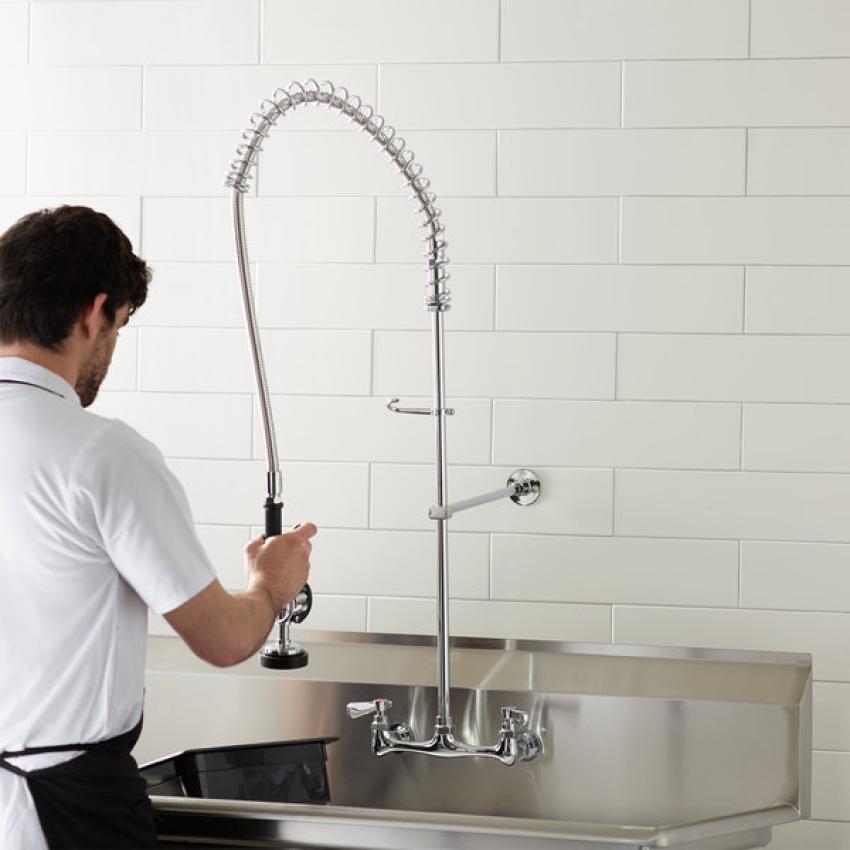
A pre-rinse unit with riser is a commercial sink fitting consisting of an elevated riser, flexible spray hose and spray valve. The riser holds the spray assembly above the sink, while the flexible hose lets staff direct water around large pots, pans, trays, and other equipment.
Unlike a conventional fixed tap, a pre-rinse spray provides greater flexibility when removing sauces, grease, and food debris. Leading Catering Equipment's Australian commercial range includes different configurations designed for commercial sinks and wash-up areas.
How Do You Choose the Right Size?
First, measure the sink and surrounding workspace. The riser should provide enough height for comfortable operation without interfering with shelves, extraction equipment or other overhead structures.
The following measurements are particularly important.
Measurement
Why It Matters
Sink width
Determines how much spray coverage is required
Sink depth
Helps establish comfortable hose reach
Bench space
Determines whether a deck-mounted unit is practical
Riser height
Provides clearance for pots, pans and cookware
Hose length
Determines how far the spray can be moved
Overhead clearance
Prevents the riser or hose from hitting shelving
Mounting position
Ensures the spray is centred over the working area
For example, a compact café wash-up station may need a smaller configuration with limited projection. At the same time, a restaurant handling large pots and trays may benefit from greater hose reach and clearance.
How Should the Pre-Rinse Unit Fit into the Dishwashing Workflow?
The pre-rinse unit should sit where dirty dishes arrive, immediately before loading the dishwasher. A practical workflow is dirty dishes first, food scraping second, pre-rinsing third and dishwasher loading fourth. Clean dishes should then leave through a separate clean-side area.
This arrangement reduces unnecessary movement and helps prevent dirty items from crossing back into the clean zone. Therefore, plan the dishwashing area as a complete workflow rather than treating the pre-rinse tap as an isolated fixture.
Dish-wash inlet benches can also combine a sink and work surface to provide a dedicated location for scraping, rinsing and staging dirty dishes before they enter the machine.
What Water Connections Should You Check?
Check the existing hot and cold water connections before purchasing. You should also confirm the required connection sizes, available water pressure and plumbing route.
Water efficiency is another consideration. A commercial pre-rinse unit should provide an effective spray without unnecessarily increasing water consumption. Look for appropriate water-efficiency information and certification where applicable. Some Australian commercial models, for example, are available with WaterMark certification and WELS ratings.
Professional installation is recommended to ensure the fitting is correctly connected, securely mounted, and suitable for the site's plumbing arrangement.
Should the Unit Be Wall-Mounted or Deck-Mounted?
The available mounting area should determine the setup style. A deck-mounted or hob-mounted pre-rinse unit is installed through the sink or bench, making it suitable for many existing commercial sink configurations. A wall-mounted model can save valuable bench space where the wall behind the sink provides a suitable mounting point.
Feature
Deck-Mounted
Wall-Mounted
Installation
Through sink or bench
Fixed to wall
Bench space
Uses mounting space
Keeps more deck space available
Best for
Existing sink benches
Compact or wall-backed wash areas
Wall structure required
No
Yes
Plumbing planning
Sink/bench connection
Wall connection
Some commercial models combine deck mounting with a wall bracket that supports the riser. For example, Australian-market units are available with hot and cold connections, flexible hoses, spray valves and supporting brackets.
Does Operator Height Matter?
Yes. Operator comfort is an important part of choosing the correct riser height. The spray valve should be easy to reach without excessive stretching, bending or shoulder lifting. The hose should also move freely around the sink without catching on the bench, dishwasher or nearby equipment.
A riser that is too low can restrict movement when washing large cookware. One that is unnecessarily high can make the spray difficult to control and may interfere with overhead shelving.
For kitchens with staff of different heights, prioritise a practical operating position that lets most users work comfortably throughout a busy service.
How Does the Sink Configuration Affect the Choice?
The sink configuration is one of the most important compatibility factors. Before ordering, check whether the unit is intended for a single-bowl, double-bowl or larger commercial wash-up arrangement.
Australian food-premises guidance based on AS 4674 recognises different equipment-washing configurations depending on the type of washing and sanitising process required. In some circumstances, double- or triple-compartment sinks may be appropriate.
Position the pre-rinse spray over the bowl where staff receive and rinse dirty equipment. It should not obstruct the workflow between washing, rinsing, sanitising and drying areas.
What Australian Installation Requirements Should You Consider?
AS 4674-2004 provides design, construction and fit-out criteria for new food establishments and alterations to existing food premises in Australia.
Many experts also provide guidance concerning cleaning and sanitising equipment and commercial dishwashers. Where hot-water sanitising is used, the required time and temperature combination must be achieved according to the applicable procedure and equipment requirements.
A pre-rinse unit itself does not replace the dishwasher's washing or sanitising cycle. It removes meal leftovers and prepares items for the main cleaning procedure.
What Is the Best Way to Match a Pre-Rinse Unit?
The best approach is to match the unit to the complete dishwashing station. Measure the sink, confirm the mounting method, check riser height and hose reach, assess water connections and make sure the spray position suits the operator and dishwasher loading area.
Kitchen requirement
Recommended consideration
Small café
Compact unit with practical hose reach
Busy restaurant
Greater spray coverage and durable construction
Large cookware
Higher clearance and flexible hose
Limited bench space
Consider wall-mounted installation
Existing sink bench
Check deck-mount compatibility
High-volume wash-up
Prioritise durability, reach and easy operation.
A well-matched pre-rinse unit with riser can make the wash-up area faster, more organised and easier to operate. The key is to select the unit as part of the entire sink and dishwasher layout rather than choosing a model based on appearance alone.
For Australian restaurants, cafés, bakeries, hotels, catering businesses and institutional kitchens, careful measurement and installation planning can help create a practical pre-rinse station that supports everyday commercial dishwashing demands.