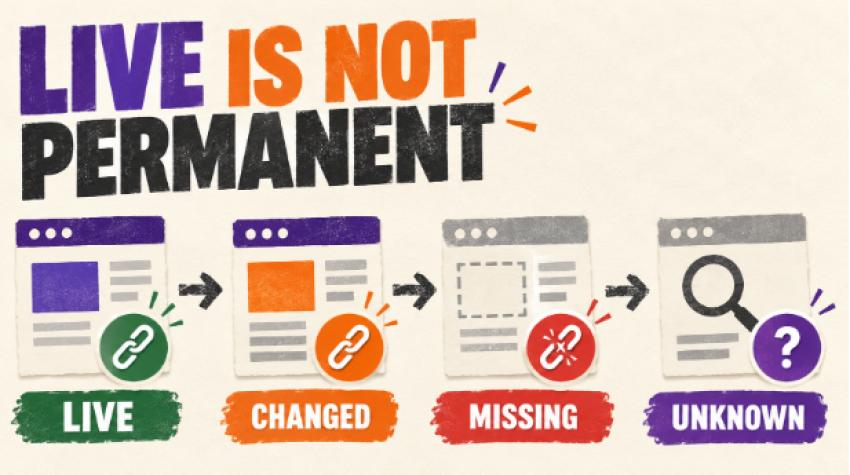
A backlink is not finished when the publisher clicks “Publish.” The source page can move, the link can disappear, the destination can change, and a followed link can later gain a nofollow or sponsored attribute. Sometimes nothing changed at all and a backlink tool simply stopped reporting it.
That is why a spreadsheet marked “Live” is only a dated observation. Useful backlink management preserves what was agreed, records what is visible now, and gives every change a proportionate next action.
The goal is not to panic whenever a chart moves. It is to detect changes that matter while keeping incomplete evidence out of the decision.
Keep the expected link separate from the observed link
Before monitoring anything, create a baseline for each placement. Save the exact source URL, intended destination, approved anchor text, link attributes, placement type, publication date and the date you checked it.
Then keep a second set of fields for the current observation.
- Expected field: Current observation
- Published source URL: Final URL after redirects
- Approved destination: Destination currently linked
- Approved anchor: Anchor visible on the page
- Agreed attribute: follow, no-follow, sponsored or ugc observed now
- Main-content placement: Current location and surrounding sentence
- Live on publication date: Last successfully verified date
This separation matters. If the report overwrites the expected destination with the current one, you lose the evidence needed to explain what changed. A history of observations is more useful than one green or red status cell.
Do not confuse discovery with verification
Backlink indexes are useful for discovering links and spotting broad changes. They are not a complete, real-time record of every link on the web.
Google says its own Search Console Links report shows a sample rather than a comprehensive list. It can also include links found over time that have since been removed. Third-party indexes have their own crawl schedules and coverage limits.
Therefore, a link disappearing from a report does not prove that the publisher removed it. Open the exact source page and check the link before contacting anyone.
The same principle works in the other direction. A tool may continue showing a historical backlink after the source page was deleted or the citation changed. The index is a discovery layer. The source page is the evidence layer.
A hand-checked Web Diagnosis study illustrates why page-level verification matters. In one purchased list of 1,001 prospect URLs, 213 pages could not be read and 163 were unedited theme-demo posts. Those figures apply to that dataset, not every campaign, but they show how easily a domain metric or saved URL can hide an unusable page.
Use statuses that describe what you actually know
“Live” and “lost” are too blunt for most backlink operations. A practical status system should preserve uncertainty.
Verified and unchanged
The source page loads, the link is present, and the destination, anchor, attribute and placement still match the baseline. Save the check date and move on.
Link changed
The page still links to your site, but the anchor, destination, attribute or surrounding placement changed. Record the exact difference before deciding whether it needs correction.
A new nofollow value is a change, but not automatically a publishing error. Google recommends sponsored or nofollow for paid placements and ugc for user-generated links. Its outbound-link guidance is more useful here than treating “dofollow” as a universal quality label.
Link missing
The source page loads normally, but the expected link is absent. Check whether the article was edited, whether the mention remains as plain text, and whether the page now points to another version before asking the publisher to restore it.
Page unavailable
The URL returns an error, redirects somewhere unrelated or has been removed. Look for a legitimate replacement URL, a site migration or a canonical version before classifying the backlink as permanently lost.
Unable to verify
The page timed out, blocked access or returned content that could not be inspected reliably. This is not the same as “missing.” Set a retry date and keep it out of both the success and loss totals until you have better evidence.
That final status prevents a temporary technical problem from becoming an unnecessary outreach email.
Monitor valuable links more closely, not every link equally
Checking thousands of backlinks every day creates noise and cost without guaranteeing a better decision. Use a schedule based on the link’s value, recency and recoverability.
A sensible starting cadence is:
Verify a new placement shortly after publication and store the baseline.
Recheck important new links more frequently during the first month, when corrections are usually easier to request.
Move stable placements to a monthly or quarterly review.
Recheck immediately after a migration, redesign, domain change or destination-page removal.
Prioritize links that support important pages, send referral visits or required significant editorial effort.
This is one reason a focused backlink management workflow is more useful than repeatedly exporting bigger lists. The operational question is not “How many backlinks do we have?” It is “Which verified change requires action now?”
Match the response to the change
Not every alert deserves outreach, and not every lost link should be rebuilt.
Wrong destination: Ask for a correction when the publisher linked to the wrong page. If your own URL moved, restore it or add a relevant redirect instead of blaming the source.
Changed anchor: Correct it only when the wording is inaccurate, misleading or violates the agreement. An editor choosing more natural language is not automatically a problem.
Changed attribute: Compare the published state with the agreement and the commercial relationship. Do not ask a publisher to remove a policy-appropriate attribute merely to pass ranking credit.
Removed citation: Read the updated article first. If your resource no longer supports the page, replacing the link may not be justified. If it still adds value, send the editor the exact source URL, missing citation and useful destination.
Missing from a tool, present on the page: Record the index discrepancy and take no corrective action against the publisher.
Suspicious new links: Review the pattern and origin. Do not build a disavow file from a risk score or one unattractive domain. Google says most sites do not need the disavow tool and warns that incorrect use can harm search performance.
Specific evidence makes outreach easier. “Our backlink disappeared” invites a debate. “The citation in paragraph six linked to this resource on 4 September, but the current article contains unlinked text” gives the editor something concrete to check.
Measure the workflow, not just the backlink count
A good management report should show how many placements were verified, changed, restored, intentionally left alone or still unverified. It should also record the time between detecting a meaningful change and resolving it.
Keep ranking and traffic outcomes separate. Restoring a useful citation may preserve a reader’s path and a valid editorial reference, but no individual backlink guarantees a ranking improvement.
The strongest backlink record is not the one with the most rows. It is the one that can explain what was expected, what was observed, what changed and why the chosen response made sense.