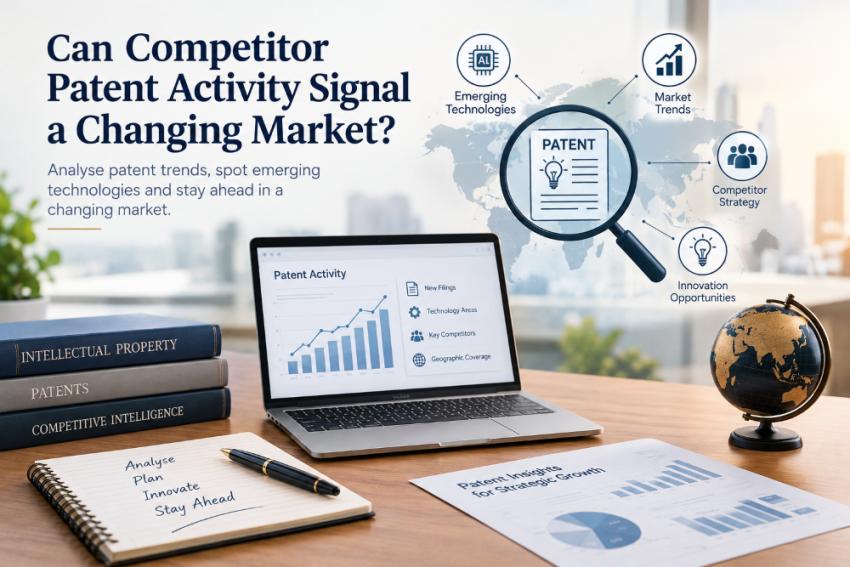
Markets rarely change overnight. New technologies, changing customer expectations and emerging commercial opportunities often develop over several years. Businesses may notice these changes through customer behaviour or industry reports. However, competitor patent activity can provide another useful source of insight.
Patent applications reveal areas in which companies are seeking to protect technical innovations. A rise in filings within a particular field, a shift towards new technologies or an increase in applications from established competitors may indicate changing business priorities. For companies operating in technology driven industries, these developments can offer valuable clues about future market direction. Patent activity does not guarantee commercial success. Some inventions never reach the market, and not every application leads to a granted patent. Yet, when analysed alongside other business information, patent data can help companies recognise emerging opportunities, evaluate competitive threats and make better informed strategic decisions.
What Competitor Patent Activity Reveals About Market Trends
Patent filings can provide an early indication of where businesses are directing their research and development efforts. Companies usually invest time and resources in developing inventions before seeking legal protection. A growing number of applications in a technical field may therefore reflect increased interest in solving particular problems or improving existing products. For example, if several manufacturers begin filing patents relating to battery efficiency, charging systems and energy storage, the trend may indicate growing competition in electric mobility. Similarly, increased patent activity in artificial intelligence, medical devices or industrial automation may suggest a shift in research priorities.
However, businesses should examine the subject matter of applications rather than relying solely on filing numbers. A few significant inventions may reveal more about an industry's direction than a large number of minor technical improvements. Patent documents can also help companies understand which technical challenges competitors are trying to overcome. This information may support product development decisions, research planning and assessments of future demand.
Why Changes in Patent Filing Patterns Matter
A competitor's patent portfolio can change considerably as its business strategy evolves. Tracking these changes over time can help organisations identify emerging priorities. For instance, a company traditionally focused on mechanical equipment may begin filing applications related to sensors, connected devices and predictive maintenance. This change could indicate an effort to develop smarter products or enter a new technology segment.
Likewise, a sudden increase in filings across several related technical areas may suggest a broader research programme. If competitors begin protecting inventions in areas previously overlooked by the industry, businesses may need to reconsider their assumptions about future competition. The timing of these changes also matters. A patent application published shortly before a product launch may help explain the technical direction of the new offering. However, publication dates do not necessarily reflect when the underlying innovation was developed. Patent applications are generally published after a period of confidentiality, often around 18 months from the relevant filing or priority date, subject to applicable rules and exceptions. Companies should therefore interpret patent activity in context rather than treating every new publication as evidence of an immediate market shift.
Using Patent Intelligence to Assess Competitors
Patent intelligence involves collecting and analysing patent information to understand technological developments and competitive positioning. It goes beyond counting applications. Businesses examine the technologies involved, the applicants, the countries in which protection is sought and the relationship between different inventions. A company may discover, for example, a competitor filing related applications in several jurisdictions. This could suggest plans to protect a technology in multiple markets, although geographical filings alone do not prove an intention to launch a product in each country.
Businesses can also review patent families, which connect applications relating to the same invention across different jurisdictions. Examining these records may help identify the territories a competitor considers important. Another useful indicator is the development of a company's patent portfolio over time. A shift from incremental improvements to a new technical field may signal a change in research priorities. Repeated filings by several competitors in the same area may also reveal an increasingly important technological challenge. For meaningful conclusions, businesses should combine patent information with product announcements, research publications, industry developments and customer demand. This reduces the risk of drawing conclusions from isolated filings.
Identifying Opportunities for Innovation and Investment
Competitor patent activity can help businesses identify areas where existing products may have limitations or where new technical solutions are receiving attention. A review of patent documents may reveal recurring problems, alternative engineering approaches or technical areas attracting investment. Research teams can use these findings to refine product concepts, explore different designs and identify opportunities for further development. For startups and growing businesses, patent intelligence can also inform investment decisions. Understanding where competitors are focusing their research may help management assess whether a proposed product addresses an established need or enters an increasingly crowded field.
Nevertheless, high patent activity does not automatically mean a market is attractive. It may indicate strong demand, but it can also point to intense competition, substantial development costs or complex intellectual property restrictions. Businesses should assess commercial demand, manufacturing feasibility, regulatory requirements and potential customer adoption before committing significant resources.
Understanding Patent Risks Before Developing New Products
Patent intelligence has an important legal function alongside its commercial value. A company developing a new product should assess whether relevant third party patents could restrict its activities in the intended markets. A competitor's patent application does not automatically establish an enforceable right. Its status, claims, jurisdiction and eventual grant must be examined carefully. Even a granted patent may be limited to specific technical features rather than covering an entire product category. Businesses should distinguish patent landscaping from a freedom to operate assessment. Patent landscaping provides a broader view of technological activity, while a freedom to operate assessment examines whether a proposed product or process may infringe relevant enforceable patent rights in a particular jurisdiction.
These assessments can influence product design, licensing discussions and market entry decisions. Patent lawyers for businesses can help evaluate relevant claims, review patent status and identify potential infringement concerns before a product reaches commercial production. Early assessment is especially important when a company plans to launch a product in multiple countries, since patent rights and enforcement risks may differ between jurisdictions.
Integrating Patent Data Into Business Strategy
Patent monitoring is most effective when it becomes part of a regular decision making process. Businesses should identify competitors and technical fields relevant to their operations, then review new applications and changes in existing portfolios at appropriate intervals. The findings should be shared with research, product development, legal and commercial teams. Engineers may use patent documents to understand technical approaches, while management may assess whether emerging trends justify new investment or strategic partnerships.
Companies should also consider the relationship between patents and other intellectual property rights. Software products, product branding, technical drawings and supporting content may require different forms of protection. Depending on the circumstances, copyright protection for businesses can help safeguard original software code, documentation, illustrations and other qualifying creative works, although copyright does not protect an underlying idea or technical function as such. A coordinated intellectual property strategy helps businesses protect their own innovations while making informed decisions about competitors' developments.
Recognising the Limitations of Patent Data
Patent activity is a useful indicator, but it is not a complete picture of market demand. Companies may file applications for defensive reasons, to support licensing plans or to preserve future options. Some technologies remain commercially unsuccessful despite extensive patent protection. Other innovations may never appear in published patent records because businesses rely on trade secrets or choose not to seek patent protection. Publication delays can also make current technological activity difficult to assess fully. Businesses should therefore avoid treating patent counts as a direct measure of innovation quality, market share or future revenue. The strongest analysis combines patent information with financial performance, product launches, customer research and broader industry developments.
Conclusion
Competitor patent activity can provide valuable signals about changing technologies, research priorities and competitive pressures. When businesses examine filing patterns, technical claims and geographical coverage, they gain a clearer understanding of how an industry may be evolving. However, patent data should support rather than replace commercial judgement. By combining patent intelligence with market research, legal assessments and product planning, businesses can identify opportunities earlier and manage risks more effectively. Regular monitoring also helps companies make informed decisions about innovation, investment and intellectual property protection. In markets shaped by rapid technological change, understanding what competitors are trying to protect can offer a useful advantage when planning the next stage of business growth.