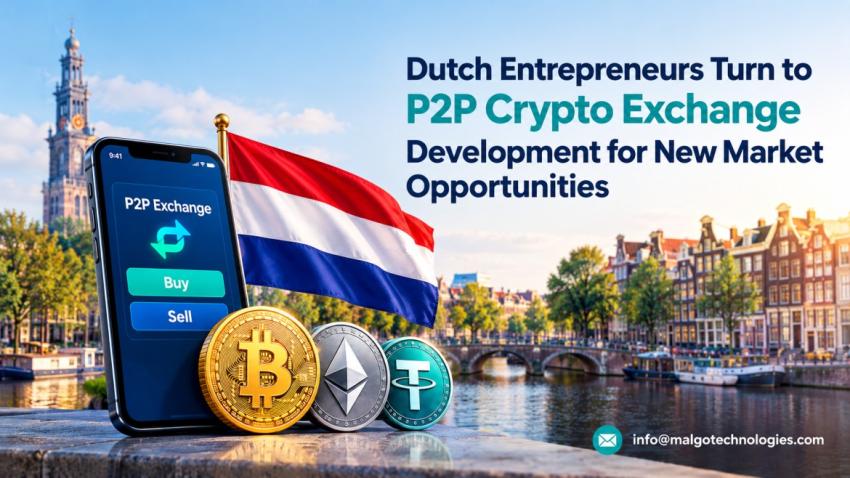
Dutch entrepreneurs are showing growing interest in digital asset businesses as blockchain and cryptocurrency services continue to develop across Europe. One model attracting attention is peer-to-peer (P2P) crypto exchange development, which allows users to trade digital assets directly with each other through a dedicated platform.
Unlike a traditional exchange where trading mainly happens through a central order book, a P2P exchange connects buyers and sellers and provides the infrastructure needed to complete transactions. This creates room for businesses to build trading services around specific customer groups, payment preferences, supported assets, and local market needs.
Why Are Dutch Entrepreneurs Exploring P2P Crypto Exchange Development?
Dutch entrepreneurs may see P2P crypto exchanges as an opportunity to create more flexible digital asset trading services. Users can choose offers based on factors such as price, payment method, trading limits, and transaction preferences, while the exchange provides the tools needed to facilitate the trade.
The model also gives businesses more flexibility in defining their target market. An entrepreneur could build a general P2P exchange or focus on a particular group, such as retail crypto users, businesses, or users looking for specific payment options. This market-focused approach can help a new platform establish a clearer value proposition instead of competing solely on the number of available trading pairs.
People Also Asked: Why are businesses in the Netherlands interested in P2P crypto exchanges?
Businesses may be interested because P2P platforms support direct buyer-seller trading, flexible payment options, and different approaches to building digital asset services around specific user requirements.
What Business Opportunities Can a P2P Crypto Exchange Create in the Netherlands?
A P2P crypto exchange can generate revenue through transaction fees, withdrawal charges, asset listing fees, premium services, advertising, and other platform-based offerings. The best approach depends on the target audience and how frequently users are expected to trade.
There are also opportunities to build specialized services around the exchange. For example, a business could provide premium trading tools, merchant services, analytics, API access, or additional account features. A focused business model can be more practical for a new entrant than trying to provide every possible service from the beginning.
For entrepreneurs, the key question is not simply how many revenue streams can be added. It is whether the selected model provides enough value for users to keep trading on the platform.
People Also Asked: How can a P2P crypto exchange generate revenue?
A P2P crypto exchange can earn through trading fees, withdrawal fees, listing charges, premium accounts, advertising, and additional services. The revenue model should match the platform's users and trading activity.
What Features Should a P2P Crypto Exchange Include for the Dutch Market?
A P2P exchange needs features that make the trading process easy to discover, complete, and track. Core functionality usually includes user registration, identity verification, buy and sell listings, search and filtering, order matching, escrow, payment integration, transaction history, notifications, and dispute management.
Security is equally important. Two-factor authentication, wallet protection, access controls, transaction monitoring, secure API connections, and appropriate account permissions can help protect users and the platform. For a Dutch-focused product, businesses should also consider language and currency preferences, payment options relevant to their customers, and the compliance requirements that apply to their activities.
The user experience should remain straightforward. Traders should be able to create an offer, compare available offers, initiate a transaction, make or confirm payment, and complete the trade without unnecessary steps.
People Also Asked: What features are needed to build a P2P crypto exchange?
A P2P crypto exchange generally needs user verification, trade listings, matching, escrow, wallet functionality, payment integration, transaction tracking, notifications, dispute resolution, security controls, and an admin dashboard.
What Should Dutch Businesses Consider Before Starting P2P Crypto Exchange Development?
The development process should begin with the business model rather than the technology. Entrepreneurs should decide who the exchange will serve, which cryptocurrencies and currencies will be supported, which payment methods will be available, and how the platform will make money.
Liquidity should receive particular attention. A P2P exchange needs active buyers and sellers for users to find suitable offers. A business may therefore need a clear user-acquisition plan, incentives for early participants, and strategies for maintaining trading activity after launch.
Compliance is another area that requires early planning. Businesses operating in the Netherlands need to assess the European and Dutch regulatory requirements that apply to their specific activities. The requirements can vary based on services offered, custody arrangements, customer locations, and other business characteristics. Professional legal and compliance advice should be obtained before launch.
People Also Asked: What are the main challenges of launching a P2P crypto exchange?
Key challenges can include regulatory requirements, liquidity, fraud prevention, security, payment integration, dispute handling, user acquisition, and maintaining consistent trading activity.
How Can Dutch Entrepreneurs Choose the Right P2P Crypto Exchange Development Company?
The development partner should be able to build more than a basic trading interface. Entrepreneurs should look for capabilities across P2P matching, escrow, wallet integration, payment gateways, identity verification, security, admin management, APIs, and scalable infrastructure.
It is also useful to discuss the complete business model before development starts. For example, an exchange focused on Dutch retail users may have different requirements from a platform serving businesses across multiple European markets. The development approach should account for supported payment methods, currencies, assets, user verification, security, and future expansion.
Businesses should also ask about testing, deployment, maintenance, and upgrades. New payment methods, cryptocurrencies, security requirements, and user expectations can emerge after launch, so the platform should have room for future improvements.
People Also Asked: How do I choose a P2P crypto exchange development company?
Compare development companies based on their P2P trading capabilities, security approach, payment integrations, customization options, scalability, testing, maintenance, and ability to support your specific business model.
Ready to Build a P2P Crypto Exchange for the Dutch Market?
P2P crypto exchange development can give Dutch entrepreneurs a way to build digital asset services around specific users and trading requirements. The strongest projects start with a clear business model, realistic liquidity strategy, suitable payment options, strong security measures, and a clear approach to applicable regulations.
Whether the target market is in Amsterdam, Rotterdam, The Hague, Utrecht, Eindhoven, or other Dutch business hubs, the development plan should reflect the needs of the intended users rather than simply copying an existing exchange.
A P2P crypto exchange development company can help turn the concept into a functional platform with trading, escrow, wallet, payment, security, and administrative features. A free demo is available for businesses that want to explore their exchange concept before development.
Discuss your target users, supported assets, payment preferences, revenue model, and platform requirements to determine a practical approach for launching a P2P crypto exchange in the Dutch market.
Add a stronger Dutch-market CTAMake the opening more specific
Call: +91 87780 74071
Email: info@malgotechnologies.com