How Is India’s Vinyl Record Market Performing?
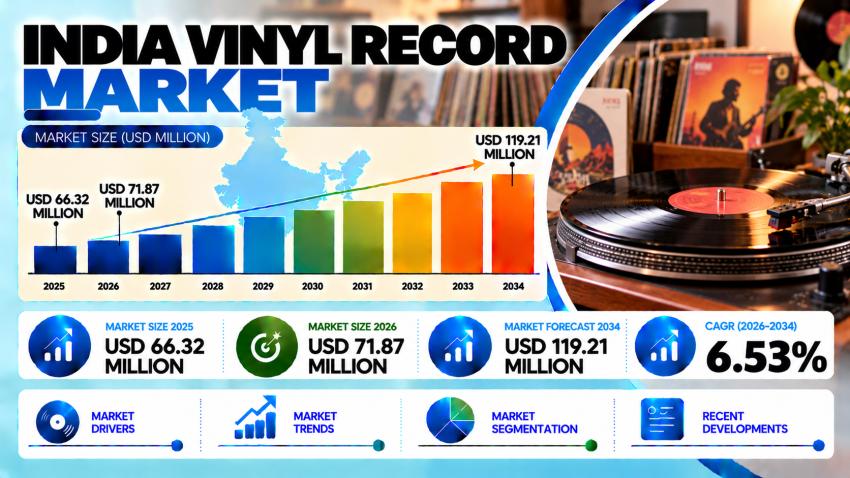
The vinyl record size in India grew from USD 66.32 Million in 2025 to USD 71.87 Million in 2026. Looking forward, IMARC Group expects the market to reach USD 119.21 Million by 2034, exhibiting a growth rate (CAGR) of 6.53% during 2026-2034. The India vinyl record market forecast is anchored by nostalgia-led demand among Gen Z and millennial listeners, a growing audiophile culture, wider curated retail formats, and rising domestic pressing capacity.
India Vinyl Record Market Dynamics
- Driver: Nostalgia, Listening Bars, and Community Culture:
Vinyl has moved from a niche collector pursuit to a broader lifestyle format embraced by younger, digitally native audiences alongside long-time audiophiles. Interest in tactile, collectible music is driving steady demand for new pressings and reissues of Bollywood and international catalogs. Listening bars have opened across Ahmedabad, Bengaluru, Chennai, Delhi, Goa, and Mumbai, creating social venues that normalize vinyl consumption beyond private collections. In July 2025, Mumbai’s first vinyl-exclusive listening bar, Baroke, opened in Grant Road with more than 220 carefully selected records spanning the golden ages of music from the 1960s to the 1990s.
Retail access is widening as well. Specialized stores and online marketplaces now deliver catalog depth to buyers in smaller cities, reducing past dependence on imports from Europe and the United States. Growing domestic pressing capacity is shortening supply lead times and allowing labels and independent artists to serve demand for locally produced titles, which is steadily reshaping the vinyl record size in India.
- Opportunity: Catalog Reissues and Tier-2 City Expansion:
Rights holders with decades of Bollywood, ghazal, and regional music catalogs have a wide opportunity to release curated vinyl reissues for collectors. Digital mastering tools used alongside traditional analog techniques allow decades-old recordings to be restored and remastered for vinyl, preserving catalog value.
Growing disposable incomes and cultural interest in smaller cities create room for retailers to move beyond the metro-led base. Hybrid formats that combine retail, cafes, and listening lounges let buyers experience records before purchase, while subscription-style delivery models and pre-orders for limited pressings extend reach into tier-2 and tier-3 cities.
- Restraint: Equipment Costs, Streaming Competition, and Pressing Limits:
A turntable, sound system, and starter collection represent a meaningful upfront outlay, well above what casual listeners typically spend on entertainment. The convenience and low cost of digital streaming also limit vinyl’s addressable audience relative to the wider recorded music market.
On the supply side, limited access to specialized pressing and mastering facilities can constrain capacity and extend turnaround times. Premium variants such as colored vinyl and picture discs often still require import, and mastering and pressing expertise remains concentrated among a small pool of specialists, which slows the pace of new capacity additions among vinyl record manufacturers in India.
How Is India’s Vinyl Record Market Segmented?
By Product:
- LP/EP Vinyl Records: leading at 73.6% share in 2025, driven by collector preference for full-album experiences, richer gatefold artwork, and deeper catalog depth; also expanding faster than the overall market
- Single Vinyl Records: 26.4% share; popular for limited-run releases and as a lower-priced entry format for first-time buyers
By Gender:
- Men: leading at 67.4% share in 2025, consistent with the historically male-skewed audiophile and hi-fi ownership base
- Women: 32.6% share; the faster-growing buyer segment, supported by curated subscription formats, wider genre representation, and community listening events
Other Segments Covered:
- Feature: Colored, Gatefold, Picture
- Age Group: 13-17, 18-25, 26-35, 36-50, Above 50
- Application: Private, Commercial
- Distribution Channel: Supermarkets and Hypermarkets, Independent Retailers, Online Stores, Others
Regional Insights:
- West India (33.5%): Mumbai’s dense concentration of record stores, listening bars, and collector communities
- North India (28.4%): Rising urban disposable incomes, expanding retail formats, and growing cultural interest in physical music
- South India (24.2%): Fastest-growing region; IT-driven consumer base, multi-genre listening interest, and rising e-commerce adoption across Bengaluru, Chennai, and Hyderabad
- East India (13.9%): Emerging retail presence, growing youth engagement, and gradual expansion of curated stores
Competitive Landscape
The market is moderately fragmented, with a small group of domestic labels and manufacturers building supply capability alongside global music companies whose catalogs reach India through import and reissue channels. Manufacturing capacity, catalog depth, and retail reach are the main differentiators, while high capital costs, limited technical expertise, and the need to secure catalog licensing keep barriers to entry meaningful.
Key players include Saregama India Ltd., Samanvii Digimedia Art And Solutions Private Limited, The Revolver Club, Sony Music Entertainment, and Universal Music Group, among others. Saregama is leveraging its Bollywood and classical catalog for curated reissues, Samanvii is scaling domestic pressing services, and The Revolver Club is growing retail and subscription reach through community-led events. The report offers a detailed look at market structure, competitive positioning, company profiles, and strategies.
Government Initiatives Supporting the Market
- Make in India: encourages domestic manufacturing and can support local pressing, packaging, and compound supply for vinyl records
- Startup India: supports new entrants launching vinyl-focused retail, subscription, and listening-bar concepts
- Digital India: strengthens e-commerce and digital payments that carry vinyl catalogs to buyers in smaller cities
- Copyright and creative economy support: protection of music rights and promotion of cultural industries underpin catalog licensing and reissue activity
Investment Opportunities
- LP/EP Reissues and Independent Limited Editions: The fastest-expanding product format, supported by deeper catalog reissues and interest in niche genres and exclusive pressings.
- South India and Tier-2 Cities: The fastest-growing region offers room for retailers that combine curated catalogs with community listening experiences.
- Domestic Pressing and Experiential Retail: Investment is concentrating in pressing capacity, curated stores, subscription models, and venues that combine vinyl retail with cafes and events.
Frequently Asked Questions (FAQ)
- What is the vinyl record size in India?
The India vinyl record market was valued at USD 66.32 Million in 2025 and grew to USD 71.87 Million in 2026.
- What is the forecast by 2034?
The market is projected to reach USD 119.21 Million by 2034, at a CAGR of 6.53% during 2026-2034.
- Which segments and regions lead?
LP/EP vinyl records lead with 73.6% share, men with 67.4%, and West India with 33.5% in 2025.
- What are the main growth drivers?
Nostalgia-led demand among younger listeners, a growing audiophile culture, expanding retail and e-commerce access, and rising domestic pressing capacity.
- What are the key restraints?
High entry costs for turntables and playback equipment, competition from streaming, and limited domestic pressing infrastructure.
Conclusion
India’s vinyl record market is moving from a collector niche toward a lifestyle category, with listening bars, curated stores, and reissue programs drawing new audiences. Growth through 2034 will be shaped by domestic pressing capacity, deeper e-commerce reach, and catalog activity from domestic and global labels.
Players that scale pressing, invest in regional retail, and unlock catalog value through reissues are well placed to capture the roughly USD 52.89 Million in incremental value expected over the forecast period.
Source: IMARC Group