With the publication of ISO 9001:2026, organizations are reviewing their existing quality management systems to understand what needs to be updated, added, or improved. Documentation is an important part of this process because it helps an organization define its processes, demonstrate implementation, and maintain consistent evidence of QMS activities. However, ISO 9001:2026 does not require every organization to maintain an identical set of documents. The type and extent of documented information depend on the organization's size, processes, complexity, and operational needs.
What Should ISO 9001:2026 QMS Documents Include?
A practical documentation system should support the organization's actual processes rather than create unnecessary paperwork. When reviewing ISO 9001:2026 documentation, organizations can consider the following areas:
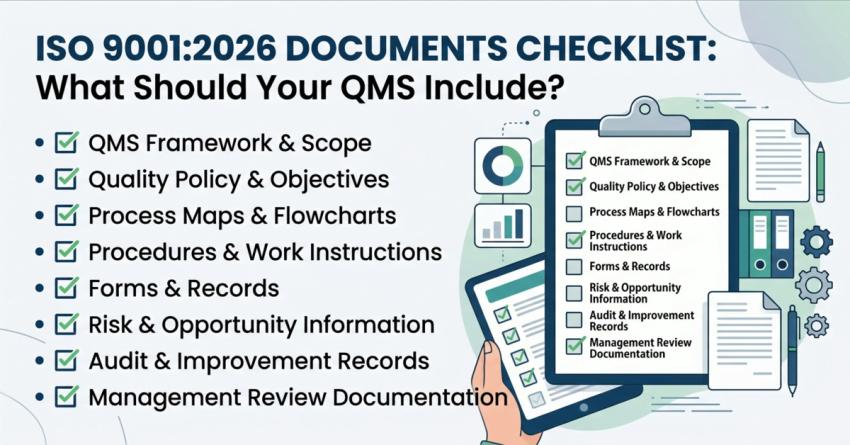
- QMS framework: A documented overview of the quality management system, including its scope and key processes.
- Quality policy and objectives: Documents that communicate the organization's quality direction and measurable objectives.
- Process documentation: Process maps, flow charts, criteria, responsibilities, and controls that help explain how activities are performed.
- Procedures and work instructions: Detailed instructions for activities where documented guidance is necessary for consistent operation.
- Forms and records: Templates and completed records that provide evidence that required processes and activities have been carried out.
- Risk and opportunity information: Appropriate documented information supporting the organization's approach to addressing risks and opportunities.
- Audit and improvement records: Internal audit results, nonconformities, corrective actions, and related evidence.
- Management review documentation: Information and records demonstrating that the QMS is periodically reviewed and evaluated.
ISO 9001:2026 Documentation Checklist
Before a transition or certification audit, organizations can use an ISO 9001:2026 documentation checklist to review whether their existing system is complete and relevant. Check that documents reflect current processes, responsibilities are clearly defined, outdated versions have been controlled, and required records are available as objective evidence.
It is also useful to compare existing ISO 9001 documents against the updated ISO 9001:2026 requirements. This can reveal gaps that may otherwise be overlooked during routine QMS activities.
Updating Your ISO 9001:2026 Manual and Procedures
Organizations transitioning from ISO 9001:2015 should avoid simply changing the standard's year on existing documents. The QMS should be reviewed clause by clause to determine whether policies, processes, procedures, forms, records, and supporting documents need modification.
An ISO 9001:2026 manual can provide a structured overview of the QMS, while ISO 9001:2026 procedures and supporting work instructions can explain how important processes are implemented. The key is to ensure that documentation matches what the organization actually does.
For organizations looking for a structured starting point, ISO 9001:2026 documents can help simplify the documentation process with ready-to-edit QMS materials that can be adapted to organizational processes.
Prepare Your QMS Documentation With Confidence
Good QMS documentation should make processes easier to understand, support consistent implementation, and provide useful evidence during audits. Instead of creating documents simply to satisfy a checklist, organizations should focus on maintaining practical, controlled, and process-relevant documented information.
Reviewing your current system against the new requirements, updating relevant documentation, and verifying implementation can make the transition to ISO 9001:2026 more organized and effective.
Final Checklist Before Transition or Certification
Before an audit or transition assessment, review whether your documentation is current, controlled, implemented, and supported by appropriate records. More importantly, ensure that employees understand and follow the documented processes.
A complete set of ISO 9001 documents should make the QMS easier to manage—not simply create more paperwork. By systematically reviewing documentation against ISO 9001:2026 requirements and actual operations, organizations can identify gaps, improve consistency, and approach their assessment with greater confidence.