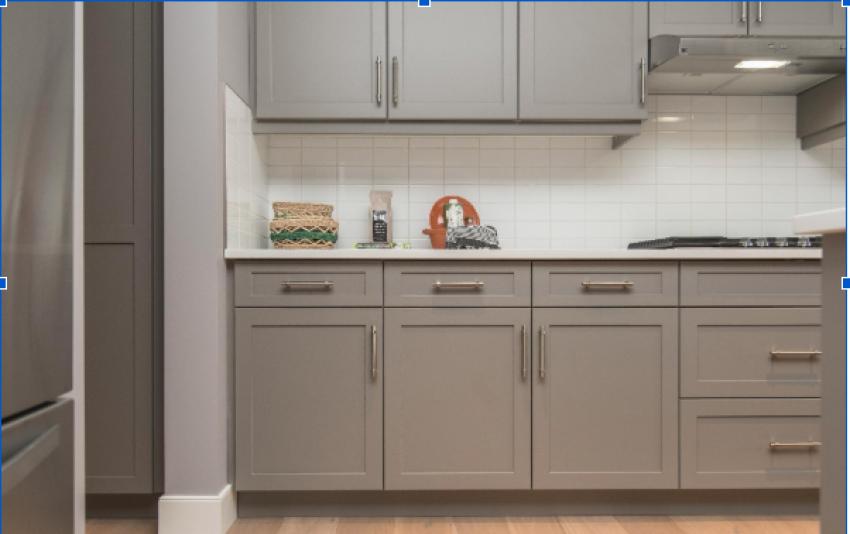
The Central Statistics Office counted 1.85 million occupied dwellings in Ireland in its 2022 census. For homeowners in the capital, a Dublin kitchen respray is now one of the options.
Picking between a spray finish and a new kitchen is easier with a method. This guide offers one, built on five questions. Each question rules an option in or out, and the answers add up to a clear next step.
Four routes are on the table. The first is brush painting the existing doors, which suits small or low-use spaces. The second is a professional spray finish on the existing doors and, where wanted, the worktops. The third is new doors fitted to the existing boxes. The fourth is a full replacement kitchen. The questions below sort a kitchen into one of these four.
Question One: Are the Cabinet Boxes Sound?
Start with the boxes, which are the frames that hold the shelves, drawers and doors. A kitchen is only worth refinishing if those frames are in good order. The doors can look dreadful and still be a fair case for spraying. Sound boxes behind worn doors are the situation a respray is made for. Money spent on a new finish over failing boxes is money spent twice.
Test the boxes with your hands. Open each door and press the bottom edges of the base units, especially around the sink and dishwasher. Water damage shows up there first. Look for soft or swollen board, and check that the hinges still hold their screws. Look inside for sagging shelves too.
One Kinsealy-based provider is plain about the limit. It says swollen or badly broken doors need repair or replacement before any spraying, and the structure must be sound. A sprayer can fill chips and key a surface. A sprayer cannot rebuild board that has absorbed water.
If the boxes fail this test, the answer is already clear. A new kitchen, or at least new units, is the route to take. If they pass, move on to the next question.
Question Two: Does the Layout Still Work?
A respray keeps every unit where it stands. It changes colour and finish, not the plan. So the second question is about how you use the room. Can you reach the hob, sink and fridge easily? Is there enough storage? Would you like an island, or a different spot for the appliances?
If the layout works, the doors and the finish are the only problems, and spraying stays in the running.
If the layout does not work, no finish will fix it. Where do you stand when you prepare food, and how far do you walk between the sink, hob and fridge? A tired door is easy to forgive. A badly placed hob is not.
The table below sets out a general guide. It is a rule of thumb for planning, not a price list or a promise.
Your kitchen
Route to lean towards
Sound boxes, worn doors, layout works
Respray
Sound boxes, layout does not work
New kitchen or new units
Soft, swollen or broken boxes
Replacement
One or two damaged doors, the rest in good order
Replace those doors, then price a respray of the full set
A small, little-used space with plain doors
Brush painting may be enough
The first and third rows are the easy calls. The middle rows need a closer look and a second opinion.
Question Three: What Are the Doors Made Of?
Door material decides how much preparation is needed. The provider lists the types it sprays. Solid timber is sanded and primed, and the grain stays visible unless a filled finish is requested. Painted MDF is the easiest case. Laminate and melamine, which it calls the most common Irish kitchen of the 1990s and 2000s, are also on the list.
Vinyl-wrapped and thermofoil doors can be sprayed if they are sound, after lifted corners are removed. High-gloss doors can take any sheen but need extra coats. Shaker and profiled doors are included, and the provider says spraying reaches the profile evenly.
Wrap and thermofoil need a bonding primer, which adds a step and affects the price. A Kinsealy-based sprayer also covers worktops, including granite, and wardrobes, and the cost guide says extras such as wardrobes can be added in the same visit. Ask any firm what primer it uses on your particular doors, and why.
Colour and sheen belong in this decision too, because they change the look and the price. The provider says it matches paint to codes from ranges such as Farrow and Ball, Colourtrend and Dulux. It offers matt, satin and gloss, and its cost guide says gloss costs more than matt or satin. Choose the colour with a sample door in your own light before you agree to the work.
Question Four: What Do the Numbers Say?
Whether the plan is a Dublin kitchen respray or a full refit, price each route in writing before you choose. A rough guess for a new kitchen set against a firm quote for a respray is not a fair comparison.
The provider's 2026 cost guide gives these respray ranges:
Small kitchen: €700 to €1,000.
Medium kitchen: €1,250 to €1,400.
Large kitchen: €1,400 to €2,000.
Very large kitchen with an island: €2,000 to €3,000.
The same guide puts a full replacement at €8,000 to €15,000 or more, and says a respray saves around 70 percent. These are one firm's figures, so use them as a rough guide only.
Here is a hypothetical example. A homeowner has a medium kitchen with sound boxes and a layout that works. A respray at the published €1,250 to €1,400 sits against a replacement quote at the bottom of the published range, €8,000. The difference is at least €6,600. If nothing about the layout bothers the owner, that money stays in the household. If the layout is the real problem, the saving does not matter, because the respray does not solve it.
The guide names five things that move a respray price. They are the number of doors and drawer fronts, the condition of the surfaces, the door type, the finish and any extras. It says the quote is fixed before work begins. When comparing kitchen respray Dublin quotes, ask each firm for the same details. They are a fixed price, the number of doors counted, the finish and the preparation steps.
A replacement quote needs the same discipline. Ask what it includes. Units, worktops, fitting, plumbing, electrics and removal of the old kitchen are separate items. A low headline figure can leave some of them out. Set the totals side by side only when both cover the same work.
Question Five: How Much Disruption Can You Take?
The last question is about time. The provider says most respray jobs take 1 to 3 days. Its cost guide says a replacement takes weeks. For a family that cooks every day, that difference can matter as much as the price.
Plan for the 1 to 3 days of the work. Empty the cupboards and clear the worktops the day before. Decide where meals will come from while the kitchen is out of action, even if that means simple cold meals for a day or two. A replacement needs that planning for weeks, not days, with a stretch of going without a working sink or hob.
Think about the days around the work as well. Surfaces and appliances are masked and protected, and the doors are rehung and adjusted at the end. After that, the finish needs about two weeks to cure, so treat it gently. The provider recommends a damp cloth and mild detergent for cleaning, and no abrasive pads.
Check the guarantee before you book. The provider's website does not state a written warranty. Whichever route you take, ask for the terms in writing. Ask what they cover, such as chipping, peeling or colour change, and for how long. Then you know who to call if a door marks early or a join fails.
The Short Version
A Dublin kitchen respray fits a kitchen with sound boxes, a layout you like and doors that look tired. Everything else points to a repair or a replacement. Keep these points in view when you decide:
Test the boxes first, and rule out soft or swollen board.
Confirm that the layout works, since a respray cannot change it.
Identify the door material, because it sets the preparation needed.
Price both routes in writing, for the same scope of work.
Weigh the 1 to 3 days of disruption and the two-week curing period, and ask for guarantee terms in writing.