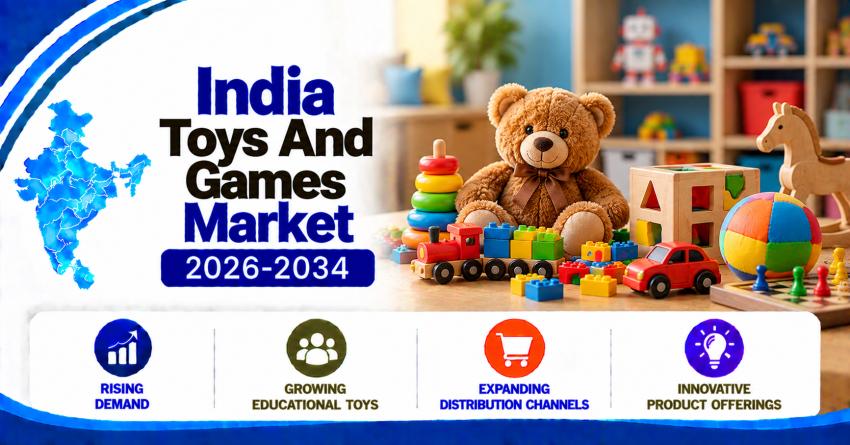
India Toys and Games Market Outlook
The market is driven by rising disposable incomes, rapid urbanization, and growing parental interest in learning-based toys. Government policy under Make in India, stricter quality norms, and higher import duties have strengthened domestic manufacturing, while a larger middle class continues to lift spending on children's entertainment and development.
Online retailing, social media influence, and the expansion of e-commerce into smaller cities are widening product access. Together with demand for STEM kits, character-themed plush toys, and electronic learning products, these factors are reshaping how Indian families buy toys and are lifting the India toys and games market size from USD 4.07 Billion in 2025 toward USD 5.89 Billion by 2034.
Market-At-A-Glance
- Market Size (2025): USD 4.07 Billion
- Market Size (2026): USD 4.24 Billion
- Forecast Market Size (2034): USD 5.89 Billion
- CAGR (2026-2034): 4.18%
- Leading Product Type: Plush Toys, 18% share
- Leading Distribution Channel: Online Stores, 31% share
- Leading Region: North India, 33% share
Why the India Toys and Games Market Is Growing?
- Policy Support for Domestic Manufacturing:
Make in India, the National Action Plan for Toys, and Production Linked Incentive schemes have created a favorable production ecosystem. From FY 2014-15 to FY 2022-23, toy imports declined by 52% while exports rose by 239%, reflecting a clear shift toward local manufacturing.
- Rising Disposable Incomes and a Growing Middle Class:
Higher household purchasing power is encouraging families to treat quality toys as investments in child development. Private consumption has doubled over the past decade, and urban consumers increasingly pay a premium for branded, educational, and technology-integrated toys.
- E-Commerce Expansion and Digital Retail:
Online platforms now reach tier-II and tier-III cities where physical toy retail is limited. Wider selection, competitive pricing, customer reviews, and doorstep delivery, supported by digital payments and smartphone penetration, are making online the preferred buying route.
- Demand for Educational and STEM-Based Toys:
Parents are seeking puzzles, building blocks, and science kits that support cognitive development and problem-solving, aligning with the broader emphasis on STEM education.
- Entry of Established Players into Electronic Toys:
In December 2025, Funskool India entered the electronic toys category with learning pads, interactive laptops, and melody books under its Giggles brand, supported by upgraded electronic assembly lines at its Ranipet and Goa facilities.
What Are the Key Trends Shaping the India Toys and Games Market?
- Rise of Educational and STEM-Based Toys:
Awareness of developmental needs is driving demand for toys that promote learning, creativity, and brain skills. The government's e-Toycathon 2025 initiative has encouraged young innovators to design indigenous electronic toys that combine education with entertainment.
- E-Commerce Transformation of Distribution:
Online shopping has become the preferred way to buy toys for many consumers. The India e-commerce market was valued at USD 129.72 Billion in 2025 and is projected to reach USD 651.10 Billion by 2034, growing at a CAGR of 19.63% during 2026-2034, which also eases the entry of global toy brands.
- Growing Focus on Sustainability and Eco-Friendly Materials:
Parents increasingly prefer FSC-certified wood, recycled plastics, and non-toxic dyes. Manufacturers are investing in sustainable sourcing, supported by incentives for eco-friendly toy manufacturing clusters outlined in the Union Budget 2025-26.
Government Support Driving Market Expansion
Make in India and National Action Plan for Toys:
- Policy framework that has built a supportive ecosystem for domestic toy production
- Production Linked Incentive schemes encouraging manufacturing investment
- Alignment with the Aatmanirbhar Bharat vision of local sourcing and value addition
Import Duty and Quality Control Measures:
- Import duties raised from 20% to 70% to reduce reliance on imports
- Strict quality control orders enforced through the Bureau of Indian Standards
- Higher safety and quality standards that favor compliant domestic manufacturers
Union Budget 2025-26:
- Announcement of a comprehensive scheme to make India a global hub for toys
- Increased tax benefits for domestic manufacturers and expanded toy manufacturing clusters
- Incentives for eco-friendly production and skill enhancement
Technology and Innovation Programs:
- e-Toycathon 2025 encouraging young innovators to build indigenous electronic toys
- In February 2025, the Ministry of Electronics and Information Technology partnered CDAC-Noida with the LEGO Group to develop electronic toys and build design skills among young engineers
State-Level Initiatives:
- Haryana's Draft Electronic Toys Manufacturing Policy 2024 aims to attract investments worth one thousand crore rupees and generate ten thousand jobs
- The Toy Park at Greater Noida provides dedicated infrastructure and logistics advantages for production and exports
Segment Insights
The India toys and games market report from IMARC Group segments the market by product type, distribution channel, and region.
Product Type Insights:
- Plush Toys
- Infant/Preschool Toys
- Activity Toys
- Dolls
- Games and Puzzles
- Ride-Ons
- Others
Plush toys dominate with a market share of 18% of the total India toys and games market in 2025.
Distribution Channel Insights:
- Specialty Stores
- Supermarkets and Hypermarkets
- Departmental Stores
- Online Stores
- General Stores
Online stores lead with a market share of 31% of the total India toys and games market in 2025.
Regional Insights:
- North India
- South India
- East India
- West India
North India exhibits a clear dominance with a 33% share of the total India toys and games market in 2025.
The India toys and games market share of North India reflects its manufacturing concentration, as more than eighty percent of toy manufacturing plants in India are based in the northern region, primarily in the Delhi-NCR belt.
Competitive Landscape
The India toys and games market is fragmented, with established multinational corporations competing alongside prominent domestic manufacturers and numerous regional players. Domestic leaders have strengthened their positions through expanded manufacturing capabilities, licensing agreements with international brands, and product innovation, while global companies rely on brand recognition and content licensing.
Competition increasingly centers on educational value, technology integration, and alignment with popular entertainment properties. In April 2024, Funskool India completed a major expansion at its Ranipet facilities, adding 163,000 square feet of space with a dedicated wing for wooden toys, and in January 2026, KV Toys India launched its SME IPO to fund working capital and product innovation.
Key Opportunities for Businesses and Investors
High-Growth Areas:
- Educational and STEM-focused toys supporting early learning and cognitive development
- Electronic and interactive toys aligned with e-Toycathon and domestic design initiatives
- Eco-friendly toys using certified wood, recycled plastics, and non-toxic materials
- Character-themed and personalized plush toys tied to popular media franchises
Strategic Opportunities:
- Direct-to-consumer and e-commerce strategies targeting tier-II and tier-III cities
- Manufacturing investments in toy clusters such as the Toy Park at Greater Noida to benefit from policy incentives
- Licensing partnerships with global entertainment brands to capture character-led demand
- Local supply chain development to reduce dependence on imported raw materials and specialized components
Frequently Asked Questions (FAQ)
- How big is the India toys and games market?
The India toys and games market grew from USD 4.07 Billion in 2025 to USD 4.24 Billion in 2026.
- What is the projected growth rate?
The market is expected to grow at a CAGR of 4.18% during 2026-2034, reaching USD 5.89 Billion by 2034.
- Which product type holds the largest market share?
Plush toys dominate with an 18% share in 2025, driven by their role as comfort items and gifts and by strong demand for character-themed products.
- What are the major challenges?
Key challenges include limited rural market penetration, competition from the unorganized sector and counterfeit products, and supply chain constraints tied to raw material dependencies.
- How is the government supporting the market?
Support includes Make in India, the National Action Plan for Toys, Production Linked Incentive schemes, higher import duties, BIS quality control orders, and the Union Budget 2025-26 scheme to make India a global toy hub.
Conclusion
India's toys and games market is positioned for steady growth through 2034, underpinned by policy momentum, a growing middle class, and the rapid reach of e-commerce.
The combination of educational demand, domestic manufacturing incentives, and digital retail creates a balanced foundation for long-term expansion. Companies that invest in local production, STEM and electronic toy innovation, and online distribution will be best placed to capture the next phase of growth.
Source: IMARC Group