How Is India's Microwave Oven Market Performing?
The India aircraft MRO market size reached USD 572.4 Million in 2025. Looking forward, IMARC Group expects the market to reach USD 905.5 Million by 2034, exhibiting a growth rate (CAGR) of 5.07% during 2026-2034.
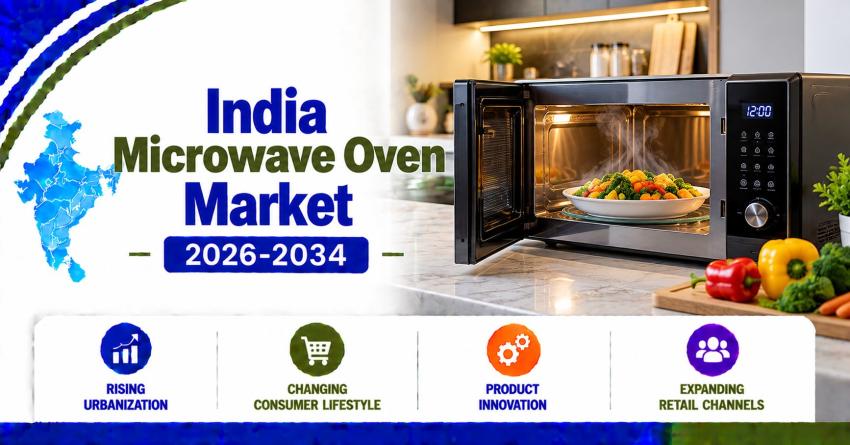
The market is driven by rising urbanization, hectic lifestyles, and growing demand for intelligent kitchen appliances. Preference for multi-feature and energy-saving models, online shopping growth, and the availability of solo and convection microwaves are encouraging adoption in urban and semi-urban households.
India Microwave Oven Market Dynamics
- Driver: Urbanization, Busy Lifestyles, and Rising Disposable Incomes:
The microwave oven market in India is benefiting from a lasting change in how households cook. Urbanization and hectic work schedules are increasing demand for quick and effective cooking solutions, particularly for reheating, defrosting, and baking. Expanding nuclear families, rising numbers of working professionals, and greater awareness of modern kitchen appliances are widening the buyer base beyond metro cities into semi-urban areas.
Rising disposable incomes are also encouraging households to move toward higher-end and multipurpose models. Consumers are increasingly drawn to appliances that combine grilling, convection, and air frying, while manufacturers are launching compact and budget-friendly models for small families and individuals. Retail expansion and e-commerce growth are strengthening access, with brands using digital platforms to offer exclusive product lines, discounts, bundling offers, extended warranties, and financing options that reach a wider customer base.
- Opportunity: Smart, Connected, and Energy-Efficient Microwaves:
Smart features represent the most visible opportunity for manufacturers. Microwave ovens with Wi-Fi connectivity, voice control, and AI-powered cooking aids let consumers set precise cooking conditions through smartphone applications. In June 2024, LG Electronics launched nine new microwave ovens in India, including seven Scan to Cook models and two premium Objet series models with ThinQ connectivity and charcoal heating. In April 2024, Samsung launched its Bespoke AI-powered microwave in India, featuring personalized diet recipes, SmartThings connectivity, and AI-driven cooking automation.
Energy efficiency is a parallel opportunity. Brands are introducing appliances designed to cut power usage, and the Bureau of Energy Efficiency's Standards and Labelling Programme, which covers microwave ovens, helps consumers compare models on efficiency. As automation and connectivity features improve, manufacturers can build premium positioning while still serving first-time buyers through simpler solo models.
- Restraint: Price Sensitivity and Competition from Alternative Appliances:
Despite healthy demand, price sensitivity remains a challenge, particularly among first-time buyers in smaller cities who compare microwave ovens against other cooking appliances. Traditional cooking preferences, limited kitchen space in compact homes, and the cost of premium smart models can slow adoption in some households. Multi-function appliances such as air fryers and induction cookers compete for the same kitchen budget.
Manufacturers must also manage input costs, product differentiation, and after-sales service quality to retain customer trust. Sustained competition among established global and domestic brands can compress margins, making strategic pricing, bundling, and service support critical for long-term profitability.
Evaluate Market Opportunity with the Business Sample Report
How Is India's Microwave Oven Market Segmented?
By Type:
- Convection: baking and grilling capabilities for users seeking wider cooking applications
- Solo: affordable and simple, popular with first-time consumers
- Grill: added grilling function for everyday cooking variety
By Capacity:
- Below 25 Liters
- 25-30 Liters
- Above 30 Liters
By End-User:
- Residential: households adopting convenient, faster cooking
- Commercial: kitchens and food service outlets
By Distribution Channel:
- Multi-Branded Store: broad brand comparison for shoppers
- Supermarkets/Hypermarkets: bundled retail purchases
- Exclusive Stores: brand experience and after-sales support
- Online: digital platforms with exclusive lines, discounts, and financing
- Others
Regional Insights:
- North India: Urban households and semi-urban expansion across a large consumer base
- South India: Digitally connected consumers and strong appliance retail networks
- West India: Metro-led demand for premium and smart models
- East India: Emerging demand supported by growing retail access
Understanding India microwave oven market share by type, capacity, and channel helps manufacturers and retailers plan product mix and distribution.
Competitive Landscape
The report offers an in-depth examination of the competitive landscape, including market structure, key player positioning, leading strategies for success, a competitive dashboard, and a company evaluation quadrant.
Government Initiatives Supporting the Market
- BEE Standards and Labelling Programme: star rating framework covering microwave ovens, helping consumers identify energy-efficient models and encouraging manufacturers to improve efficiency
- BIS Safety Standards: appliance safety certification requirements for microwave ovens supporting consumer confidence and product quality
- Make in India: policy push for domestic appliance manufacturing and assembly, supporting local production and supply chains
- Digital India and ONDC: digital commerce initiatives widening online access to appliances for buyers in smaller cities
- Consumer Protection (E-Commerce) Rules: transparency and grievance-redressal requirements that strengthen trust in online appliance purchases
Investment Opportunities
- Smart and AI-Enabled Models: Wi-Fi, voice control, and app-based cooking assistance are among the fastest-growing feature sets as urban consumers seek convenience and connected kitchens.
- Compact and Budget-Friendly Solo and Convection Models: Small families, individuals, and first-time buyers in semi-urban markets represent a large addressable base for affordable, easy-to-use designs.
- Online and Omnichannel Distribution: Exclusive digital product lines, bundled offers, financing options, and extended warranty services can deepen penetration across cities.
Frequently Asked Questions (FAQ)
- How big is the India microwave oven market?
The India microwave oven market was valued at USD 572.4 Million in 2025.
- What is the forecast size by 2034?
The market is projected to reach USD 905.5 Million by 2034, exhibiting a CAGR of 5.07% during 2026-2034.
- What are the key growth drivers?
Key drivers include rising urbanization, increasing disposable income, changing lifestyles, a preference for convenient cooking, expanding nuclear families, working professionals, e-commerce growth, and product innovation.
- Which product types are gaining traction?
Solo and convection models are seeing good demand. Solo microwaves attract first-time buyers with affordability, while convection models appeal to consumers seeking baking and grilling capabilities.
- How are smart features changing the market?
Wi-Fi, voice control, and AI-powered cooking aids from brands such as LG and Samsung are pushing demand for connected, energy-efficient models, particularly in urban and semi-urban markets.
Conclusion
India's microwave oven market offers steady multi-year growth, underpinned by urban lifestyles, rising incomes, and a shift toward convenient, technology-enabled cooking. Solo and convection models are widening access, while smart and multifunctional designs are raising the value of each sale.
Manufacturers that invest in connected features, energy efficiency, compact designs, and strong online and offline distribution will capture the largest share of growth as government efficiency and safety frameworks continue to shape consumer confidence.
Source: IMARC Group