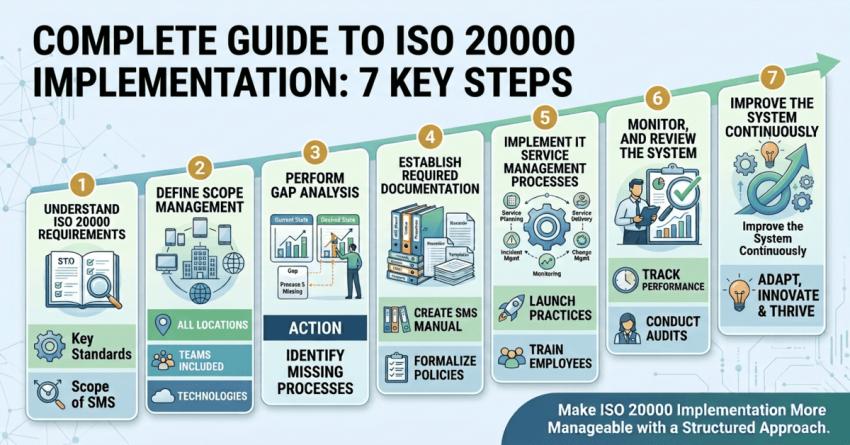
Implementing ISO 20000 can feel challenging when an organization is trying to organize IT services, define responsibilities, establish processes, and prepare documentation at the same time. ISO/IEC 20000-1 provides requirements for establishing, implementing, maintaining, and continually improving a service management system (SMS). A structured approach can make the implementation more manageable and help ensure that the system reflects actual IT service activities.
If you are planning ISO 20000 implementation, the following seven steps provide a practical starting point.
1. Understand the ISO 20000 Requirements
Begin by understanding what ISO/IEC 20000-1 requires from the organization. Review the service management system requirements, service scope, processes, responsibilities, resources, and performance expectations. This helps the implementation team understand what needs to be established rather than simply creating documents for certification.
2. Define the IT Service Management Scope
Clearly identify which services, locations, teams, technologies, and organizational activities will be included in the IT service management system. A well-defined scope helps prevent confusion during implementation and provides a clear boundary for monitoring, auditing, and continual improvement.
3. Perform an ISO 20000 Gap Analysis
Compare existing IT service management practices with the applicable ISO 20000 requirements. Identify missing processes, undocumented activities, unclear responsibilities, and areas where existing controls need improvement. The resulting gap analysis can become an implementation plan with priorities, responsibilities, and target dates.
4. Establish the Required Documentation
Documentation gives the SMS a consistent framework for managing IT services. Depending on the organization's scope and processes, this can include the IT SMS manual, service management plan, policies, procedures, SOPs, forms, records, responsibilities, and supporting templates.
Using structured ISO 20000 documents can provide a practical starting point instead of developing every document from scratch. Editable documentation can be customized with the organization's name, logo, services, processes, responsibilities, and other relevant operational details.
5. Implement IT Service Management Processes
Documentation alone does not create an effective SMS. Put the defined processes into practice and make sure employees understand their responsibilities. Activities such as service planning, service delivery, incident management, change management, service continuity, monitoring, and improvement should connect with actual business operations.
The objective is to create a working IT service management system rather than a collection of documents prepared only for an audit.
6. Monitor, Audit, and Review the System
Once processes are operating, monitor their performance and maintain appropriate records. Conduct internal audits to identify nonconformities and improvement opportunities. Management review can then help evaluate whether the SMS continues to support service requirements and organizational objectives.
An ISO 20000 audit checklist can also provide a structured way to review requirements before an external certification audit.
7. Improve the System Continuously
ISO 20000 implementation should not end when certification is achieved. Use audit results, service performance information, incidents, feedback, and management review outputs to identify opportunities for improvement. Continual improvement helps the SMS remain useful as services, technology, customer expectations, and organizational needs change.
Make ISO 20000 Implementation More Manageable
A successful ISO 20000 implementation combines clear requirements, defined processes, practical documentation, employee involvement, monitoring, and continual improvement. Starting with a structured implementation approach can make the transition easier and reduce unnecessary documentation work.
For organizations that need a practical documentation starting point, editable ISO 20000 documents can help provide a structured base for developing an IT service management system and preparing the supporting documentation needed for implementation and certification. This can save preparation time while supporting consistent processes, responsibilities, records, and audit readiness.