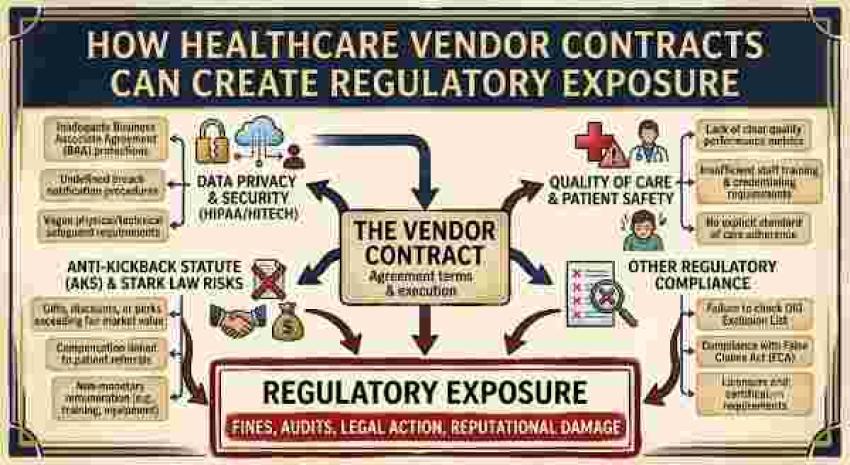
Healthcare organisations often depend on external vendors for technology, laboratory services, logistics, equipment, manufacturing support, data processing and other essential functions. These arrangements can improve efficiency and provide access to specialist capabilities. However, outsourcing a function does not necessarily remove the healthcare company's regulatory responsibilities.
A poorly drafted vendor contract can create uncertainty over compliance, data protection, quality standards and accountability. Regulatory exposure may arise when a vendor fails to follow required procedures, mishandles sensitive information or performs services without appropriate controls. Careful contractual planning is therefore important before a healthcare organisation begins working with an external provider.
Why Vendor Contracts Matter in Healthcare
A healthcare vendor contract does more than establish commercial terms. It creates a framework for how the parties will perform their respective responsibilities. The agreement can determine who handles sensitive information, who maintains records, who monitors quality and who responds when a regulatory concern arises.
The healthcare organisation may continue to face regulatory scrutiny even when a third party performs the relevant activity. For this reason, the contract should reflect applicable legal and regulatory obligations. Responsibilities should be specific enough for both parties to understand what is expected and how compliance will be demonstrated.
Regulatory Responsibility Cannot Always Be Outsourced
Healthcare businesses often assume a vendor will take responsibility for compliance once a particular function is outsourced. This assumption can create problems. A company may remain responsible for certain statutory or regulatory obligations even when an external provider performs the underlying service.
The contract should therefore distinguish between operational responsibility and ultimate accountability. A vendor can be responsible for performing a service according to agreed standards, while the healthcare company may still need to maintain oversight. Regular reviews and appropriate reporting can help the company identify whether the vendor continues to meet relevant requirements.
Data Protection Can Increase Regulatory Exposure
Healthcare vendors frequently process sensitive personal information. This may include patient records, medical information, employee details and other confidential data. A contract should explain how such information can be accessed, used, stored and transferred.
Data security requirements should be proportionate to the nature of the information and services involved. The agreement should also address incident reporting, access controls, retention and deletion requirements where relevant. If a vendor experiences a security incident, unclear contractual obligations can make it more difficult to determine who must respond and how quickly the healthcare organisation must be informed.
Quality Control Should Be Contractually Defined
Quality standards are particularly important when a vendor's services can affect healthcare delivery or regulated products. A contract should establish measurable expectations for service performance, documentation and quality control. General statements about maintaining high standards may not provide enough practical guidance.
Healthcare companies should consider how vendor performance will be monitored. Reporting requirements, inspections and audit rights can provide useful oversight. Where quality failures could affect patients or regulated products, the agreement should also establish suitable escalation procedures. Clear standards can help demonstrate a structured approach to vendor management.
Vendor Credentials Need Verification
Before entering into a contract, healthcare companies should examine whether the proposed vendor has the necessary expertise, licences, registrations and infrastructure for the services involved. Contractual promises cannot replace proper due diligence before the relationship begins.
The level of due diligence should depend on the nature of the vendor's role. A provider handling administrative services may present different risks from a provider involved in clinical support, laboratory operations or pharmaceutical supply. Reviewing credentials, relevant experience and compliance history can help identify concerns before the vendor receives access to important systems or information.
Subcontracting Can Create Additional Risk
A healthcare vendor may use subcontractors to perform part of its obligations. This can introduce another layer of regulatory and operational risk. The healthcare company may have limited visibility into how the subcontractor handles information, performs services or maintains required standards.
The main agreement should therefore address whether subcontracting is permitted and what controls apply. The healthcare company may require prior notification or approval for material subcontracting arrangements. It should also be clear whether the primary vendor remains responsible for the subcontractor's conduct and performance.
Liability Provisions Need Careful Attention
Vendor contracts should clearly address responsibility for regulatory breaches, service failures, data incidents and other losses. Liability provisions can have a significant effect on the financial consequences of a problem. A contract may contain liability caps, exclusions or indemnities which determine how risk is allocated between the parties.
Healthcare companies should review these provisions in light of the actual risks involved. A standard limitation of liability may not be suitable where a vendor handles sensitive patient information or performs a critical regulated function. Insurance requirements should also be considered alongside contractual liability so the overall risk allocation remains commercially sensible.
Audit Rights Can Support Compliance
A healthcare organisation may need evidence showing how its vendors are performing. Audit rights can provide a mechanism for reviewing relevant records, controls and procedures. Without appropriate access, it may be difficult to establish whether a vendor continues to meet contractual and regulatory expectations.
Audit provisions should be drafted according to the nature of the services. Some arrangements may require periodic documentation and compliance reports, while higher risk services may justify more detailed inspections. The contract should also explain how serious deficiencies will be addressed and whether corrective action must be completed within a specified period.
Incident Reporting Should Be Immediate and Clear
A regulatory or operational incident can become more serious when communication is delayed. Vendor contracts should establish clear procedures for reporting significant events. These may include data breaches, product quality concerns, regulatory notices, service interruptions or incidents affecting patient safety.
The agreement should identify the type of information the vendor must provide and the expected reporting process. It should also establish how the parties will cooperate during investigations and corrective action. Clear incident procedures can help healthcare companies respond more efficiently when an unexpected event occurs.
Business Continuity Can Affect Compliance
A vendor failure may disrupt essential healthcare operations. Technology outages, supply interruptions, staffing problems or infrastructure failures can affect a company's ability to meet its own obligations. Business continuity should therefore be considered during contract negotiations.
Healthcare companies should assess whether vendors have appropriate backup and recovery arrangements. Contracts can establish minimum continuity expectations for critical services. Exit provisions are also important. If a relationship ends suddenly, the healthcare organisation should have a practical route for transferring services and information without creating unnecessary regulatory or operational disruption.
Contractual Compliance Should Be Reviewed Regularly
Signing a vendor agreement does not end the compliance process. Regulatory requirements can change, business operations can expand and vendors can introduce new systems or subcontractors. A contract suitable at the beginning of a relationship may become inadequate as circumstances develop.
Healthcare organisations should periodically review important vendor arrangements. Performance records, compliance reports and incidents can help identify areas requiring attention. Contract amendments may be necessary when services change or new regulatory requirements apply. Ongoing oversight can therefore be as important as careful drafting at the start.
Specialist Legal Review Can Reduce Uncertainty
Healthcare vendor arrangements often involve several areas of law at the same time. Regulatory compliance, data protection, commercial contracts, intellectual property and liability may all need consideration. A general commercial agreement may not address the specific risks associated with healthcare services.
Companies may seek advice from top life sciences law firms when reviewing complex vendor arrangements involving regulated products, healthcare services or sensitive information. Specialist legal review can help identify contractual gaps and clarify responsibilities before the agreement is signed. It can also help organisations assess whether the proposed risk allocation is appropriate for the relationship.
Disputes Can Develop From Regulatory Issues
Regulatory concerns can sometimes lead to contractual disputes between healthcare companies and their vendors. Disagreements may involve responsibility for a compliance failure, financial losses, service interruptions or alleged breaches of contractual obligations. The contract's dispute resolution provisions can influence how such matters are addressed.
Businesses should consider governing law, jurisdiction and dispute resolution mechanisms before a relationship begins. Where a dispute has already developed, litigation law firms in india may assist with assessing contractual rights, available remedies and the evidence required to support a claim or defence. Early attention to dispute provisions can provide greater clarity if the commercial relationship later becomes contentious.
Conclusion
Healthcare vendor contracts can create regulatory exposure when responsibilities are unclear, compliance controls are inadequate or the organisation assumes outsourcing removes its own obligations. The risks can involve data protection, quality standards, licensing, patient safety, subcontracting and business continuity.
A carefully drafted agreement should reflect the actual nature of the services and the regulatory environment in which the parties operate. Healthcare companies should also conduct appropriate due diligence and monitor important vendor relationships after signing. Treating vendor contracts as part of the organisation's broader compliance framework can help create clearer accountability and reduce avoidable regulatory uncertainty.