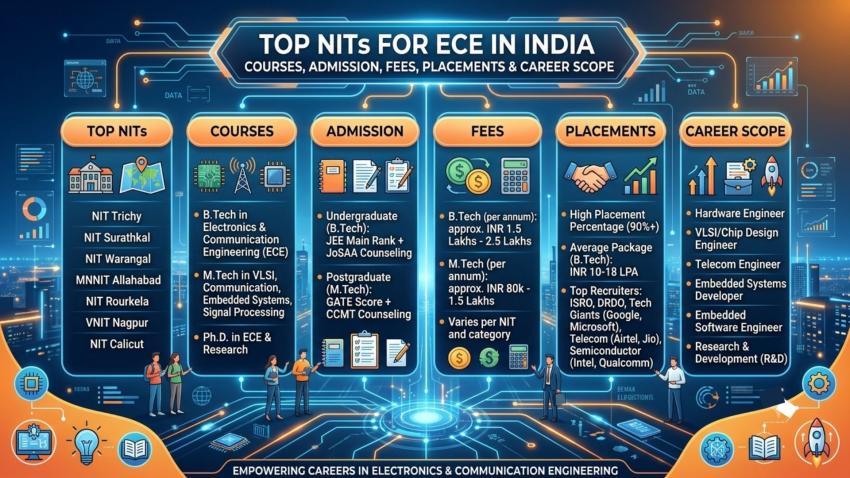
National Institutes of Technology, commonly known as NITs, are among the most sought-after engineering institutes in India. For students interested in Electronics and Communication Engineering, NITs provide opportunities to study electronics, communication systems, embedded systems, VLSI, signal processing, semiconductor technology and related fields.
NITs are centrally funded technical institutes that admit students primarily through JEE Main and the JoSAA counselling process. Several NITs have established Electronics and Communication Engineering departments with dedicated laboratories, research facilities, technical clubs and industry interaction.
Choosing the right NIT for ECE requires looking beyond the overall institute ranking. Students should compare the ECE curriculum, placement performance, fees, admission cutoffs, laboratories, internships, faculty, research opportunities and location.
This guide covers some of the top NITs for ECE in India and explains what students should consider before making their college choice.
Top NITs for ECE in India
Some of the prominent NITs offering Electronics and Communication Engineering or closely related programmes include:
NIT Tiruchirappalli
NIT Karnataka, Surathkal
NIT Rourkela
NIT Warangal
NIT Calicut
NIT Delhi
NIT Allahabad
NIT Kurukshetra
NIT Jaipur
NIT Durgapur
The exact programme name and curriculum can differ between institutes. Students should therefore check the latest official admission brochure and department website before applying.
NIRF Engineering rankings can be used as one reference point when comparing institutes, but NIRF does not provide a separate ECE branch ranking. A student's final comparison should therefore include programme-level information as well.
1. NIT Tiruchirappalli
National Institute of Technology Tiruchirappalli, commonly known as NIT Trichy, is one of India's prominent NITs and has a well-established Electronics and Communication Engineering department.
The institute's ECE programme covers a broad range of subjects, including mobile communication, digital signal processing, microwave and optical communication, computer networks, VLSI, embedded systems, IoT, machine learning and ASIC design.
This combination allows students to develop both hardware and software-related technical skills.
ECE at NIT Trichy
The ECE department provides opportunities to explore areas such as:
Digital electronics
Analog electronics
Communication systems
Wireless communication
Signal processing
VLSI
Embedded systems
IoT
Computer networks
Microwave engineering
Optical communication
ASIC design
The department also has research activity in communication systems, wireless networks, signal and image processing, RF and microwave engineering, antennas, optical communication, photonics and VLSI.
Admission to NIT Trichy ECE
Admission to the B.Tech ECE programme is primarily through JEE Main followed by JoSAA counselling.
Eligible candidates may also participate in CSAB counselling after the JoSAA rounds, depending on the applicable rules for that admission year.
Placements
Placement statistics should always be checked according to the year and branch.
NIT Trichy's ECE department has reported strong placement outcomes in recent placement cycles, making it an important institute for students targeting both core electronics and technology careers.
Students should compare ECE-specific placement figures rather than relying only on the institute-wide highest package.
2. NIT Karnataka, Surathkal
National Institute of Technology Karnataka, commonly called NIT Surathkal or NITK, is another well-known NIT for Electronics and Communication Engineering.
The institute's ECE programme covers electronics, communication systems, signal processing, digital systems, embedded systems and related technologies.
NITK's location in Karnataka also provides students with proximity to a major technology and engineering ecosystem.
ECE curriculum
Students can explore areas such as:
Electronic circuits
Digital electronics
Communication engineering
Signal processing
Embedded systems
VLSI
Wireless communication
Computer networks
Microprocessors
RF engineering
Students can also participate in technical clubs, projects, internships and research activities.
Admission
Admission to NITK B.Tech programmes is primarily through JEE Main and JoSAA counselling.
Students should check the latest JoSAA seat matrix and eligibility requirements before selecting the programme.
Placements
ECE graduates can pursue roles in semiconductor companies, electronics companies, communication companies, technology firms and software organizations.
Recent ECE placement data has included average and median salary figures that are useful when comparing NITs, but students should always check the latest official placement report for the relevant academic year.
3. NIT Rourkela
NIT Rourkela is a major technical institute in Odisha and offers Electronics and Instrumentation and related electronics programmes alongside other engineering disciplines.
Students interested in electronics should carefully check the institute's current programme structure because programme names and branch offerings may differ from the traditional ECE structure found at other NITs.
The institute provides opportunities across electronics, communication, instrumentation, embedded systems, control and related technologies.
Career opportunities
Students can explore:
Embedded systems
Electronics design
Instrumentation
Communication systems
Signal processing
Control systems
Semiconductor technology
Software development
NIT Rourkela also provides a research-oriented academic environment, with opportunities for undergraduate projects and higher studies.
4. NIT Warangal
NIT Warangal is one of the established NITs and is a popular destination for engineering aspirants.
Its Electronics and Communication Engineering programme provides students with a foundation in electronics, communication and digital technologies.
What can ECE students study?
Typical areas include:
Analog circuits
Digital circuits
Communication systems
Digital signal processing
Microwave engineering
Antenna systems
Embedded systems
VLSI
Wireless communication
Computer networks
The programme can prepare students for careers in both core electronics and software-related technology roles.
Admission and placements
Admission is primarily through JEE Main followed by JoSAA counselling.
Placement performance can vary by year and branch. Students should examine the latest ECE placement statistics, internship opportunities and recruiter information before making a decision.
5. NIT Calicut
National Institute of Technology Calicut is another important NIT for students considering Electronics and Communication Engineering.
The institute offers an established engineering environment and opportunities in electronics, communications, embedded systems and related areas.
ECE career areas
Graduates can work toward careers in:
Electronics engineering
Embedded systems
Communication engineering
VLSI
Signal processing
Semiconductor technology
Software engineering
Research and development
Students can also pursue postgraduate education in specialized areas such as VLSI, communication systems, signal processing and microelectronics.
6. NIT Delhi
NIT Delhi is a relatively newer NIT compared with institutions such as NIT Trichy and NIT Warangal, but it has expanded its academic and infrastructure capabilities.
The institute offers Electronics and Communication Engineering at the undergraduate level.
Students interested in ECE can explore electronics, communication systems, digital technologies and related areas.
Why consider NIT Delhi?
Its location provides proximity to Delhi's large technology, government, research and corporate ecosystem.
Students can explore internships and projects across:
Electronics
Communication
Embedded systems
Software
IoT
VLSI
Research and development
Admission is primarily based on JEE Main followed by JoSAA counselling.
7. NIT Allahabad
Motilal Nehru National Institute of Technology Allahabad, commonly called MNNIT Allahabad, is an important engineering institute in Uttar Pradesh.
Its Electronics and Communication Engineering programme provides students with exposure to electronics and communication technologies.
The curriculum can include areas such as:
Digital electronics
Analog electronics
Communication systems
Signal processing
Microprocessors
Embedded systems
VLSI
Wireless communication
Students can also participate in technical projects and research activities.
Admission
B.Tech admission is primarily through JEE Main and JoSAA counselling.
Students should check the current programme-specific closing ranks and seat availability before applying.
8. NIT Kurukshetra
National Institute of Technology Kurukshetra offers Electronics and Communication Engineering and has an established engineering education ecosystem.
The programme combines electronics fundamentals with communication and digital technologies.
Areas students can explore
ECE students can develop knowledge in:
Electronic circuits
Digital systems
Communication engineering
Signal processing
Embedded systems
Microprocessors
VLSI
Wireless communication
The programme can lead to opportunities in core electronics as well as software and technology companies.
NIT Kurukshetra also provides opportunities for technical projects, internships and postgraduate studies.
9. Malaviya National Institute of Technology Jaipur
Malaviya National Institute of Technology Jaipur, commonly known as MNIT Jaipur, is one of India's established NITs.
The institute offers Electronics and Communication Engineering and provides students with exposure to electronics, communication, signal processing and related engineering fields.
ECE at MNIT Jaipur
Students can explore areas such as:
Digital communication
Electronics
Signal processing
Microwave engineering
Embedded systems
VLSI
Wireless communication
Computer networks
The institute's location in Jaipur also provides access to a growing technology and industrial ecosystem.
Admission is generally through JEE Main followed by JoSAA counselling.
10. NIT Durgapur
National Institute of Technology Durgapur is another established NIT offering Electronics and Communication Engineering.
The programme covers the fundamentals of electronics and communication while providing opportunities to develop practical and technical skills.
Students can explore:
Digital electronics
Analog electronics
Communication systems
Signal processing
Embedded systems
VLSI
Microwave engineering
Wireless technologies
Graduates can pursue careers in electronics, telecommunications, semiconductor-related fields, software and research.
NIT ECE Admission Process
For most NITs, the undergraduate admission process follows a common pathway.
Step 1: Appear for JEE Main
Students interested in NIT B.Tech programmes generally need to appear for JEE Main.
Eligibility requirements are determined according to the rules applicable for the admission year.
Step 2: Register for JoSAA Counselling
After JEE Main results are announced, eligible candidates participate in JoSAA counselling.
Students submit their preferred institutes and programmes in order of preference.
Step 3: Choose ECE carefully
When filling choices, students should check the exact programme name.
Some institutes may use:
Electronics and Communication Engineering
Electronics and Instrumentation Engineering
Electronics and Electrical Communication Engineering
Electrical Engineering
Other related programme names
Do not assume that two programmes with similar names have identical curricula.
Step 4: Seat allotment
JoSAA conducts multiple counselling rounds.
Seat allocation depends on factors such as rank, category, preferences, seat availability and applicable counselling rules.
Step 5: CSAB counselling
After JoSAA, CSAB may conduct additional counselling for eligible candidates and vacant seats.
Students should consult the official CSAB notification for the relevant admission year.
NIT ECE Fees
The total cost of studying ECE at an NIT depends on the institute and the student's circumstances.
Major expenses can include:
Tuition fees
Hostel fees
Mess charges
Examination fees
Institute fees
One-time admission charges
Other student services
Fee waivers and scholarships may also be available for eligible students.
Before applying, students should download the latest fee structure from the official institute website rather than relying on older articles.
NIT ECE Cutoff
The ECE cutoff varies every year.
It can depend on:
JEE Main rank
Category
Home state quota
Other state quota
Gender-neutral or applicable seat pool
Counselling round
Seat availability
Candidate preferences
For this reason, there is no single permanent "NIT ECE cutoff."
Students should compare previous JoSAA opening and closing ranks for the specific NIT, category and counselling round.
A student should also consider multiple NIT options instead of focusing on only one institute.
NIT ECE Placements
Placements are an important consideration for ECE students.
However, placement figures should be interpreted carefully.
An institute may report its overall average package, while another may publish department-specific ECE data.
When comparing NITs, check:
ECE average salary
ECE median salary
Placement percentage
Number of students registered
Number of students placed
Internship opportunities
Core electronics recruiters
Semiconductor recruiters
Software recruiters
Year of the placement report
The highest package alone does not provide a complete picture of placement opportunities.
Career Options After ECE at an NIT
An ECE degree can lead to several career paths.
VLSI Engineer - VLSI professionals work on integrated circuit design and semiconductor technologies.
Students interested in this field should develop knowledge of digital logic, computer architecture, Verilog, SystemVerilog and VLSI design concepts.
Embedded Systems Engineer - Embedded engineers work on hardware and software systems used in automobiles, consumer electronics, medical devices, industrial equipment and other products.
Communication Engineer - Communication engineers can work in wireless communication, RF systems, networking, optical communication and telecommunications.
Semiconductor Engineer - ECE graduates can pursue semiconductor-related roles involving chip design, verification, testing and other areas of the semiconductor ecosystem.
Software Engineer - ECE students can also enter software roles by developing strong programming and computer science fundamentals.
Important skills include:
C++
Python
Data structures
Algorithms
Operating systems
Computer networks
Databases
Research and Higher Studies - Students interested in research can pursue M.Tech, MS or PhD programmes in areas such as:
VLSI
Microelectronics
Communications
Signal processing
Semiconductor technology
Embedded systems
Wireless systems
Skills ECE Students Should Develop
The NIT curriculum provides a foundation, but students should build practical skills alongside their academic studies.
Programming - Learn at least one strong programming language and develop problem-solving skills.
C and C++ are particularly useful for embedded systems and hardware-oriented careers, while Python is widely used for automation, data processing and machine learning.
Electronics - Understand:
Analog circuits
Digital circuits
Electronic devices
Microprocessors
Microcontrollers
Communication systems
Hardware description languages - Students interested in VLSI should consider learning Verilog or SystemVerilog.
Embedded systems - Students interested in embedded careers should learn microcontrollers, communication protocols, sensors and real-time systems.
Projects - Build practical projects rather than relying entirely on theoretical coursework.
Examples include:
IoT devices
Robotics projects
Embedded systems
FPGA projects
Communication systems
Sensor networks
Smart devices
How to Choose the Right NIT for ECE
Before selecting an NIT, compare the following factors.
Programme curriculum - Check whether the curriculum matches your career goals.
- For VLSI, look for microelectronics and chip design subjects.
- For communications, look for wireless systems, RF, antennas and signal processing.
- For embedded systems, look for microcontrollers, embedded programming and hardware design.
Placement data - Prefer branch-specific placement information whenever it is available.
Look at median and average salary rather than only the highest package.
Faculty and research - Check the research interests of ECE faculty members and the laboratories available to undergraduate students.
Internships - Look at internship opportunities and the types of companies and organizations where students have worked.
Fees - Compare total tuition, hostel and living costs.
Location - Location can influence internships, industry exposure and networking opportunities.
Cutoff - Review previous JoSAA opening and closing ranks for your category and preferred programme.
NIT ECE vs Other Engineering Branches
Students often compare ECE with CSE, Electrical Engineering and other branches.
ECE provides a combination of electronics, communication and computing concepts.
CSE focuses more heavily on programming, algorithms, software systems and computer science.
Electrical Engineering covers areas such as electrical machines, power systems, control and electrical networks, while also overlapping with electronics in some institutes.
The best branch depends on the student's interests and intended career path.
Students who enjoy both hardware and software may find ECE particularly interesting because it provides exposure to both areas.
Frequently Asked Questions
- Which NIT is good for ECE?
Several NITs offer established ECE programmes, including NIT Trichy, NIT Surathkal, NIT Warangal, NIT Calicut, MNNIT Allahabad, NIT Kurukshetra, MNIT Jaipur and NIT Durgapur.Students should compare curriculum, placement data, fees, cutoff and location rather than relying on a single ranking. - Is ECE available in all NITs?
Many NITs offer Electronics and Communication Engineering or closely related electronics programmes, but the exact programme availability varies by institute.
Always check the current JoSAA programme list before selecting your choices. - How can I get ECE in an NIT?
Students generally need to appear for JEE Main and participate in JoSAA counselling.
The required rank depends on the NIT, category, counselling round and seat type. - Is ECE a good option for semiconductor careers?
ECE provides a relevant foundation for semiconductor careers because students can study electronics, digital systems, electronic devices, VLSI and related subjects.
Students targeting semiconductor jobs should also develop practical skills in digital design, HDL, VLSI and semiconductor technologies. - Can ECE students get software jobs?
Yes. ECE graduates can apply for software roles if they develop programming, data structures, algorithms and other computer science skills. - What is the NIT ECE cutoff?
There is no single NIT ECE cutoff. The closing rank varies by institute, category, home state, seat type, counselling round and admission year. - Which entrance exam is required for NIT ECE?
JEE Main is the primary entrance examination for NIT undergraduate engineering admissions, followed by JoSAA counselling. - Are NITs good for ECE?
NITs have established engineering departments, laboratories, technical clubs and placement ecosystems. The experience can differ between institutes, so students should compare the specific ECE programme and recent placement information.
Conclusion
NITs are important destinations for students interested in Electronics and Communication Engineering in India.
Institutes such as NIT Trichy, NIT Surathkal, NIT Warangal, NIT Calicut, MNNIT Allahabad, NIT Kurukshetra, MNIT Jaipur and NIT Durgapur provide opportunities to study electronics and communication technologies.
However, choosing an NIT should involve more than looking at the institute name or ranking.
Students should check the exact ECE programme, curriculum, admission cutoff, fees, laboratories, internships, research opportunities and branch-specific placement information.
For students interested in VLSI, embedded systems, semiconductor technology, communication engineering or electronics, the curriculum and practical exposure are particularly important.
The admission route for most NITs begins with JEE Main and continues through JoSAA counselling, while eligible students may also consider CSAB counselling for subsequent seat allocation.
Before making a final choice, always verify the latest information from the official institute, JoSAA and CSAB websites because admission rules, fees, programmes, cutoffs and seat availability can change from year to year.
For students exploring ECE as a career option, comparing NITs with IITs, BITS Pilani, DTU and other engineering institutes can provide a broader view of available academic and career pathways.