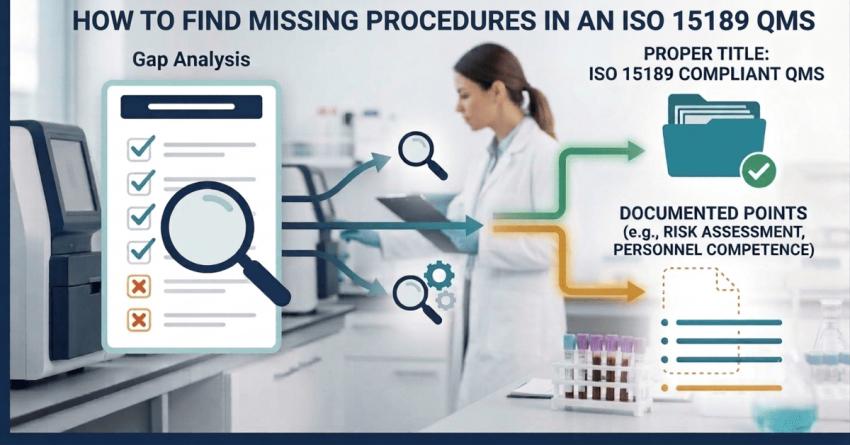
A well-documented Quality Management System (QMS) is essential for every medical laboratory seeking ISO 15189 accreditation. However, many laboratories discover during internal audits that critical procedures are incomplete, outdated, or missing altogether. These documentation gaps can result in nonconformities, inconsistent laboratory practices, and unnecessary delays in accreditation. Identifying missing procedures early helps improve compliance, operational consistency, and the reliability of patient results.
Why do laboratories have missing procedures?
Missing procedures often develop gradually as laboratories expand testing services, introduce new equipment, or modify workflows without updating their documentation. While day-to-day operations continue to evolve, the documented QMS may no longer reflect actual laboratory practices.
Common areas where documentation gaps appear include risk management, personnel competence, equipment maintenance, document control, corrective actions, and management review. A structured review of laboratory documentation helps ensure that every critical activity is supported by an approved and controlled procedure.
5 Practical Steps to Identify Missing Procedures
1. Review the standard clause by clause
Start by comparing your existing documents with every applicable requirement of ISO 15189:2022. A clause-wise compliance matrix makes it easier to verify whether each requirement is covered by a quality manual, procedure, SOP, or supporting form.
2. Observe actual laboratory workflows
Walk through pre-examination, examination, and post-examination processes with laboratory staff. If employees perform activities that are not described in documented procedures, those tasks should be formally documented to maintain consistency and traceability.
3. Analyze internal audit findings
Repeated audit observations usually indicate weaknesses in the documentation system rather than isolated mistakes. Reviewing trends in internal audits helps identify procedures that require revision or need to be created for better compliance.
4. Check supporting records and forms
Every documented procedure should generate appropriate records. Calibration logs, training records, equipment maintenance reports, and corrective action forms should all correspond to documented processes. Missing records often reveal incomplete procedures.
5. Involve both technical and quality teams
The most effective documentation reviews combine technical expertise with quality management knowledge. Collaboration ensures that procedures remain practical, compliant, and aligned with real laboratory operations.
Essential procedures every laboratory should review
When evaluating your ISO 15189 QMS, prioritize procedures that directly support accreditation and quality performance. These include document and record control, personnel competence and training, equipment calibration and verification, sample handling, examination and reporting processes, corrective action, risk management, complaint handling, internal audits, and management reviews. Regularly reviewing these areas reduces documentation gaps and strengthens overall laboratory performance.
Simplify documentation without starting from scratch
Developing an entire documentation system internally can require significant time and resources. Many laboratories choose editable templates that provide a structured foundation while allowing customization for their own scope and testing activities.
The ISO 15189 procedures documentation package includes a quality manual, mandatory procedures, SOPs, audit checklists, forms, templates, and clause-wise compliance support. Because the documents are fully editable in Microsoft Word, laboratories can efficiently adapt them to their departments, processes, and accreditation requirements.
It helps laboratories reduce documentation time, improve implementation consistency, strengthen audit readiness, and accelerate preparation for ISO 15189 accreditation with confidence.
Conclusion
Finding missing procedures in an ISO 15189 QMS is more than an accreditation exercise—it is a proactive way to improve laboratory quality and patient safety. Regular document reviews, workflow verification, and internal audits help identify gaps before they become nonconformities. By maintaining complete and up-to-date procedures, medical laboratories can strengthen compliance, improve operational consistency, and build a more effective quality management system.