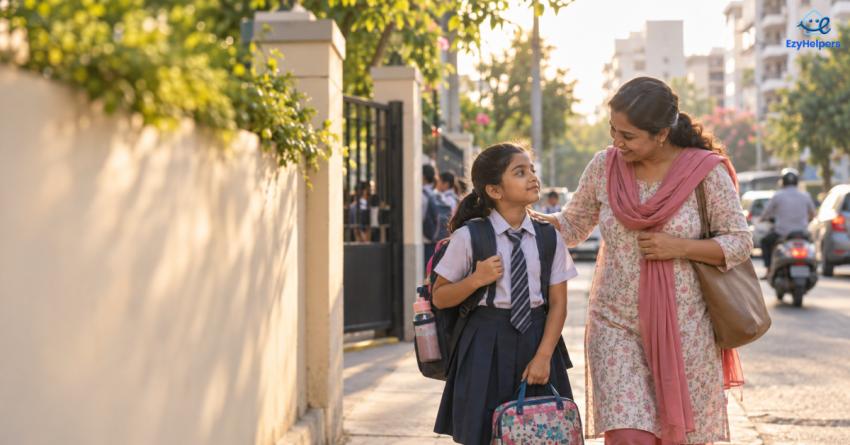
It is 3:10 PM outside a school gate in HSR Layout. The last bus has left. One child is still sitting on the step, bag between his knees, waiting for someone. His mother is stuck near Silk Board, and her meeting overran by twenty minutes.
Nobody plans for this. It just happens, week after week, in a city where school hours end at 3 and office hours end somewhere between 6 and 8.
If you are looking for a short answer: a nanny in Bangalore is most useful for the gap between school closing and parents reaching home. For children aged three and above, a trained babysitter handles pickup, lunch, homework, play, and evening routine until a parent takes over. Families usually choose between part-time, full-time, and live-in arrangements depending on how long that gap actually is.
What Is the 3 PM Gap, and Why Is It Worse in Bangalore?
The gap is simple to describe. School lets out around 3 PM. A working parent gets home closer to 7 or 8. That leaves four to five hours a day, five days a week, when a child needs an adult and there is not one.
In smaller cities, grandparents or neighbours fill that space. Bangalore is different. Most families here moved for work. Parents are in Kerala, Bihar, or Punjab. Neighbours are also at work. The apartment corridor is empty at 4 PM.
Add traffic that nobody can predict, and the gap stretches. A 40-minute commute becomes 90 minutes twice a month because of rain in Bellandur or a road closure in Marathahalli. That unpredictability is the real problem. A child cannot be told to simply wait longer.
What Does a Nanny Actually Do for School-Age Children?
There is a common idea that babysitting services are only for infants. That is not how most Bangalore families use them. The bigger demand is for children between three and twelve years old, who are independent enough to talk and play but far too young to be alone.
A child caregiver for this age group usually handles:
School pickup or receiving the child from the bus at the gate
Changing, washing up, and a proper lunch instead of biscuits
Homework supervision and reading time
Structured play, drawing, or outdoor time in the apartment park
Escorting the child to skating, music, or tuition classes
Screen time limits agreed with parents
Evening bath, dinner, and settling the child before bedtime
Notice what is not on that list. A nanny is not a tutor and is not a replacement parent. The job is safe supervision and a steady routine, so the child is not spending five hours on a tablet waiting for the door to open.
Families who want this arranged properly often start by comparing what different nanny and babysitter services in Bangalore actually include, because the scope varies a lot between one provider and the next.
Part-Time, Full-Time, or Live-In: Which One Fits?
This is where most parents get stuck, so here is a plain comparison.
A part-time babysitter works a fixed slot, usually 3 PM to 8 PM. This suits families where one parent has some flexibility, or where a grandparent is around in the mornings. It is the lowest-cost option and covers exactly the gap.
A full-time nanny works a longer day, often 8 to 10 hours, and may also handle the child's laundry, room, and meals. This suits families with two children, or with a younger child at home who does not go to school yet.
A live-in nanny stays with the family. This is the choice for parents who travel for work, do night shifts, or have unpredictable hours. It removes the daily arrival risk completely, because nobody is stuck in traffic. It also needs a separate room and a clear understanding of off-duty hours, which matters more than most families expect.
There is no correct answer. There is only the honest answer about your own week. Count how many days last month you got home after 7 PM. That number decides this.
What Does It Cost in Bangalore?
Costs move with locality, hours, experience, and language. As a rough guide from what families in the city commonly report:
Part-time babysitter, four to five hours a day: around 12,000 to 18,000 rupees a month
Full-time day nanny, eight to nine hours: around 18,000 to 26,000 rupees a month
Live-in nanny with room and food: around 22,000 to 32,000 rupees a month
Treat these as starting points, not fixed rates. A caregiver who speaks English and has experience with special needs children will cost more, and reasonably so. Always confirm current rates directly, and clarify whether festival bonus, weekly off, and overtime are included before anyone starts.
How Do You Check If a Babysitter Is Safe?
This is the part parents worry about most, and the worry is fair. You are handing over your child and your house keys.
Verification should cover four things. Government photo ID with an address that can be checked. A police verification or background check on record. At least two references from previous families, called by you, not just shown to you. And basic health checks, because someone spending eight hours near your child should be free of contagious illness.
Beyond documents, run a paid trial of three to five days while you are still at home or working from home. Watch how the caregiver responds when the child refuses food or throws a tantrum. Patience under pressure tells you more than any certificate.
Ask direct questions in the first meeting. What would you do if my child falls and there is bleeding? Do you know how to reach the nearest clinic from here? What would you do if a delivery person rings the bell? The answers do not need to be perfect. They need to be calm and sensible.
Also agree on what is written down. Working hours, weekly off, salary date, notice period, and what happens if the caregiver falls sick. A one-page written understanding prevents 90 percent of arguments later.
Helping Your Child Adjust
Children take time to accept a new adult, and that is normal, not a warning sign.
Introduce the babysitter while you are present, for two or three short sessions. Let your child show the caregiver their toys and their room. Keep your own routines separate and protected, such as bedtime stories or Sunday breakfast, so the child knows where the emotional centre still is.
If your child becomes attached to the caregiver, that is a good outcome. It means the child feels safe. It does not mean they love you less.
When One Person Is Not Enough
Some households find the child is settled, but the house is falling apart. Meals, laundry, and cleaning still pile up on the weekend. In those cases, families often split the roles, keeping a dedicated caregiver for the child and separate live-in household help in Bangalore for cooking and cleaning. Mixing both jobs into one person usually means the child gets less attention than promised.
Closing Thought
The 3 PM gap is not a parenting failure. It is a scheduling problem created by a city where work and school run on different clocks.
A good nanny in Bangalore closes that gap with something simple and undramatic: a familiar adult at the gate, a hot lunch, homework done before dark, and a child who is not waiting alone. If you are trying to work out which arrangement suits your family, it helps to read through the different childcare options available across Bangalore before you start interviewing.
Then ask yourself the only question that matters. Where is my child at 4 PM tomorrow?