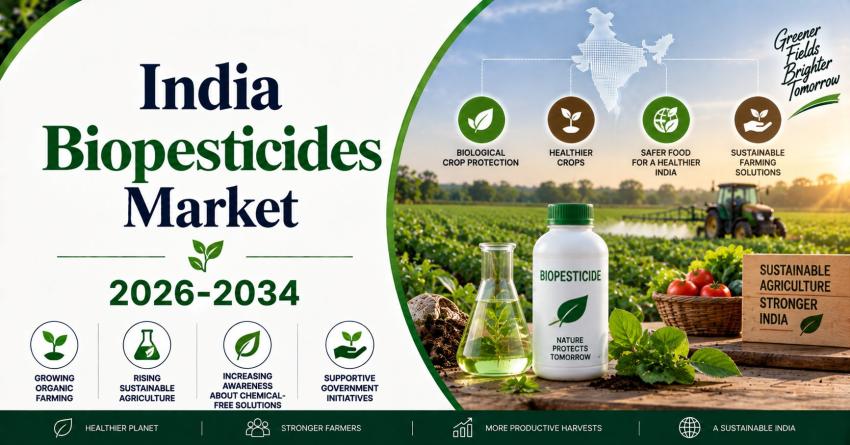
India Biopesticides Market Outlook
The market is expanding on rising organic farming adoption, strong government support, and increasing awareness of sustainable agriculture practices. Accelerating demand for residue-free agricultural produce, mounting pressure to reduce synthetic chemical dependency, and expanding government incentive programs are collectively shaping the market across crop categories.
Advancements in integrated pest management (IPM) and eco-friendly formulations are further shaping growth, ensuring long-term adoption. Government subsidies, stricter food-export residue regulations, and farmer education programs are creating a compelling structural environment for the biopesticides market in India.
Market Snapshot
- Market Size (2025): USD 286.78 Million
- Market Size (2026): USD 316.86 Million
- Forecast Market Size (2034): USD 703.81 Million
- CAGR (2026–2034): 10.49%
- Leading Mode of Application: Foliar Application — 42.0% share
- Leading Source: Microbial — 64.0% share
- Leading Region: North India — 29.0% share
- Key Growth Drivers: Organic farming, government support, chemical restrictions, IPM adoption
India Biopesticides Market Key Drivers
- Rising Demand for Residue-Free Agricultural Produce:
Growing domestic consumer preference for pesticide-safe food is compelling farmers and exporters to adopt biopesticide-based crop protection programs that meet residue compliance standards without compromising efficacy.
- Government Incentive Programs and Organic Farming Mandates:
Central and state government programs are actively incentivizing bio-input adoption among smallholder farmers. As per IMARC Group, India's organic farming market size was valued at USD 6,133.68 Million in 2025, and these programs provide subsidized access to biopesticide products, reducing adoption cost barriers.
- Expanding IPM Adoption Across Crop Systems:
The nationwide scale-up of IPM programs through Krishi Vigyan Kendras (KVKs) and state agricultural universities is systematically training farmers in biopesticide use, creating structured demand across rice, wheat, cotton, and vegetable cultivation.
- Cost-Competitive Domestic Manufacturing:
India has developed a robust domestic manufacturing base for microbial biopesticides, with production costs significantly lower than import-equivalent chemical pesticides for specific pest targets, enabling price-competitive positioning across Tier-2 and Tier-3 distribution.
India Biopesticides Market Emerging Trends
- Transition from Single-Organism to Multi-Strain Consortia Products:
Manufacturers are moving toward multi-strain consortia products combining bacterial, fungal, and biochemical actives to deliver broader pest and disease spectrum coverage, reducing applications required per season.
- Digital Agronomy Platforms Driving Biopesticide Adoption:
Agri-tech platforms providing AI-powered crop advisory services are increasingly recommending biopesticide protocols as default crop protection choices, creating structured digital demand channels.
- Export-Oriented Organic Supply Chain Development:
Rising international demand for residue-free produce is compelling organized farmer producer organizations (FPOs) and agri-exporters to formalize biopesticide-based production protocols as part of global food safety compliance.
- Shelf-Life Extension Technologies Expanding Rural Reach:
Microencapsulation, oil dispersion formulation, and wettable granule formats are significantly extending shelf lives under ambient storage, addressing cold-chain dependency and enabling deeper rural retail penetration.
India Biopesticides Market Challenges
Despite strong growth momentum, the biopesticides market in India faces several structural headwinds:
- Shorter shelf life compared to synthetic pesticides increases storage and logistics costs, particularly in rural markets with limited cold chain infrastructure
- Inconsistent product quality and efficacy across manufacturers can erode farmer confidence relative to well-established chemical alternatives
- Limited awareness among smallholder farmers about application techniques and IPM integration slows adoption beyond early-adopter communities
- Fragmented CIBRC regulatory approval timelines limit the speed at which innovative products reach the market
Govt. Initiavties
- Government incentive programs and organic farming mandates are actively subsidizing bio-input adoption among smallholder farmers, reducing first-time cost barriers
- The Central Insecticides Board and Registration Committee (CIBRC) governs registration and regulatory approval pathways for new biopesticide formulations
- Krishi Vigyan Kendras (KVKs) and state agricultural universities are scaling up Integrated Pest Management (IPM) training nationwide, systematically building farmer adoption
- In June 2025, Haryana's Chief Minister announced new natural and organic produce markets in Gurugram and Hisar to advance large-scale natural farming and farmer education
India Biopesticides Market Segment Insights
By Source
- Microbial — 64.0% (dominant; bacteria, fungi, viruses, nematodes)
- Biochemical — 36.0% (plant extracts, pheromones, mineral-based formulations)
By Mode of Application
- Foliar Application — 42.0% (most common; compatible with conventional spray equipment)
- Seed Treatment — 30.0% (fast-growing; targeted protection at germination)
- Soil Treatment — remainder (for soil-borne pests and nematodes)
By Type and Crop Type
- Bioinsecticides, Biofungicides, Bionematicides, and Others form the type segmentation
- Cereals, Oilseeds, Fruits and Vegetables, and Others form the crop type segmentation, with fruit and vegetable cultivation driving export residue compliance demand
Regional Insights
- North India — Share (2025): 29.0%
- South India — Share (2025): 27.0%, the fastest-growing region at ~11.8% CAGR through 2034
- West India — Share (2025): 24.0%
- East India — Share (2025): 20.0%
Competitive Landscape
The India biopesticides market is moderately fragmented, featuring global agri-input majors with biological portfolios alongside specialized domestic biopesticide manufacturers and emerging agri-biotech startups. Bayer AG and BASF account for a significant share of premium segment sales, particularly in formulated microbial biofungicides for export-oriented and commercial horticulture applications, while domestic manufacturers remain competitive in price-sensitive Tier-2 and Tier-3 channels.
- Bayer AG — Brand/Product: SERENADE, BioAct
Core Strength: Integrated biological and conventional crop protection portfolio with strong global R&D and registration capabilities.
- BASF — Brand/Product: Serifel
Core Strength: Biofungicide and bionematicide development backed by extensive formulation and regulatory expertise.
- Corteva — Brand/Product: Bexfond
Core Strength: Biological fungicide and bioinsecticide portfolio targeting sustainable crop protection systems.
- UPL — Brand/Product: Bioclassic
Core Strength: Broad-based biologicals platform under NPP with strong India distribution and registration network.
- Biostadt — Brand/Product: Biozyme
Core Strength: India-focused biologicals company delivering microbial biopesticides through agri-retail channels.
Recent Developments
- In July 2025, Bayer signed an exclusive distribution agreement with France-based M2i Group, granting rights to distribute pheromone-based mating disruption gel products across Asia-Pacific, Latin America, and the United States
- In June 2025, Haryana's Chief Minister announced the creation of natural and organic markets in Gurugram and Hisar to advance large-scale natural farming and educate farmers on residue-free cultivation
Investment Opportunities
- Next-Generation Microbial Strain Development: Advances in genomics and fermentation engineering are enabling high-efficacy microbial products with improved shelf stability, opening new addressable markets in commercial horticulture and export crops.
- Combination Product Formulations: Integrated biostimulant-biopesticide products are emerging as high-value segment extensions, commanding premium pricing in organic and specialty-crop segments.
- South India Growth Corridor: At approximately 11.8% CAGR, South India represents significant untapped opportunity for operators with certified organic and residue-free protocol capability, particularly in spice, grape, and mango export supply chains.
Frequently Asked Questions (FAQ)
- What is the size of the India biopesticides market?
The India Biopesticides Market size is estimated at USD 316.86 Million in 2026, driven by expanding organic farming mandates and rising demand for residue-free produce.
- What is the projected CAGR?
The market is projected to grow at a CAGR of 10.49% during 2026–2034, reaching USD 703.81 Million by 2034.
- Which source leads the India biopesticides market?
Microbial dominates with 64.0% share, anchored by Bt insecticides and Trichoderma-based fungicides with strong domestic manufacturing support.
- Which region holds the largest share?
North India commands 29.0% share, led by Uttar Pradesh, Punjab, and Haryana, supported by diverse crop systems and dense agri-input networks.
- Who are the leading companies in the India biopesticides market?
Leading companies include Bayer AG, BASF, Corteva, UPL, and Biostadt, among others.
- What are the key challenges facing the market?
Key challenges include short microbial product shelf life, cold-chain dependency, slower efficacy versus chemical alternatives, and fragmented CIBRC approval pathways.
Conclusion
The India Biopesticides Market Outlook remains strongly positive, supported by a favorable combination of government policy momentum, regulatory push, and consumer-driven demand for residue-free produce.
Companies that invest in microbial discovery, consortium formulation, and farmer education programs are best positioned to capture the largest share of the approximately USD 417 Million incremental opportunity through 2034.
Source: IMARC Group