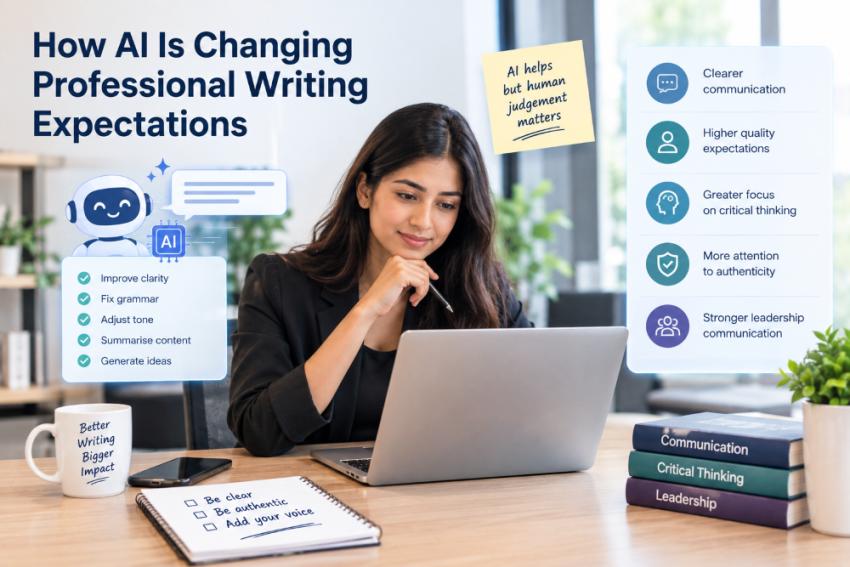
Artificial Intelligence is changing how people write at work. Emails, reports, proposals, presentations and internal communications can now be drafted or refined within seconds. Employees can use AI tools to improve grammar, organise ideas and produce clearer content. As these tools become common, professional writing expectations are also changing.
Employers may increasingly expect communication to be clear, concise and well structured. At the same time, employees are expected to bring something AI cannot easily provide: judgement, originality, context and a genuine understanding of the audience. This creates a new standard for professional writing. The question is no longer simply whether an employee can write well. It is whether they can use AI effectively while still producing accurate, meaningful and authentic communication.
The Meaning of Good Professional Writing Is Changing
Traditional professional writing focused heavily on grammar, spelling and structure. These elements remain important, but AI has made basic language correction much easier. Employees can now ask an AI tool to identify grammatical errors or improve sentence structure almost instantly. As a result, employers may place greater value on higher level writing skills.
These include:
- Understanding the purpose of a message
- Choosing the right tone
- Presenting complex ideas clearly
- Knowing what information matters
- Adapting communication to different audiences
- Making sound judgements about content
- Communicating with empathy
Good writing is therefore becoming less about producing perfect sentences and more about communicating the right message effectively.
Faster Writing Is Becoming an Expectation
AI can significantly reduce the time required to complete routine writing tasks. An employee may previously have spent an hour preparing a detailed email or report. With AI assistance, the initial draft may take only a few minutes. This creates an obvious productivity benefit. It can also change workplace expectations.
When employees have access to AI tools, managers may expect faster responses and quicker completion of written tasks. However, faster writing should not automatically mean better writing. Employees still need sufficient time to verify information, consider the audience and review the final content. Organisations should avoid creating unrealistic expectations simply because AI can produce text quickly.
Employees Are Expected to Edit, Not Simply Generate
AI can produce a first draft, but professional responsibility does not end there. Employees need to review AI assisted content before using it. A draft may contain inaccurate information, unsuitable wording or statements which do not reflect the organisation's position. Editing therefore becomes an increasingly important workplace skill.
Employees should be able to identify:
- Incorrect facts
- Missing information
- Repetitive wording
- Unnecessary explanations
- Inappropriate tone
- Unsupported claims
- Potentially misleading statements
The ability to improve AI output may become just as important as the ability to create an initial draft.
Authenticity Is Becoming More Valuable
As AI writing becomes widespread, authentic human communication may become easier to recognise. Employees who rely entirely on automated wording may produce messages which sound polished but lack personality. This can be particularly noticeable in leadership communication, client relationships and sensitive workplace discussions.
Professional writing does not need to sound artificial to be professional. A strong email can be concise while still reflecting the writer's individual voice. A manager can use AI to organise a message while adding personal observations and relevant context. The objective should be better communication, not identical communication.
Critical Thinking Matters More Than Ever
One of the biggest changes brought by AI is the growing importance of critical thinking. AI can generate an answer quickly. It cannot guarantee the answer is appropriate or correct. Employees need to question the content they receive. They should consider whether the information is relevant, accurate and suitable for the intended audience.
This becomes especially important when writing involves legal, financial, regulatory or commercially sensitive matters. An employee who accepts AI output without review may unintentionally communicate incorrect information. The consequences can range from confusion within a team to more serious business or compliance problems. AI should therefore support professional judgement rather than replace it.
Writing for Different Audiences
Professional communication is rarely one size fits all. An email to a colleague may have a different tone from a report prepared for senior management. A client proposal may require a different approach from an internal policy document. AI can help employees adjust tone and structure. However, employees still need to understand the audience.
Before using AI, a writer should consider:
- Who will read this?
- What do they already know?
- What do they need to understand?
- What action should they take?
- How formal should the communication be?
- Could any wording create confusion?
These questions require human judgement.
The Risk of Over Reliance on AI
AI can improve productivity, but excessive reliance may weaken writing ability. Employees who rarely draft their own messages may have fewer opportunities to develop their communication skills. Junior employees could be particularly affected because writing is an important part of professional development.
Writing requires practice. Employees learn by drafting, receiving feedback and improving their work. Businesses should therefore ensure AI does not remove opportunities for employees to develop independent communication abilities. Providing soft skills training for employees can help organisations strengthen communication, critical thinking, collaboration and interpersonal skills alongside responsible use of AI.
Professional Writing and Workplace Accountability
AI also raises questions about responsibility. If an employee uses AI to prepare a business email, the employee remains responsible for the final communication. The use of AI does not transfer accountability to the technology. This is especially important where written communication creates or appears to create business commitments.
Employees should carefully review messages containing:
- Contractual information
- Financial commitments
- Employee related decisions
- Client advice
- Regulatory information
- Confidential business details
- Statements about third parties
A professional writer needs to understand the content before approving it.
Confidentiality Is Part of the New Writing Standard
Professional writing increasingly involves digital tools. Employees may copy information into AI platforms while asking for assistance with drafting or editing. This can create confidentiality and data protection concerns. Organisations should establish clear policies on approved AI tools and the types of information employees may enter into them.
Employees should understand the difference between general information and confidential business material. Personal data, customer information, internal strategies and sensitive employee matters require particular care. Responsible use of AI should therefore become part of professional writing standards.
How AI Is Changing Management Expectations
Managers are also adapting to these changes. They may expect employees to communicate more quickly because AI can reduce the time required for drafting. They may also expect higher standards of structure and presentation.
However, managers should recognise the difference between productivity and quality. An employee who takes longer to review an important document may be demonstrating better judgement than one who produces a quick AI assisted draft without checking it. Management should therefore assess the quality and value of communication rather than focusing only on speed.
Leadership Writing Requires Greater Human Input
Leaders have an additional responsibility because their written communication often influences workplace culture. Announcements, feedback, organisational updates and difficult conversations require clarity and trust. Employees may quickly notice when an important message feels generic or disconnected. Leaders can use AI to prepare structures, organise information or improve readability. The final message should still reflect the leader's own judgement and understanding.
An executive leadership training programme can help senior professionals develop communication, critical thinking and decision making skills while learning how to use emerging technologies responsibly. The stronger the leadership role, the more important authentic communication becomes.
AI Can Raise the Standard for Creativity
AI has also made content creation easier. Employees can generate ideas, headlines, outlines and alternative approaches quickly. This may increase expectations around creativity.
However, generating more ideas does not necessarily produce better ideas. Employees still need to select, refine and develop concepts. Original thinking remains valuable because businesses need people who can understand problems, challenge assumptions and create solutions suited to real situations. AI can support creative thinking, but human experience remains central to meaningful professional writing.
The Future of Professional Writing
AI is likely to become a normal part of workplace writing. Employees may use AI tools as routinely as they currently use spell checkers, search engines and collaboration platforms. As adoption grows, the ability to work with AI may become an expected professional skill. However, the most valuable employees will not necessarily be those who generate the most content.
They will be those who can combine technology with strong judgement.
Future professional writing is likely to prioritise:
- Accuracy
- Clarity
- Original thinking
- Audience awareness
- Authenticity
- Critical review
- Ethical technology use
- Strong communication skills
These qualities can help employees remain effective even as AI capabilities continue to develop.
Conclusion
AI is changing professional writing expectations by making drafting, editing and content creation faster and more accessible. As basic writing tasks become easier to automate, employers may place greater importance on skills such as critical thinking, judgement, creativity and audience awareness. The role of the professional writer is therefore not disappearing. It is evolving.
Employees need to understand how AI works while retaining responsibility for the words they communicate. Businesses also need to create clear expectations around accuracy, confidentiality, authenticity and responsible technology use. The future of professional writing will not be defined by how much content AI can produce. It will be defined by how effectively people use AI while preserving the human judgement behind every important message.