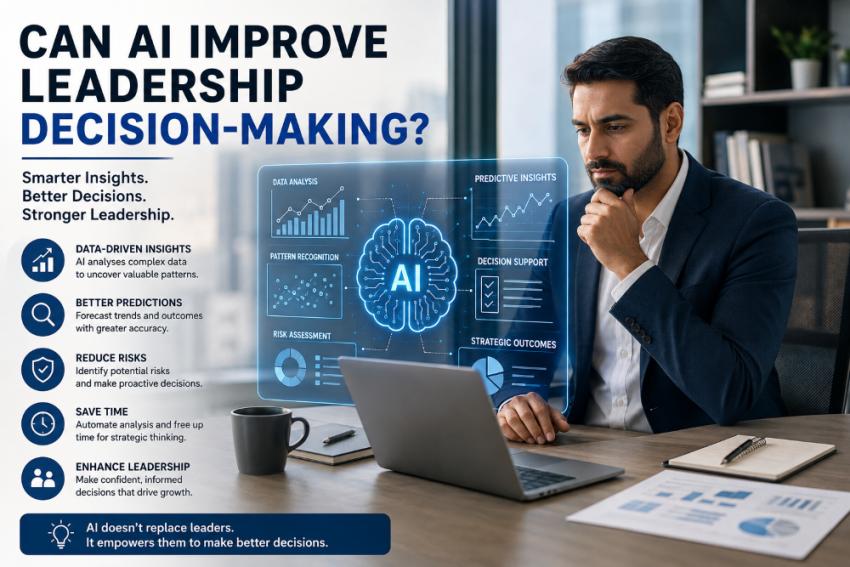
Leadership decisions often involve incomplete information, competing priorities and considerable pressure. Managers may need to assess financial data, understand customer behaviour, manage employees and respond to changing market conditions at the same time. Artificial intelligence is increasingly becoming part of this process.
AI can analyse large volumes of information, identify patterns and provide insights within a short period. These capabilities can support leaders when they need to make informed decisions. However, AI should not replace human judgement. Leadership involves ethics, empathy, context and accountability, all of which require human involvement. The real question is not whether AI can make decisions for leaders. It is whether leaders can use AI effectively to improve the quality, speed and consistency of their decision making.
How AI Supports Leadership Decision Making
Traditional decision making often depends on reports, meetings and manually analysed information. These methods remain important, but they can take considerable time. AI can process structured and unstructured data quickly. It can identify trends, compare information and highlight potential issues. This allows leaders to spend more time interpreting insights and considering strategic options.
For example, an organisation may use AI to analyse sales performance across different regions. The system could identify declining sales, changing customer preferences or unusual patterns in purchasing behaviour. A manager can then investigate the reasons behind these trends and decide how to respond. AI therefore works best as a decision support tool. It can improve access to information without taking responsibility away from the person making the final decision.
Faster Access to Business Insights
Speed is an important part of modern leadership. Delayed decisions can affect operations, customer relationships and business performance. AI tools can help leaders access relevant information more quickly. Instead of reviewing thousands of records manually, a leader may receive a summary of key trends and potential areas of concern.
This can be particularly useful in areas such as:
• Sales forecasting
• Customer behaviour analysis
• Financial planning
• Workforce planning
• Risk assessment
• Operational performance
• Market research
Faster access to information does not automatically produce better decisions. Leaders still need to assess the quality of the information and understand the context behind the results.
AI Can Help Leaders Identify Patterns
Human beings can overlook patterns when dealing with large amounts of information. AI systems are designed to identify relationships and trends within datasets. For leaders, this can provide another perspective when evaluating a business problem.
Suppose employee turnover has increased within a particular department. AI could help analyse factors such as employee feedback, tenure, workload and absenteeism. The results may help managers identify possible areas for further investigation. The AI output should not be treated as proof of a specific cause. It should be viewed as an additional source of insight. Managers must still speak with employees, examine workplace conditions and consider other relevant factors.
Improving Risk Assessment
Leadership decisions often involve risk. Entering a new market, changing suppliers, restructuring a team or adopting new technology can create uncertainty. AI can support risk assessment by examining historical information and identifying possible risk indicators. It can also help leaders compare different scenarios.
For example, a business considering expansion may use AI to analyse market trends, customer demand and competitor activity. This can help leadership teams develop a more informed understanding of potential outcomes. However, historical data cannot predict every future event. Unexpected economic, social or regulatory changes may affect the outcome. Leaders must therefore combine AI generated insights with professional judgement.
Supporting More Objective Decisions
AI can potentially reduce some forms of inconsistency in decision making. A system can apply the same analytical process to large datasets and present comparable results. This can be useful when leaders need to assess performance, identify operational problems or compare business scenarios.
However, AI itself is not automatically free from bias. If an AI system is trained using incomplete, inaccurate or biased information, its recommendations may reproduce or even amplify those problems. Leaders must therefore ask important questions before relying on an AI output.
Where did the data come from?
Is the information complete?
How was the system trained?
Are there signs of bias?
Can the recommendation be explained?
Who is responsible for reviewing the result?
These questions are essential for responsible AI supported decision making.
AI and Leadership Development
Technology can change the skills leaders need. Managers increasingly require more than traditional management knowledge. They need enough technological awareness to understand how AI systems work and where their limitations lie. They do not necessarily need to become technical specialists. They should, however, understand concepts such as data quality, algorithmic bias, privacy, security and responsible AI use.
This is one reason modern leadership development training for managers can include practical education on AI supported decision making. Managers can learn how to interpret AI outputs, challenge questionable recommendations and combine technology with human judgement. Leadership development should also focus on communication. A manager may need to explain why an AI recommendation was considered, rejected or modified. Employees need confidence in the decision making process rather than simply being told a system produced an answer.
Human Judgement Remains Essential
AI can process information efficiently, but leadership decisions often involve factors which cannot be reduced to data. Consider a decision involving an employee's performance. An AI system may identify patterns in productivity or attendance. It cannot fully understand personal circumstances, workplace relationships or the emotional impact of a managerial decision.
Similarly, a business decision may involve reputation, ethical considerations or long term relationships. These factors require human judgement. Leaders should therefore treat AI as an adviser rather than an authority. The final responsibility should remain with an accountable human decision maker.
Ethical Considerations in AI Based Decisions
The use of AI in leadership raises important ethical questions. These concerns become more significant when AI is used in areas involving employees. For example, organisations may use technology to analyse recruitment data, performance information or employee behaviour. Leaders need to consider privacy, fairness and transparency before relying on such systems.
Employees should also understand how significant decisions affecting them are made. Organisations should establish clear internal policies governing the use of AI. Good governance can help prevent technology from being used without adequate oversight.
AI Can Improve Strategic Planning
Strategic planning requires leaders to consider different possibilities. AI can help by analysing market information and modelling potential scenarios. For instance, a leadership team may want to understand how changes in customer demand could affect revenue. AI can process different assumptions and present possible outcomes. This can help leaders compare options before committing resources.
Scenario analysis can also encourage leaders to think beyond a single expected outcome. Instead of asking what will happen, leaders can consider what might happen under different circumstances. This approach can make strategic planning more flexible.
Developing AI Literacy Across Organisations
AI supported leadership should not be limited to senior executives. Managers at different levels may encounter AI tools in recruitment, customer service, finance, marketing and daily operations. Organisations should therefore consider AI literacy as part of wider professional development.
Well designed corporate employee training programmes can help employees understand responsible AI use, data protection, workplace implications and the importance of human oversight. Training also reduces the risk of employees relying blindly on automated recommendations. People should understand both the capabilities and limitations of the systems they use.
Common Mistakes Leaders Should Avoid
One common mistake is assuming AI is always accurate. AI can produce incorrect or incomplete outputs. Another mistake is using AI without checking the underlying data. Poor data can lead to poor recommendations. Leaders should also avoid allowing technology to replace conversations with employees, customers or colleagues. Data provides useful evidence, but people provide context.
A further concern is excessive reliance on automated recommendations. Leaders may become less willing to challenge an AI output if they assume the system is more objective than a human. Effective leadership requires the opposite approach. Leaders should remain curious, ask questions and challenge information when necessary.
How Leaders Can Use AI Responsibly
A practical approach is to use AI throughout the decision making process without allowing it to control the final outcome. First, define the business problem clearly. Next, identify the information required and assess its quality. AI can then be used to analyse the information and identify possible insights.
Leaders should review the output carefully and compare it with other evidence. They should consider ethical, legal and organisational implications before making a decision. Finally, the outcome should be monitored. If the decision produces unexpected results, leaders should review what went wrong and adjust the approach. This creates a continuous learning process rather than treating AI as a one time solution.
The Future of AI and Leadership
AI is likely to become increasingly integrated into management and strategic planning. As technology develops, leaders may gain access to more sophisticated forecasting, analysis and decision support tools. The most effective leaders will not necessarily be those who use the most AI. They will be those who understand when AI adds value and when human judgement should take priority.
Leadership will continue to require qualities such as accountability, emotional intelligence, critical thinking and ethical awareness. Technology can strengthen these capabilities, but it cannot replace them.
Conclusion
AI can improve leadership decision making by helping managers analyse information, identify patterns, assess risks and explore different scenarios. It can also reduce the time required to process complex information. However, AI should support leadership rather than replace it. Data can inform a decision, but responsible leaders must consider context, people, ethics and long term consequences.
The future of effective leadership will depend on combining technological capability with human judgement. Organisations that help managers develop both skills will be better positioned to use AI responsibly and make more informed decisions.