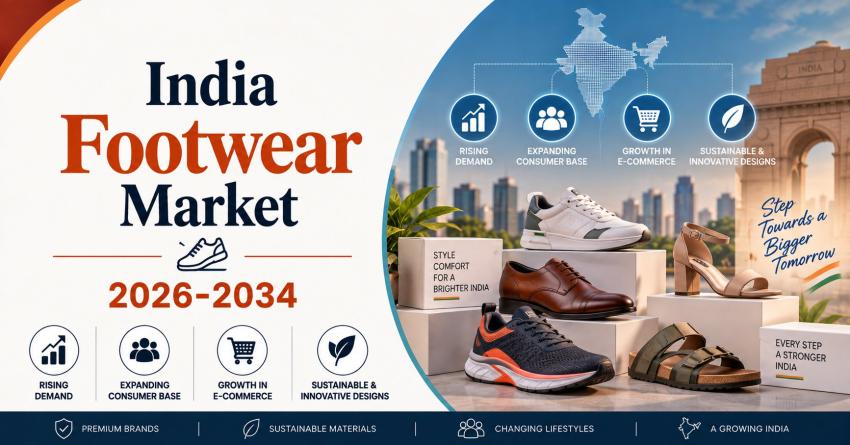
India Footwear Market Outlook
The market is driven by rapid urbanization, rising disposable incomes, and evolving consumer preferences toward fashionable and functional footwear. India ranks as the world's second-largest producer and consumer of footwear, with government PLI schemes driving manufacturing modernization and strengthening footwear brands across both domestic and export markets.
Growing e-commerce penetration, athleisure adoption, and manufacturing FDI continue to improve category economics, while demand from urban premiumization and Tier-2/3 city expansion supports market uptake. Rising private-label and D2C sustainable footwear investment, alongside expanding organized retail, is collectively accelerating growth across the footwear industry in India.
Market-At-A-Glance
- Market Size (2025): USD 20.67 Billion
- Market Size (2026): USD 22.67 Billion
- Forecast Market Size (2034): USD 47.53 Billion
- CAGR (2026–2034): 9.7%
- Leading Product: Non-Athletic Footwear — 67.64% share
- Leading Pricing Segment: Premium — 54% share
- Leading Region: North India — 35% share
Why Is the India Footwear Market Growing?
- Urbanization and Rising Disposable Incomes:
India's urban population is projected to reach 600 million by 2031, significantly expanding the addressable market and driving demand for footwear, particularly in branded and organized segments. This shift is accelerating premiumization trends, enabling deeper market penetration across Tier I and Tier II cities and pushing up the market size.
- E-Commerce Platform Expansion:
Rapid internet and smartphone penetration is transforming footwear distribution. E-commerce in India is expected to surpass US$145 billion in 2025, powered by mobile commerce and AI-driven hyper-personalization, enabling footwear brands in India to reach previously inaccessible Tier-2/3 consumers cost-effectively.
- Athleisure and Fashion Footwear Trends:
India's growing fitness awareness and youth-driven fashion preferences are fueling demand for versatile, stylish footwear. Hybrid work culture is accelerating demand for comfortable, multipurpose footwear bridging athletic and casual categories.
- Government Manufacturing Initiatives:
The Indian government's 100% FDI allowance in footwear, Production-Linked Incentive schemes, and leather cluster development programs are attracting global manufacturers and strengthening the footwear industry in India's export competitiveness.
What Are the Key Trends Shaping the India Footwear Market?
- Rise of Athleisure and Performance-Comfort Hybrid Footwear:
The convergence of athletic performance and everyday casual wear is reshaping India's footwear landscape. Lehar Footwear's 2025 launch of the RANNR brand and Campus Activewear's expanding athleisure lines reflect manufacturers pivoting toward comfort-performance hybrids targeting fitness-conscious millennials and Gen Z.
- Accelerated E-Commerce and D2C Brand Growth:
E-commerce platforms now account for a growing share of India's footwear sales, enabled by AI-driven personalization and virtual try-on features. Meesho's 2025 AI expansion demonstrates how digital-first platforms are extending accessible footwear commerce to first-time online buyers in rural India.
- Sustainable and Vegan Footwear Innovation:
Metro Brands' March 2025 shoe recycling campaign and growing adoption of plant-based materials signal a structural shift toward circular economy principles among footwear brands in India, attracting environmentally conscious consumers willing to pay above-market prices.
Government Support and Manufacturing Initiatives
FDI and PLI Framework:
- 100% FDI allowance in footwear manufacturing attracting global manufacturers
- Production-Linked Incentive schemes reducing import dependence and strengthening export competitiveness
- Leather cluster development programs supporting Agra, Chennai, and Kanpur manufacturing hubs
Manufacturing FDI and Export Hub Development:
- Hwaseung Footwear Group's USD 210 million Tamil Nadu investment in 2025, creating 20,000 jobs
- FDI inflows modernizing production infrastructure and positioning India to capture export share amid supply chain diversification
- Agra's footwear cluster contributing approximately 28% of India's total footwear exports
Segment Insights
Product Insights:
- Non-Athletic Footwear
- Athletic Footwear
Non-Athletic Footwear dominates with a market share of 67.64% of the total India footwear market in 2025.
Pricing Insights:
- Premium
- Mass
Premium exhibits clear dominance with a 54.0% share of the total India footwear market in 2025.
Regional Insights:
- North India
- South India
- West & Central India
- East India
North India dominates with a market share of 35.0% of the total India footwear market in 2025.
Competitive Landscape
The India footwear market is moderately competitive, featuring domestic champions with mass-market scale alongside premium international footwear brands in India competing across product categories, pricing tiers, and distribution channels.
Market dynamics reflect a dual structure: domestic players including Bata, Relaxo, Liberty, and Paragon hold strong mass-market positions, while Nike, adidas, and PUMA lead the aspirational athletic and premium segments of the footwear industry.
Key Opportunities for Businesses and Investors
High-Growth Areas:
- Athletic footwear at approximately 11.8% CAGR through 2034, driven by India's growing fitness culture and government Khelo India programs
- Premium segment at approximately 10.2% CAGR, capturing rising brand aspirations among India's expanding upper-middle-class cohort
- Tier-2 and Tier-3 city expansion across Lucknow, Jaipur, Coimbatore, Surat, and Indore as organized retail penetration deepens
- Sustainable and vegan footwear innovation attracting environmentally conscious urban consumers willing to pay premium prices
Strategic Opportunities:
- D2C digital brands targeting sustainable materials, customization, and women's comfort footwear niches with strong unit economics
- Manufacturing FDI continuing to flow into Tamil Nadu and Andhra Pradesh footwear clusters, supported by state government incentive packages
- Export hub development positioning India to emerge as a top-three global footwear exporter by 2034
Frequently Asked Questions (FAQ)
- What is the footwear market size in India?
The India footwear market grew from USD 20.67 Billion in 2025 to an estimated USD 22.67 Billion in 2026, and is projected to reach USD 47.53 Billion by 2034 at a CAGR of 9.7%.
- What is the projected growth rate?
The market is projected to grow at a CAGR of 9.7% during 2026–2034, adding over USD 26 Billion in incremental annual market value.
- Which product segment leads?
Non-athletic footwear dominates with a 67.64% share in 2025, while athletic footwear at 32.36% is the fastest-growing segment at approximately 11.8% CAGR.
- Which region leads the footwear industry in India?
North India leads with a 35.0% share in 2025, supported by Agra's manufacturing clusters, which contribute approximately 28% of India's total footwear exports.
- Who are the leading footwear brands in India?
Leading companies include Bata Brand, Relaxo Footwears Limited, Nike, Inc., adidas India Marketing Pvt. Ltd, PUMA India Ltd., and Campus Activewear Limited, among others.
Conclusion
India's footwear market presents a compelling multi-decade growth opportunity, underpinned by structural urbanization, expanding organized retail, and accelerating digital adoption. E-commerce and D2C brand growth, athleisure convergence, and sustainable material innovation are reshaping competitive dynamics among footwear brands in India, while manufacturing FDI and PLI incentives strengthen the country's position as a global production hub.
Organizations that invest in product innovation, omnichannel capabilities, and Tier-2/3 distribution will be best positioned to capture disproportionate value as the footwear industry in India moves toward its 2034 forecast of USD 47.53 Billion.
Source: IMARC Group