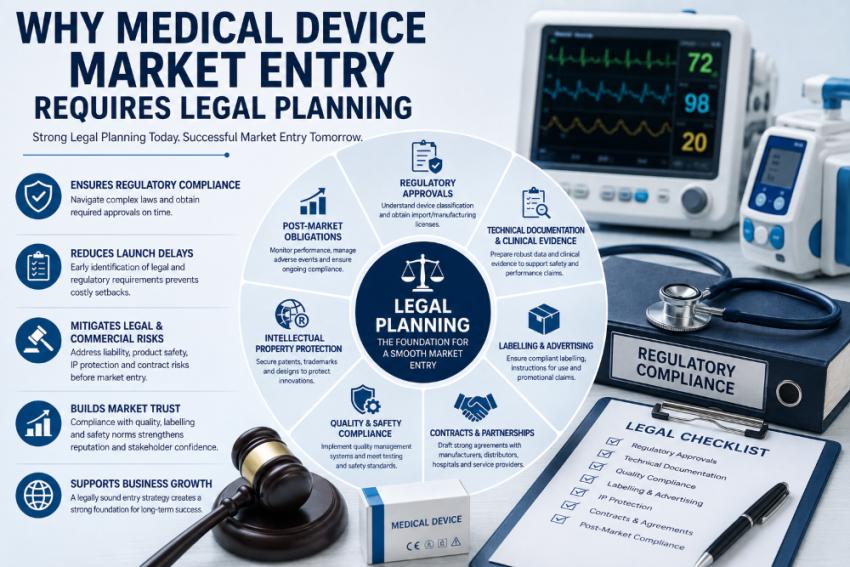
Bringing a medical device into the Indian market involves much more than product development and commercial preparation. A device may have strong clinical potential and market demand, yet its launch can still face delays if the regulatory pathway is not identified early.
India regulates medical devices through the Drugs and Cosmetics Act, 1940 and the Medical Devices Rules, 2017. The regulatory framework covers areas such as manufacture, import, sale, distribution, clinical investigation and product safety. Medical devices are also classified according to risk, which can affect the applicable regulatory requirements. For this reason, legal planning should begin well before a company starts commercialising a device. Early planning helps identify approvals, documentation, contracts and compliance obligations before they become barriers to market entry.
What Does Medical Device Market Entry Involve?
Market entry refers to the process of bringing a medical device into a particular jurisdiction for lawful commercial use.
For a company entering India, this may involve questions such as:
• Is the product regulated as a medical device?
• Which risk class applies?
• Is an import or manufacturing licence required?
• Are clinical investigations or performance evaluations necessary?
• What technical documentation must be prepared?
• What labelling requirements apply?
• Are there post market obligations?
• Does the product require additional certification?
These questions can have a direct impact on launch timelines and investment decisions. Legal planning helps connect these regulatory requirements with the company's wider commercial strategy.
Product Classification Should Come First
Product classification is one of the most important regulatory steps.
Under the Medical Devices Rules, 2017, medical devices are divided into four risk classes:
• Class A, low risk
• Class B, low moderate risk
• Class C, moderate high risk
• Class D, high risk
The classification is based on risk parameters specified under the Rules. The intended purpose of the device is also important when determining classification.
Classification can influence the regulatory pathway, licensing authority, documentation and level of scrutiny. For example, CDSCO states that manufacturing licences for Class C and Class D devices are handled by the Central Licensing Authority. Certain Class A and Class B devices follow the applicable State Licensing Authority route. A company should therefore establish its regulatory position before finalising its market entry plan.
Import Requirements Need Early Attention
International medical device manufacturers often enter India through an authorised agent, importer or local business partner. The import structure needs careful legal review. CDSCO provides an import licensing process under the Medical Devices Rules. Applications for import licences are made in Form MD 14 through the SUGAM portal, with the licence issued in Form MD 15.
The company should identify who will act as the authorised agent and understand the responsibilities of each party. Contracts should also address regulatory submissions, product quality, inspections, adverse event reporting, recalls and allocation of liability. Using an overseas approval as the sole basis for entering India can be risky. Indian regulatory requirements must be assessed independently.
Manufacturing Arrangements Can Affect Market Entry
Companies manufacturing devices in India need to consider the applicable manufacturing licence and quality requirements. The regulatory route may vary according to the device classification. Businesses should assess their manufacturing facility, technical personnel, quality systems, testing arrangements and supporting documentation before applying. Contract manufacturing creates additional considerations.
A medtech company should establish who is responsible for regulatory compliance, product testing, manufacturing records and regulatory inspections. These responsibilities should be clearly documented in the manufacturing agreement. A poorly drafted arrangement can create uncertainty when regulators raise questions about product quality or manufacturing practices.
Clinical Evidence May Be Essential
Some devices require clinical investigation or other forms of evidence before they can be marketed. The nature of the evidence depends on the product, its intended use and the applicable regulatory pathway.
Clinical planning should therefore begin during product development. A company should understand the evidence required before committing to a commercial launch date. If additional clinical work becomes necessary late in the process, the business may face significant delays and increased costs. The same principle applies to in vitro diagnostic medical devices. CDSCO regulates IVDs under the applicable medical device framework and classifies them from Class A to Class D according to risk.
Technical Documentation Supports the Regulatory Process
A medical device application can involve extensive technical information.
Depending on the product, documentation may cover:
• Product specifications
• Design information
• Risk management
• Testing results
• Safety information
• Performance evidence
• Manufacturing details
• Quality management systems
• Labelling
• Instructions for use
• Clinical information
The documentation should be consistent across regulatory submissions and commercial materials. A discrepancy between the product description in a regulatory submission and the claims made on packaging can create unnecessary regulatory questions. Maintaining a central regulatory file can make it easier to update documents when the product or applicable requirements change.
Labelling and Advertising Require Legal Review
A product can satisfy technical requirements and still face problems because of its labelling or marketing claims. Medical device companies should review product packaging, websites, brochures, sales presentations and digital advertisements before publication.
Claims should accurately reflect the intended use and supporting evidence. A company should also avoid making claims beyond the product's approved purpose or available evidence. Overstated claims can create regulatory concerns and increase the risk of complaints or disputes. Legal review at the drafting stage is usually more efficient than changing packaging and marketing campaigns after launch.
Quality Systems Are Part of Market Readiness
Market entry is not simply about obtaining a licence. The company must also be able to maintain consistent product quality. Quality management processes should cover areas such as manufacturing controls, testing, documentation, complaints and corrective actions.
Testing requirements may also involve recognised laboratories or other appropriate assessment mechanisms. CDSCO maintains information concerning medical device testing laboratories and regulatory bodies under the Medical Devices Rules. Companies should assess these requirements before production begins.
Post Market Compliance Does Not End With Launch
Obtaining regulatory permission is not the end of the compliance journey. Once a medical device reaches the market, companies may need to monitor safety and performance. They should also maintain systems for receiving complaints and responding to adverse events. CDSCO provides an adverse event reporting mechanism for medical devices and operates the Materiovigilance Programme of India.
Companies should therefore create a post market monitoring system before launch.
This can include procedures for:
• Receiving customer complaints
• Recording adverse events
• Investigating safety concerns
• Taking corrective action
• Managing recalls
• Maintaining regulatory records
A strong post market system can also help identify emerging product risks early.
Additional Standards May Apply
Not every medical device will be governed by the same set of requirements. Depending on the nature of the product, companies may need to examine additional standards and certifications.
BIS certification is generally voluntary. However, the Central Government can make compliance with specific Indian Standards compulsory for certain products through regulatory measures such as Quality Control Orders. Medical device companies should therefore check whether their particular product falls within any mandatory certification or standards framework. Other considerations may include electrical safety, wireless communication, cybersecurity, data protection and environmental obligations.
Contracts Are Part of Regulatory Planning
Market entry often involves several commercial relationships.
A company may work with:
• Local importers
• Distributors
• Contract manufacturers
• Laboratories
• Clinical research organisations
• Technology providers
• Hospitals
• Healthcare professionals
Each relationship can create legal responsibilities.
Contracts should clearly allocate responsibility for regulatory compliance, product quality, confidentiality, intellectual property, reporting, recalls, insurance and liability. A carefully structured agreement can reduce uncertainty if a product later becomes subject to a regulatory investigation or customer complaint.
Intellectual Property Should Be Protected Early
Medical devices often involve valuable technology, designs, software, brands and manufacturing processes. Before entering a new market, companies should consider whether their intellectual property is protected in India. A freedom to operate review can also be useful. A company may have a valid patent in its home country but still need to assess third party rights in India.
Trademark protection is equally relevant for the product name and brand. Intellectual property disputes can interfere with distribution and commercialisation. Early legal planning can reduce this risk.
Data Protection Matters for Connected Devices
Modern medical devices increasingly involve software, cloud platforms and connected systems. A device may collect information from patients, healthcare professionals or hospitals. The company should therefore assess how personal information is collected, stored, transferred and used.
Contracts with technology providers should address data security and responsibilities for regulatory compliance. Cybersecurity should also form part of the product risk assessment, particularly for connected devices.
Why Legal Planning Should Begin Before Launch
A common mistake is to involve legal advisers only after the product has been developed. By then, important decisions may already have been made about product design, intended use, manufacturing, clinical studies and marketing. Changing these decisions later can be expensive. Early legal planning allows the company to create a regulatory roadmap covering:
Product classification → Testing → Clinical evidence → Licensing → Manufacturing or import → Labelling → Commercial contracts → Launch → Post market compliance
This approach gives business teams a clearer understanding of regulatory dependencies. For companies entering a complex healthcare market, guidance from top life sciences law firms in India can help integrate regulatory considerations with commercial and intellectual property planning.
What Happens When Market Entry Is Not Properly Planned?
Regulatory gaps can have commercial consequences. A company may need to repeat testing, modify product documentation, change labels or postpone manufacturing. A distributor may also be unable to sell the product until the required regulatory conditions are satisfied. In more serious situations, non compliance can lead to regulatory action, product recalls or commercial disputes.
A dispute may involve regulators, manufacturers, distributors, customers or business partners. Where a regulatory issue develops into a legal dispute, advice from litigation law firms in india may become relevant to assess liability, remedies and the appropriate legal response. Prevention, however, is usually more efficient than dealing with a dispute after market entry.
A Practical Legal Planning Checklist
Before launching a medical device in India, companies should consider the following:
Classify the product- Establish its regulatory status and risk category.
Identify approvals- Determine the applicable import, manufacturing or other regulatory permissions.
Plan evidence- Identify testing, clinical and performance requirements.
Review documentation- Ensure technical and regulatory records are complete.
Check labelling- Review product information, warnings and instructions.
Assess claims- Ensure marketing statements are accurate and supportable.
Review contracts- Allocate regulatory and commercial responsibilities clearly.
Protect intellectual property- Consider patents, trademarks and other relevant rights.
Prepare for post market duties- Establish systems for complaints, adverse events and corrective action.
Monitor regulatory changes- Review the legal position as the product and regulatory framework evolve.
Conclusion
Medical device market entry is both a commercial and legal exercise. A strong product does not automatically guarantee a smooth route to market. Classification, licensing, clinical evidence, quality systems, labelling, intellectual property, contracts and post market obligations can all influence the launch process.
Legal planning should therefore begin alongside product development rather than after the product is ready for sale. For medtech companies entering India, early regulatory assessment can reduce uncertainty, prevent avoidable costs and create a clearer path towards commercialisation. More importantly, it helps ensure the device reaches the market with the legal, regulatory and operational foundations needed for long term growth.