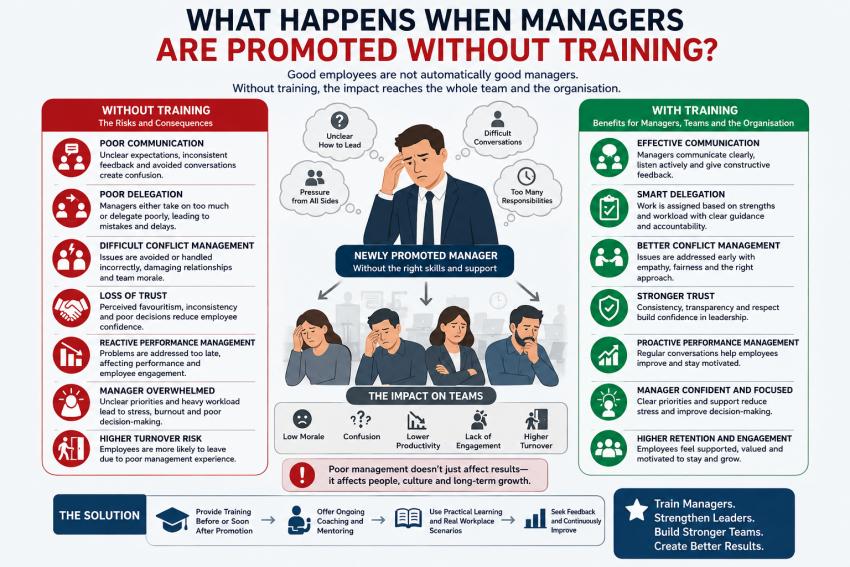
Promoting an employee into a management role is often seen as a natural step in career progression. Someone who performs well, understands the business and delivers strong results may appear ready to manage others. However, being a good employee does not automatically mean being a good manager. Management requires a different set of skills. Managers must communicate expectations, handle conflict, provide feedback, make decisions and support employee performance. They may also need to manage difficult conversations and apply workplace policies fairly. When employees are promoted without proper management training, they may struggle to adjust to these responsibilities. The impact can extend beyond the individual manager and affect team performance, employee engagement and organisational culture.
Strong Individual Performance Does Not Guarantee Management Skills
Employees are often promoted because they are successful in their existing roles. They may have strong technical knowledge, consistently meet targets or demonstrate initiative. Management, however, involves different responsibilities because a manager is no longer judged only by their own output. They become responsible for helping other people perform effectively. Without training, a newly promoted manager may continue focusing primarily on their own work and struggle to delegate tasks or provide adequate support to team members. The transition from individual contributor to manager therefore requires a change in mindset. Training can help employees understand this change before they take on significant management responsibilities.
Managers May Struggle With Communication
Communication is one of the most important management skills. Managers need to explain expectations clearly, listen to employees and provide constructive feedback. An untrained manager may communicate inconsistently, give unclear instructions, avoid difficult conversations or provide feedback only when something goes wrong. These problems can create uncertainty within a team because employees may not know what is expected from them or how their performance is being assessed. Training can give new managers practical methods for holding effective conversations, giving feedback and communicating organisational decisions with greater clarity.
Poor Delegation Can Affect Team Performance
Delegation is another area where newly promoted managers can struggle. Employees who were previously responsible for completing their own work may find it difficult to hand tasks to others. Some managers may try to complete important tasks themselves because they believe it will be faster or produce better results, while others may delegate without providing sufficient instructions or support. Both approaches can create problems because excessive involvement can lead to managerial overload, while poor delegation can cause mistakes and frustration. Managers need to understand how to assign responsibilities based on employee capability, workload and development needs. Proper training can help them build this skill.
Conflict May Become More Difficult to Manage
Workplace disagreements are common, and managers may need to deal with differences between employees, complaints about workloads or disagreements over responsibilities. Without training, a manager may avoid conflict because they are uncomfortable addressing sensitive issues or respond too quickly without understanding the underlying problem. Both responses can make a situation worse. Managers need to learn how to listen to different perspectives, remain objective and address concerns professionally. They should also understand when an issue needs to be escalated to human resources or senior leadership. Developing conflict management skills can help managers handle workplace disagreements in a more structured and balanced way.
Employee Trust Can Be Affected
Employees often expect managers to be fair, consistent and approachable. A manager who is unfamiliar with these responsibilities may unintentionally damage trust through favouritism, inconsistent application of workplace rules or poor communication. The issue may not always arise from poor intentions because a newly promoted manager may simply lack the knowledge and experience required to handle situations appropriately. Training can help managers understand the importance of consistency, transparency and professional conduct. It can also help them recognise how their behaviour influences team culture and employee confidence.
Performance Management Can Become Reactive
Managing employee performance involves more than addressing poor results. Managers need to establish clear expectations, monitor progress and provide regular feedback. An untrained manager may only respond when performance becomes a serious problem, and by this stage the employee may already be disengaged or unsure about how to improve. Effective performance management is usually more proactive, with managers holding regular discussions and addressing concerns early. Training can help new managers understand how to set expectations, document relevant concerns, provide constructive feedback and support employee improvement.
Managers May Find Difficult Conversations Challenging
Managers regularly face conversations involving performance concerns, workplace behaviour, workload and employee expectations, and these discussions can be uncomfortable. Without preparation, a manager may delay the conversation or communicate too vaguely. In other cases, they may become overly direct and create unnecessary tension. Learning how to prepare for difficult conversations can improve both the manager's confidence and the employee's understanding of the issue. Managers also need to understand the importance of maintaining professionalism during sensitive discussions. Appropriate training can help them approach these situations with greater structure, clarity and confidence.
Workplace Policies May Be Applied Inconsistently
Managers often have an important role in implementing workplace policies covering areas such as attendance, conduct, leave, performance and complaints. If managers are not familiar with relevant policies, they may interpret or apply them differently across employees. This can create perceptions of unfair treatment and may increase organisational risk. Training should therefore cover both management skills and the policies managers are expected to implement. Managers should understand which decisions they can make independently and when they need guidance from human resources or senior management.
The Manager Can Become Overwhelmed
A promotion often increases responsibility, and a new manager may still have technical duties while also supervising employees, attending meetings and managing operational priorities. Without adequate preparation, the additional workload can become overwhelming. An overloaded manager may struggle to prioritise tasks, delegate effectively or provide sufficient attention to employees. Stress can also affect decision making and communication. Organisations should recognise management as a distinct responsibility rather than simply adding people management duties to an existing role. Clear responsibilities, appropriate resources and structured training can make the transition more manageable.
Untrained Managers Can Affect Employee Retention
Employees do not leave organisations only because of salary or career opportunities. Their relationship with their manager can also influence their workplace experience. A manager who communicates poorly, provides little support or handles problems inconsistently can contribute to dissatisfaction within a team. This does not mean every management problem will lead directly to employee turnover, but repeated management issues can gradually affect morale and engagement. Developing managers early can help organisations create healthier team environments and reduce avoidable management problems.
Training Should Begin Before or Soon After Promotion
Management training is most useful when it is connected to the realities of the role. New managers should receive guidance on communication, delegation, feedback, conflict management, performance conversations and workplace policies. Organisations can use leadership development services to provide structured support for managers at different stages of their careers. Such programmes can be tailored to the organisation's management challenges and employee needs. Training should not end after a manager completes an initial programme because management skills develop through practice, feedback and continued learning. Managers may also benefit from coaching, mentoring and opportunities to discuss real workplace situations with experienced leaders.
Choosing the Right Training Approach
Not every organisation needs the same management development programme. The right approach depends on the size of the organisation, the experience of its managers and the challenges faced by its teams. Some organisations may use internal programmes, while others may work with workplace training providers for specialised management development. Practical learning can be valuable because managers can apply concepts directly to workplace situations. Role plays, case studies, guided discussions and coaching can help managers develop confidence in handling situations they may encounter in their roles. The effectiveness of training should also be reviewed over time through employee feedback, management performance and organisational outcomes.
Building Better Managers After Promotion
Promoting capable employees is an important part of building an internal leadership pipeline, but promotion should come with preparation. New managers need to understand how their responsibilities have changed and what is expected from them. They also need opportunities to develop skills which may not have been required in their previous roles. Organisations can support this transition through structured training, mentoring, regular feedback and access to experienced leaders. The goal is not to expect managers to know everything immediately. It is to give them the knowledge, guidance and support required to grow into their responsibilities and lead their teams effectively.
Conclusion
Promoting managers without training can create challenges for both the individual and the organisation. Technical expertise and strong individual performance do not automatically prepare someone for communication, delegation, conflict management or employee development. Without adequate support, new managers may struggle with difficult conversations, performance management and workplace policies. These difficulties can affect employee trust, team performance and organisational culture. Management training should therefore be viewed as part of the promotion process rather than an optional addition. Preparing managers before or soon after promotion can help them approach their responsibilities with greater confidence, support employee development and create stronger teams over time.