Foundries and steel plants don't have a single thermal hazard — they have four, often at the same time. A worker standing near a tapping ladle is dealing with radiant heat pouring off the molten bath, convective heat from rising hot air, contact heat every time they touch a rail, mold, or freshly cast part, and the ever-present risk of molten metal splash during pouring, tapping, or slag removal. Generic flame-resistant (FR) workwear rated only for flash fire — the kind common in oil & gas — is not built or tested for this combination. Selecting coveralls for this environment means understanding a different set of standards, fabric behaviors, and garment design rules than most FR procurement guides cover.
The Hazard Mix Is the Starting Point
Before looking at any garment spec, it helps to map where each hazard actually occurs on the plant floor, because different zones need different protection levels:
- Furnace and ladle areas — dominated by radiant heat, with molten splash risk during charging, tapping, and skimming.
- Pouring and casting lines — highest molten splash exposure, plus convective heat from hot metal cooling in the air.
- Rolling and forging sections — mostly contact heat, from handling hot billets, rolls, and dies, with lower splash risk.
- General maintenance and utility crews — intermittent exposure to all four hazards depending on where the job takes them that day.
Treating the whole plant as one uniform risk zone leads to either over-spending on heavy multilayer suits for people who rarely approach molten metal, or under-protecting the crew standing closest to the ladle. A documented hazard assessment by zone should drive the spec, not a single blanket purchase order.
Why NFPA 2112 Alone Doesn't Cover This
NFPA 2112 and ASTM F1506 are built around flash fire and arc flash risk respectively — short-duration flame exposure with minimal molten metal involvement. Neither tests specifically for molten metal splash. For foundries and steel plants, the relevant standard is EN ISO 11612 internationally, with ASTM F1002 (using the ASTM F955 test method) as the US equivalent framework.
EN ISO 11612 rates garments across letter codes A through F, and for this industry, three matter most:
- Code D — molten aluminium splash, tested per ISO 9185, graded D1 to D3 based on how many grams of molten aluminium the fabric can be exposed to before a skin-simulant membrane behind it deforms (roughly 100–200g for D1 up to 350g+ for D3).
- Code E — molten iron splash, tested the same way with molten iron instead of aluminium, graded E1 to E3 on the equivalent scale. Iron and aluminium are tested separately because they behave differently against protective fabrics — aluminium tends to bead and roll, while iron adheres and burns through more readily.
- Code F — contact heat, measured by pressing the fabric against a 250°C test surface and timing how long it takes for damaging heat to reach the far side, again split into ascending performance classes.
Radiant heat (Code C) is tested separately using infrared exposure, measuring how long it takes the fabric's reverse side to rise by 24°C — relevant for anyone working within visual range of an open furnace or ladle for extended periods, even without direct splash risk.
In the US market, ASTM F955 performs a comparable function: it pours a fixed quantity (typically 1 kg) of molten metal — aluminum, iron, brass, or copper — onto fabric mounted at a 70-degree angle over a heat sensor, and measures the resulting temperature rise on the back side. This feeds into the broader ASTM F1002 performance specification for molten-substance-exposed clothing.
The practical takeaway for procurement: a coverall certified only to NFPA 2112 has not been tested against molten metal at all. For foundry and steel plant work, insist on documentation showing D and/or E ratings (or ASTM F955 results), matched to the specific metal your plant handles — aluminium foundries and iron/steel plants have genuinely different splash behavior, and a garment optimized for one isn't automatically right for the other.
Fabric and Fiber Choices That Actually Matter Here
Not all FR fabric is equal once molten metal enters the picture. A few points are worth getting right:
Never allow melt-prone synthetics near molten metal exposure. Untreated nylon, polyester, and most synthetic blends melt and drip when they contact molten metal or intense radiant heat. A melted, dripping fabric causes far worse burns than a fabric that simply chars in place, because it sticks to skin. This is why foundry and steel plant coveralls must be built from inherently flame-resistant fibers (aramid-type fibers, modacrylic blends) or FR-treated natural/cellulosic fibers (treated cotton) that char rather than melt — never standard synthetic workwear, regardless of how "heavy-duty" it looks.
Fabric weight is a genuine trade-off, not a "heavier is always better" decision. Heavier fabrics generally achieve higher D/E/F ratings, but they also increase heat stress risk in already-hot environments, which is itself a safety hazard (heat exhaustion, reduced dexterity, reduced compliance from workers who find heavy suits unbearable). The right weight is the lowest one that still meets the rating required for that specific work zone — not the heaviest fabric available.
Aluminized outer layers earn their cost only in the highest-radiant-heat zones — directly at furnace mouths, ladle lips, or continuous casting areas — where radiant heat exposure is sustained rather than occasional. For general floor work with intermittent splash risk, a properly rated single- or double-layer FR fabric is usually sufficient and considerably more wearable for a full shift.
Garment Design Details Specific to Molten Metal Environments
Fabric rating alone doesn't protect a worker if the garment's construction gives molten metal a way in. Design details that matter specifically in foundry/steel settings:
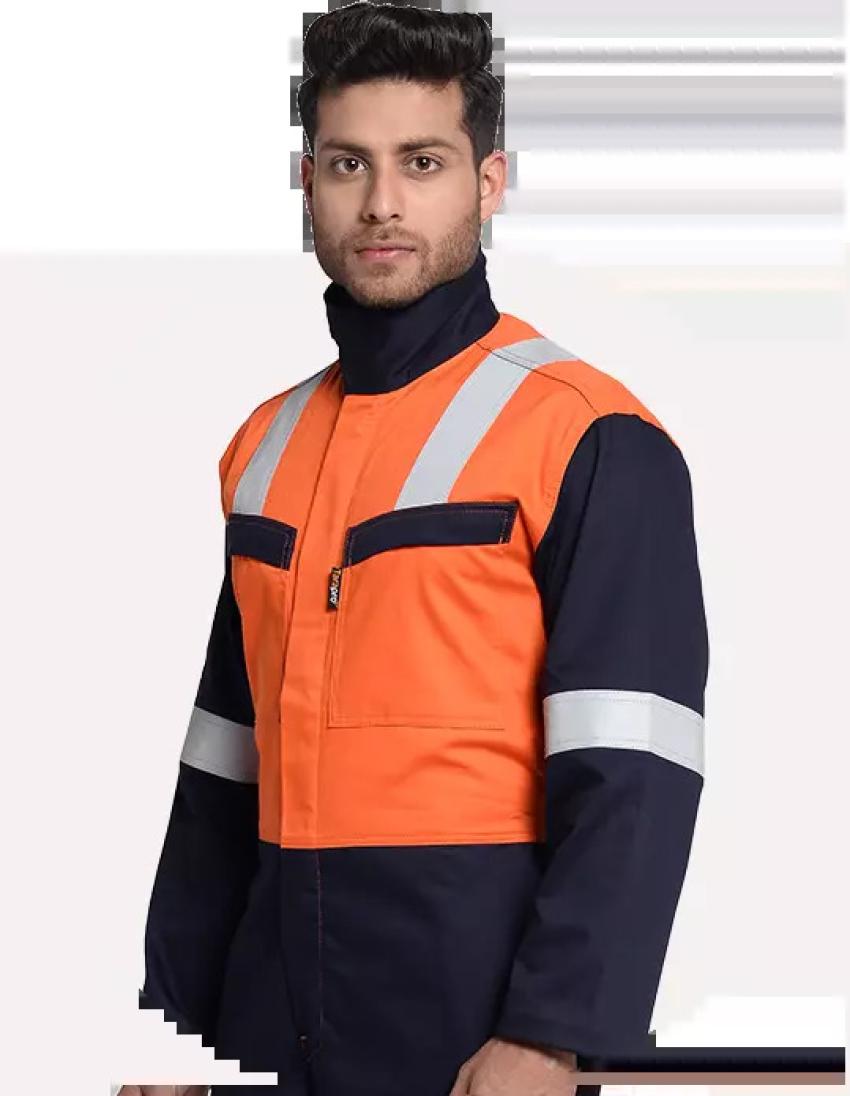
- No upward-facing openings. Pockets, especially chest and cuff pockets, should have closed flaps rather than open tops — an open pocket is a scoop for splash.
- High, snug collars and cuffs. Gaps at the neck, wrists, and boot line are the most common entry points for molten droplets. Elastic or adjustable closures that seal against the skin (without restricting movement) matter more here than in most other FR applications.
- Minimal external hardware. Exposed metal zippers, snaps, or buckles can transfer heat directly to skin on contact; these should be covered by a fabric flap or replaced with heat-resistant alternatives.
- Seam placement matters on high-splash surfaces. Fewer seams across the chest, shoulders, and forearms — the areas most exposed during pouring and tapping — reduce failure points, since seams are often the weakest point in a garment's heat resistance.
- Boot gaiters or spats for pouring and tapping crews reduce the risk of molten metal entering at the boot top, a commonly overlooked entry point.
Single-Layer vs. Multilayer Systems
ASTM F1002 distinguishes between primary materials (the outer, direct-contact layer) and secondary materials (an inner layer, if used) — a distinction that matters because a multilayer system doesn't just add insulation, it changes how molten metal behaves against the garment. An air gap between layers can help dissipate heat before it reaches skin, but a multilayer garment tested as a system will perform differently than either fabric tested alone. This is why garment-level certification (not just fabric-level) matters for foundry PPE — a fabric that passed ISO 9185 individually isn't a guarantee that the finished, layered coverall performs the same way.
Maintenance Realities in Foundry Conditions
Foundry and steel plant environments are harder on FR coveralls than most other industrial settings, for reasons specific to the job:
- Metal dust, scale, and slag residue should be brushed or vacuumed off before laundering — leaving abrasive particulate in the fabric accelerates fiber breakdown and can compromise the weave over repeated wash cycles.
- Oil and hydraulic fluid contamination from maintenance work reduces FR performance the same way it does in any industrial setting, but foundry maintenance crews are especially exposed to this given the volume of hydraulic and lubrication systems around casting and rolling equipment.
- Small perforations from repeated minor spark exposure are easy to miss visually but compound over time — a coverall with dozens of pinhole-sized burn marks from months of minor spatter should be retired even if no single incident looked serious, since cumulative damage reduces the fabric's tested protection level.
A Practical Procurement Checklist
Before signing off on a foundry or steel plant FR coveralls order, confirm:
- The garment (not just the fabric) carries a documented D and/or E rating matched to the metal your plant actually handles.
- Radiant heat (C) and contact heat (F) ratings are appropriate to the specific work zone, based on a documented hazard assessment.
- Construction avoids upward-facing pockets, exposed metal hardware, and gaps at collar/cuff/boot lines.
- Fabric is inherently FR or FR-treated natural fiber — never an untreated synthetic blend.
- Fabric weight is matched to the zone's actual risk level, not uniformly maximized across the whole workforce.
- A laundering and inspection protocol exists that accounts for metal dust, oil contamination, and cumulative spark damage — with clear, documented retirement criteria.
Getting each of these right is less about finding one "best" coverall and more about matching the right rating and design to each zone of the plant — which is exactly where a generic FR supplier conversation usually falls short of what a foundry actually needs.