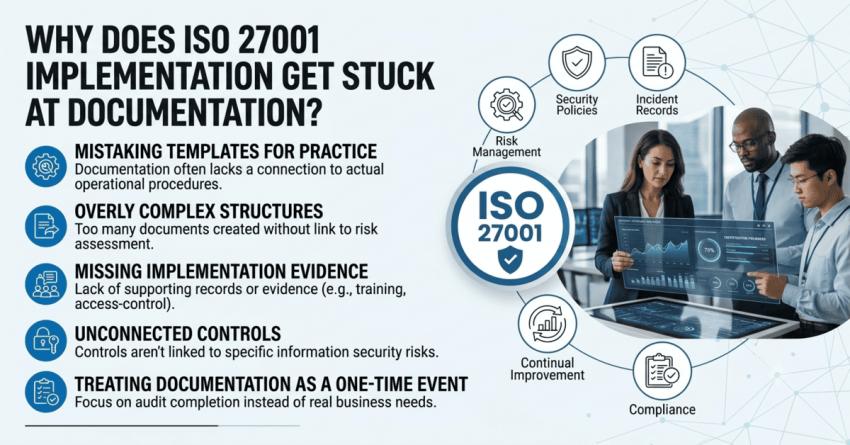
Many organizations begin ISO 27001 implementation with a clear goal: strengthen information security, manage cybersecurity risks, and achieve ISO 27001 compliance. Yet, the project often slows down at documentation. The challenge is knowing which documents are needed, how they connect to actual processes, and what evidence must be maintained.
Why Documentation Becomes a Bottleneck
A common mistake is treating ISO 27001 documentation as templates that only need to be completed before an audit. In reality, ISO 27001 documents should reflect the organization's information security risks, operational practices, responsibilities, and controls.
Organizations may have policies but lack supporting procedures, records, or evidence showing those requirements are implemented. Others create too many documents without connecting them to their ISO 27001 risk assessment and risk treatment activities.
A practical documentation structure helps turn ISO 27001 requirements into processes employees can understand and follow.
What Should ISO 27001 Documentation Cover?
Effective ISO 27001 documentation should support the organization's Information Security Management System (ISMS) and its implementation. Depending on the organization's context, documentation may include:
- Information security policies and objectives
- Information security procedures and operational controls
- ISO 27001 risk assessment and risk treatment records
- Statement of Applicability (SoA)
- Internal audit records
- Management review records
- Access-control evidence
- Incident records
- Training records
- Backup records
- Corrective-action records
The important point is that ISO 27001 policies should not stand alone. Policies establish direction, while ISO 27001 procedures explain how relevant activities are performed. Records then provide ISO 27001 audit evidence that these activities are actually being carried out.
How to Move Beyond the Documentation Stage
The first step is to understand the organization's ISO 27001 requirements and determine which documented information is necessary for the ISMS. Next, documentation should be connected to the organization's risk management approach.
For example, an identified access-control risk should lead to appropriate controls, responsibilities, procedures, and records. Similarly, information security incidents should be supported by an incident-management process and appropriate incident records.
This approach prevents documentation from becoming disconnected from day-to-day operations. It also makes ISO 27001 compliance easier to demonstrate during internal and certification audits.
How a Structured Documentation Set Can Help
Preparing every document from scratch can consume considerable time, particularly when an organization is developing its ISMS for the first time. A structured set of ISO 27001 documents can provide a practical starting point for developing the required policies, manuals, procedures, forms, and records.
Organizations can use an appropriate documentation set to establish a consistent structure, customize the content to their business and risks, assign responsibilities, and then maintain objective evidence of implementation.
The goal is not simply to have more documents. The goal is to have useful documentation that supports risk management, information security activities, and continual improvement.
From Documentation to Effective ISO 27001 Implementation
Getting past the documentation stage requires organizations to connect policies, procedures, risk assessment records, controls, and audit evidence with actual business activities. When documentation reflects how the ISMS operates, it becomes easier for employees to follow processes and for auditors to verify implementation.
A well-organized documentation approach can therefore reduce implementation delays, improve consistency, and provide a stronger foundation for demonstrating ISO 27001 compliance.
Conclusion
Getting stuck in documentation can slow down an otherwise successful ISO 27001 implementation. The solution is not to create more paperwork, but to build practical documentation that reflects real risks, responsibilities, and processes. Well-organized ISO 27001 documents help teams work consistently, prepare audit evidence, and move toward stronger, sustainable ISO 27001 compliance.