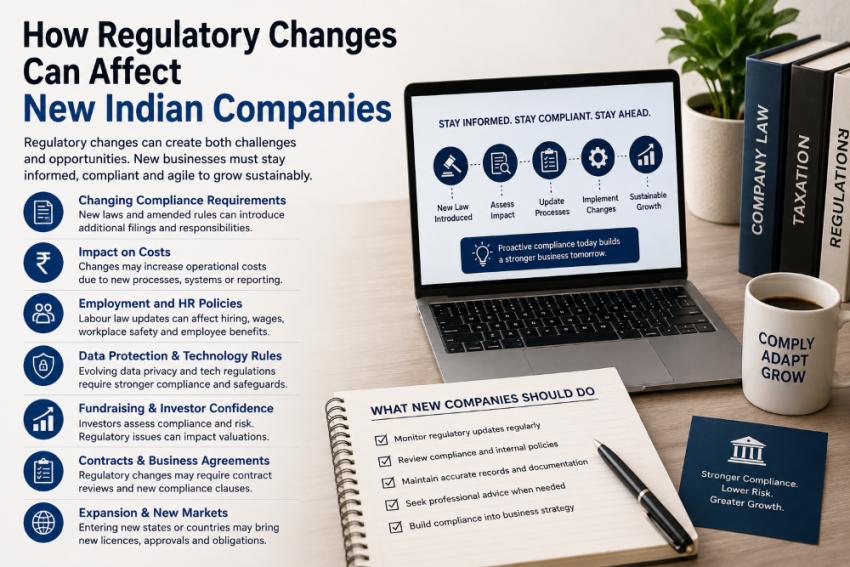
Starting a company in India involves more than choosing a business structure and registering with the appropriate authorities. Once a company begins operating, it must comply with a range of legal and regulatory requirements. These requirements can change as the government introduces new laws, amends existing legislation or updates compliance procedures.
For new Indian companies, regulatory changes can affect everything from business registration and taxation to employment, data protection, investment and corporate governance. Businesses need to monitor these developments and assess how they may affect their operations.
Understanding the impact of regulatory changes can help new companies make informed decisions and reduce compliance risks.
What Are Regulatory Changes?
Regulatory changes refer to amendments, new rules, notifications, policies or changes in administrative requirements introduced by government authorities and regulators.
Companies in India may be affected by changes issued under corporate law, tax law, labour law, environmental regulations, consumer protection rules and sector specific legislation.
For example, a company may need to update its internal processes after a change in filing requirements. A technology business may need to review its approach to handling personal data. A company employing staff may need to adjust its workplace policies after changes in employment regulations.
The effect depends on the nature and size of the business.
Why Regulatory Changes Matter for New Companies
Established companies often have dedicated legal, finance and compliance teams. New businesses may operate with smaller teams and limited resources.
As a result, a regulatory change can have a greater practical impact on a new company.
A founder may need to understand a new compliance requirement while also managing funding, recruitment, product development and customer acquisition. Failure to identify a legal requirement early can result in additional costs and operational disruption.
Regulatory awareness should therefore form part of a company's growth strategy from the beginning.
1. Changes Can Affect Company Formation
Regulatory requirements can influence how entrepreneurs structure and establish a business.
India provides several business structures, including private companies, public companies, limited liability partnerships and other forms of business organisation. Each structure has different legal and compliance requirements.
Changes in company law or registration procedures can affect incorporation documents, disclosures, filings and ongoing obligations.
Entrepreneurs planning [company setup india] should therefore consider both the current legal framework and the compliance requirements likely to apply after incorporation.
Choosing a structure solely on the basis of initial registration costs may create problems later. The business should also consider reporting requirements, taxation, ownership arrangements and future funding plans.
2. Increased Compliance Responsibilities
Regulatory reforms may introduce new filing requirements or modify existing ones.
A company may need to submit additional information, update records or adopt new internal procedures. Even a relatively small change can create an administrative burden for a business with a limited team.
New companies should maintain a compliance calendar covering important filing dates, licences, registrations and reporting obligations.
Responsibility for each compliance requirement should also be clearly assigned within the organisation.
3. Impact on Business Costs
Regulatory changes can increase the cost of running a business.
A new requirement may require companies to engage professionals, update software, train employees, modify contracts or introduce additional internal controls.
For a new business operating on a limited budget, even a modest increase in compliance costs can affect financial planning.
Founders should therefore consider regulatory compliance when preparing budgets and financial projections.
Compliance should not be treated as an expense only to be considered after a new rule comes into force. It is better to include potential regulatory costs within the company's broader financial planning.
4. Changes in Tax Obligations
Tax regulations can have a direct effect on business operations.
Changes in income tax rules, GST requirements, withholding obligations or reporting procedures may affect how companies calculate, collect and report taxes.
A new company may also need to review its invoicing, accounting and record keeping systems following a regulatory change.
Tax compliance becomes particularly important when a business expands across different states or begins dealing with international customers and suppliers.
Companies should regularly review their tax processes and ensure relevant records are maintained accurately.
5. Effect on Employment Practices
Regulatory changes can also affect how companies recruit and manage employees.
Employment related requirements may cover wages, working conditions, social security, leave, workplace safety and other employment matters.
A new company may initially have only a small number of employees. However, its employment practices should still comply with applicable requirements.
As the workforce grows, the company may need formal employment policies, appropriate contracts and stronger internal procedures.
Regular review of employment documentation can help identify gaps before they become disputes.
6. Data Protection and Technology Regulation
Technology driven companies face an evolving regulatory environment.
Businesses collecting customer information may need to consider requirements relating to privacy, data processing, cybersecurity and consent.
A company developing an online platform may therefore need to review its privacy notices, contracts, data handling procedures and security practices.
Regulatory requirements can also affect the way businesses use emerging technologies such as artificial intelligence.
For technology focused startups, monitoring legal developments should be part of product and risk management rather than an activity reserved for the legal team.
7. Sector Specific Regulations
Not every regulatory change applies equally to every company.
Businesses operating in sectors such as financial services, healthcare, education, telecommunications, insurance, food and pharmaceuticals may face additional requirements.
A new company entering a regulated sector should identify the relevant licences, approvals and reporting obligations before commencing operations.
Failure to obtain a required approval can delay the launch of a product or service.
Sector specific compliance should therefore be considered during the business planning stage.
8. Impact on Fundraising and Investment
Regulatory changes can influence how companies raise funds and structure investments.
Investors often examine a company's corporate records, ownership structure, contracts, financial information and regulatory compliance during due diligence.
A business with incomplete filings or unresolved compliance issues may face additional questions from potential investors.
Changes in regulations can also affect investment structures, reporting requirements and transaction documentation.
New companies seeking external funding should keep their corporate records organised from the beginning. Good compliance practices can make future due diligence more efficient.
9. Changes Can Affect Contracts
Regulatory reforms may require businesses to review existing agreements.
For example, a change in data protection requirements could affect technology contracts. Changes in employment regulations may require amendments to employment documentation. Changes in taxation may also influence commercial arrangements.
Companies should identify contracts containing regulatory obligations, indemnities, pricing provisions or compliance requirements.
A contract review can help determine whether existing agreements remain suitable under the new regulatory framework.
10. Impact on Business Expansion
Regulatory changes can affect expansion plans as well.
A company entering a new state or industry may face additional licences, registrations or reporting obligations. International expansion may introduce another layer of regulatory requirements.
Before entering a new market, companies should identify the legal requirements applicable to their proposed activities.
Early planning can help avoid situations where a business commits substantial resources to expansion before discovering additional compliance requirements.
How New Companies Can Prepare for Regulatory Changes
New companies cannot predict every future regulatory development. However, they can establish systems to respond efficiently.
Monitor Legal Developments
Businesses should monitor official government notifications, regulatory updates and relevant statutory changes.
Depending on the sector, companies may need to track developments from authorities such as the Ministry of Corporate Affairs, tax authorities and sector specific regulators.
Conduct Regular Compliance Reviews
A periodic review can help identify outdated policies, missing filings and new obligations.
The frequency of review should depend on the nature and risk profile of the business.
Maintain Proper Documentation
Companies should keep incorporation records, contracts, licences, tax documents, employee records and statutory filings organised.
Good documentation can make it easier to demonstrate compliance when required.
Build Compliance Into Business Decisions
Regulatory considerations should form part of decisions involving hiring, fundraising, expansion, technology and new products.
This approach allows companies to identify legal issues before making significant commitments.
Seek Professional Advice When Required
Not every regulatory change requires external legal assistance. However, complex changes can require careful interpretation.
A company may benefit from consulting a [startup lawyer India] when a regulatory development affects its structure, funding, contracts, intellectual property, employment arrangements or other significant business decisions.
What Happens If a Company Ignores Regulatory Changes?
Ignoring a regulatory requirement can create several risks.
Depending on the applicable law, consequences may include monetary penalties, additional compliance costs, regulatory action, licence related problems or disputes.
The impact can extend beyond the immediate penalty. Compliance problems may also affect investor confidence and business relationships.
For a new company, resolving a regulatory issue can consume valuable time and resources. Early compliance is usually more efficient than dealing with problems after they arise.
Conclusion
Regulatory changes are an unavoidable part of doing business in India. New companies may feel their impact more strongly because they often have limited resources and developing internal systems.
Changes can affect company formation, taxation, employment, data protection, contracts, fundraising and expansion. The exact impact depends on the company's sector, structure and activities.
New businesses should therefore treat regulatory compliance as an ongoing responsibility. Monitoring legal developments, maintaining accurate records and reviewing internal processes can help companies adapt when rules change.
A proactive approach can also give founders greater clarity when making important business decisions. Instead of viewing regulation only as a legal obligation, new companies can incorporate compliance into their long term strategy and build a stronger foundation for sustainable growth.