Developing a new product involves considerable investment in research, design, testing, manufacturing and marketing. Businesses often focus on whether an idea is commercially viable and technically achievable. Yet one important question can be overlooked: Can the product be developed and commercialised without infringing existing patent rights?
A patent search can help answer this question at an early stage.
Patent searches involve reviewing existing patent applications and granted patents to identify inventions or technologies similar to a proposed product. They can reveal existing rights, technical developments and potential legal barriers before substantial resources are committed.
For startups, technology companies and established businesses, conducting a patent search before product development can support better decision making and reduce avoidable intellectual property risks.
What Is a Patent Search?
A patent search is a systematic review of patent databases and related technical literature to identify existing inventions relevant to a proposed product or technology.
The search may consider:
• Granted patents
• Pending patent applications
• Expired patents
• Published applications
• Patent families
• Technical classifications
• Relevant scientific and technical publications
The scope depends on the purpose of the search.
For example, an inventor may conduct a prior art search to assess whether an invention appears new. A business preparing to launch a product may conduct a freedom to operate search to identify potentially enforceable patent rights within a particular market.
These searches serve different purposes and should not be treated as interchangeable.
Why Conduct a Patent Search Before Product Development?
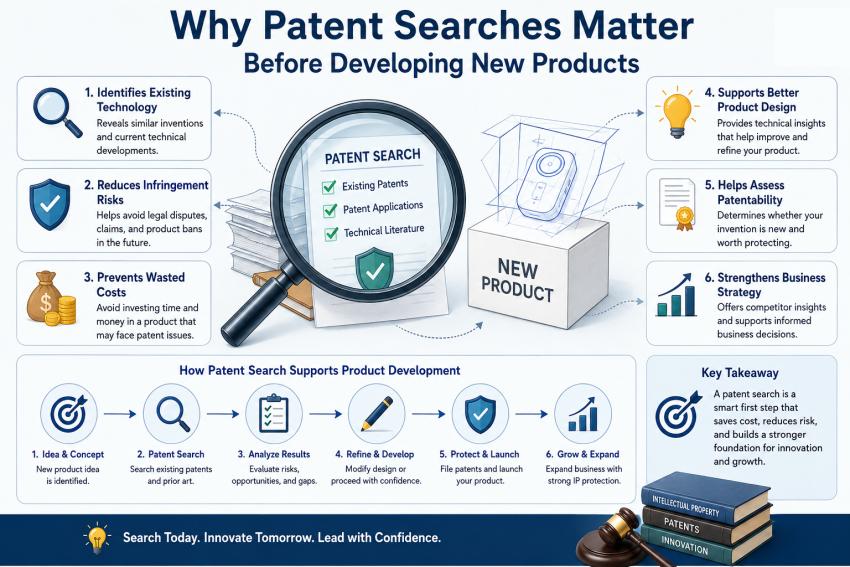
1. It Helps Identify Existing Technology
A product idea may appear original while similar technology already exists.
Patent databases contain extensive technical information covering inventions from different industries and jurisdictions. Searching these records can help businesses understand how a particular technology has already been developed.
This information can influence product design at an early stage.
It may also reveal technical solutions a development team had not previously considered.
2. It Can Reduce Patent Infringement Risks
Patent infringement can create serious commercial consequences. A business may face legal proceedings, financial claims, injunctions or restrictions on using a patented technology.
Discovering relevant patent rights before development begins gives a business an opportunity to assess the risk.
The development team may then modify the product, avoid particular technical features or explore licensing options where appropriate.
Early assessment is generally more practical than discovering a potential infringement shortly before a product launch.
3. It Helps Prevent Wasted Development Costs
Product development can require substantial financial and human resources.
Imagine a company spends months developing a product before discovering a competitor holds relevant patent rights covering an important feature. The business may then need to redesign the product or reconsider the commercial strategy.
A patent search at the beginning can help identify such concerns earlier.
It does not eliminate risk, but it can provide information needed to make more informed investment decisions.
4. It Supports Better Product Design
Patent searches are not only defensive exercises.
Patent documents can provide valuable technical information. They can show how competitors and researchers have approached particular problems and where technological developments are heading.
A research and development team can use this information to identify opportunities for improvement.
For example, an existing patent may cover one approach to solving a technical problem. A business may develop an alternative solution with different technical characteristics.
This can encourage innovation rather than simply duplicating existing technology.
5. It Helps Assess Patentability
Businesses developing a new product may also want to protect their own invention.
Before filing a patent application, it is useful to understand what has already been disclosed publicly. Earlier patents and other publications may affect whether an invention satisfies the requirements for patent protection.
A prior art search can therefore help identify relevant disclosures before significant effort is invested in preparing a patent application.
It may also help inventors identify the genuinely distinctive aspects of their technology.
However, a search result alone does not determine whether a patent will ultimately be granted. Patentability involves legal and technical assessment under the applicable law.
Patent Searches Can Reveal Competitor Activity
Patent databases can provide insight into the technological direction of competitors.
Businesses can examine patent filings to identify areas where competitors are investing in research and development. Changes in filing activity may also indicate emerging technologies or strategic areas of interest.
This information can contribute to broader commercial planning.
For example, a company developing a new medical device may discover extensive patent activity around a particular component. This could influence its research priorities, product architecture or licensing strategy.
Patent intelligence can therefore form part of a wider competitive analysis.
What Should a Patent Search Examine?
The search should be sufficiently broad to identify potentially relevant rights.
Depending on the product, the process may involve:
Keywords and Technical Terms
The search should consider the product name, technical terminology, alternative descriptions and industry specific expressions.
A narrow keyword search may miss relevant patents because patent documents often describe similar concepts using different terminology.
Patent Classifications
Patent classification systems can make searches more comprehensive.
Classification based searching can help identify documents covering a particular technical field even where the terminology differs.
Patent Families
The same invention may be protected or pursued through applications in several countries. Reviewing patent families can therefore provide a clearer picture of related filings.
Legal Status
Finding a patent document is not enough.
Its legal status should also be considered. A granted patent, pending application and expired patent can have very different implications.
Legal status information should be verified using reliable official or authoritative sources before important commercial decisions are made.
Patent Search Before Product Development vs After Development
The timing of a patent search can significantly affect its usefulness.
A search conducted before product development can influence the direction of research and design. Potential conflicts may be identified while changes are still relatively inexpensive.
A search conducted after development may still be valuable, particularly before commercial launch. However, changing a product at this stage can be more difficult and expensive.
Businesses should therefore consider patent searching as part of the product development process rather than treating it as a final compliance exercise.
Patent Search and Freedom to Operate
One important distinction is between a patentability search and a freedom to operate assessment.
A patentability search primarily considers whether an invention appears sufficiently new and inventive in light of existing disclosures.
A freedom to operate assessment focuses on whether commercial activities may potentially fall within the scope of enforceable patent rights in a particular jurisdiction.
These are different questions.
A product may be patentable while still creating infringement concerns because another party owns a patent covering aspects of its implementation.
Similarly, the existence of earlier patents does not automatically mean commercialisation is prohibited. Claim scope, legal status, jurisdiction and other factors require careful analysis.
How Legal Professionals Can Help
Patent searching is most effective when combined with legal and technical analysis.
A legal professional can help identify relevant patent claims, examine ownership and legal status, assess potential risks and distinguish between relevant and irrelevant documents.
Where necessary, the business may also consider licensing, design changes, opposition strategies or other commercial approaches.
Working with a [patent lawyer in india] can be particularly useful when a product is intended for commercial launch or involves complex technology. Professional analysis can help translate search results into practical legal and business considerations.
Patent Searches Can Also Support Intellectual Property Strategy
Patent searches should form part of a wider intellectual property strategy.
Businesses may need to consider patents alongside trademarks, copyright, designs and confidential information.
For instance, a company developing a consumer product may need patent protection for its technical innovation, design protection for its appearance and trademark protection for its brand.
Different rights serve different purposes.
Businesses should therefore identify the relevant intellectual property assets early rather than relying on one form of protection.
Trademark related expenses should also be considered separately. Businesses researching [trademark filing fees in India] should remember that trademark costs and patent related expenses involve different processes, requirements and official fees.
Common Mistakes to Avoid
Several mistakes can reduce the value of a patent search.
Searching Only One Database
Relevant information may exist across multiple databases and jurisdictions. Relying on one source can produce an incomplete picture.
Using Only the Product Name
Patent documents may use technical terminology rather than commercial product names. Searches should therefore consider concepts, functions and alternative terminology.
Ignoring Patent Claims
The claims are particularly important when assessing potential infringement. Reviewing only titles or abstracts may provide an incomplete understanding of the rights involved.
Ignoring Legal Status
An old patent document may no longer create the same legal concern as an active granted patent. Legal status must therefore be examined carefully.
Treating Search Results as Legal Conclusions
A search identifies potentially relevant information. It does not automatically provide a definitive infringement or patentability opinion.
Legal analysis is needed to understand the practical implications.
Conclusion
Patent searches can provide valuable information before a business commits substantial resources to developing a new product. They can reveal existing technology, identify potential patent risks, support product design and inform intellectual property strategy.
The greatest benefit often comes from conducting the search early.
A well planned search does not guarantee freedom from legal disputes or ensure patent protection. It does, however, give businesses a stronger information base for making decisions about research, development, protection and commercialisation.
For businesses operating in technology intensive markets, patent searching should therefore be viewed as an important part of responsible product development rather than an optional step at the end of the process.