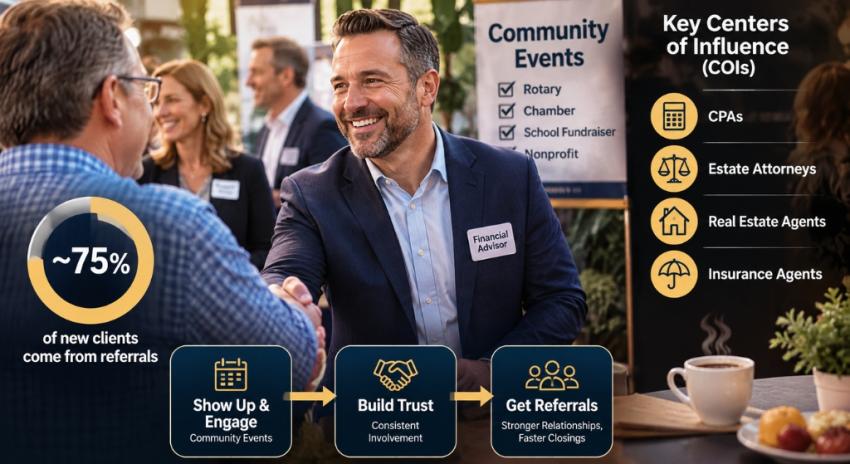
The best financial advisors don't generate leads from cold calls anymore — they generate them from the Rotary breakfast nobody else follows up on.
It's not a cute line. It's the real way that math functions in our industry. Referrals, not marketing expenditures, cold outreach, or seminar meals at the steakhouse off the interstate, account for about 75% of a financial advisor's new clientele. Additionally, a few unglamorous, recurrent touchpoints—such as a chamber of commerce mixer, a school fundraiser, a nonprofit board meeting, or a little league sponsorship banner—tend to be the source of the most successful referrals. Nearly every other channel is outperformed by financial advisor networking events centered on genuine community involvement, but only for advisors who regularly attend and have a plan for what happens after the handshake.
This isn't a sentimental issue about "being part of the community." Most consultants either ignore or overcomplicate this useful growth channel, which has a defined failure mode, a quantified return, and a compliance layer. Here's how to construct it in reality.
Why Community Events Beat Traditional Financial Advisor Networking Events
Start with the numbers, because they explain why this channel is worth the time investment.
In a recent industry survey, 76% of advisors said they gained new clients through unsolicited referrals — by far the most productive source of new business, ahead of both solicited client referrals and referrals from other professionals. Broader industry data puts referrals at roughly 75% to 80% of new client acquisition overall, with 55% of new advisory clients coming specifically from existing clients' friends and family.
Here's the part that should stop you: most financial professionals get referrals from fewer than 5% of their existing client base. Almost nobody is actively working the channel that produces three out of every four new clients. That gap is the opportunity.
A rotary breakfast, a chamber ribbon-cutting, a youth sports banquet — these aren't glamorous, but they put you in a room with the same 30 to 60 people, month after month, for years. That repetition is what a formal "financial advisor networking event" — a hotel ballroom seminar you attend once — can't replicate. Trust in this business isn't built in a single conversation. It's built by showing up to the same events, sponsoring the same Little League team, and sitting on the same school board committee long enough that people stop seeing you as "the advisor" and start seeing you as someone they already know.
Because of this familiarity, referrals from community events convert at a higher rate than referrals from one-time conferences. When a prospect is introduced to you by a fellow Rotary member or a CPA, they aren't judging you in a cold manner. It took months or years to establish the trust they inherit. That's why word-of-mouth referrals close faster and with less price sensitivity than any sponsored acquisition channel in wealth management.
The Center-of-Influence Playbook for Advisor Community Events
Not every person in the room is equally valuable to your advisor referral network. The advisors who grow fastest through community involvement are deliberate about who they build relationships with — a small group of professionals commonly called "centers of influence," or COIs.
COIs are typically CPAs, estate planning attorneys, divorce attorneys, real estate agents, and property and casualty insurance agents — professionals who serve the same client base you do, at moments when a financial decision is already on the table. A CPA doing a client's taxes may notice they have no retirement plan. An estate attorney drafting a will may realize the client hasn't reviewed beneficiary designations in a decade. These are natural, non-awkward referral moments, and they happen constantly if you've built the relationship in advance.
The economics back this up. Advisors who invest deliberately in COI relationships generate, on average, roughly $3 in revenue for every $1 spent cultivating the relationship — a return most other business development spend can't touch.
Picking the Right Events
It's not always worthwhile to attend community events routinely. Chamber of commerce meetings, Rotary or Kiwanis clubs, school booster clubs, nonprofit boards, town planning or zoning committees, and industry associations for the professions you want as COIs (CPA society mixers, bar association events for estate attorneys) should all be given priority. Attending a dozen one-time events where you won't see the same people twice is less effective than making one consistent, well-chosen commitment.
A tactic worth borrowing from advisors who've done this well: organize a small, recurring "4-on-4" gathering — yourself plus four CPAs, four estate attorneys, and four real estate agents — for an informal breakfast or lunch a few times a year. It's small enough to build real rapport and structured enough that referrals flow in both directions instead of being a one-way ask.
What to Actually Do at the Event
The advisors who fail at this lead with a pitch. The ones who succeed lead with curiosity. Ask the CPA what kind of client situations frustrate them most. Ask the estate attorney what they wish more advisors understood about their process. You're not there to sell — you're there to understand how you can make someone else's job easier, because that's what earns you a place in their referral rotation.
Just as important as the conversation itself is the follow-up. Three weeks later, a nonspecific "great to meet you, let's grab coffee sometime" message does very little. What turns a handshake into a real friendship is a precise message written within a day or two that references what they told you they needed.
The Real Bottleneck: Financial Advisor Lead Capture After the Handshake
Here's where most advisor referral network efforts die, and it isn't the event itself. It's what happens in the 48 hours after.
An advisor attends three community events a month. Each one produces a stack of business cards, a phone full of names typed into Notes, and a mental list of "people to follow up with." Two weeks later, most of that context is gone. Which CPA mentioned they had a client going through a business sale? Which realtor said they wanted an intro for their own retirement planning? It blurs. Once it blurs, follow-up either doesn't happen or turns into a generic "nice meeting you" message that does nothing to advance the relationship.
In every industry that depends on event-based lead generation, contacts are recorded inconsistently, context is lost, ownership is ambiguous, and follow-up happens too late, if at all. The expenses of a financial consultant go beyond a lost chance. They never feel that the referral they sent you was taken seriously, and the COI relationship gradually deteriorates.
Why Advisors Lose Referrals After the Event
Three things typically go wrong. First, the capture itself is inconsistent — a card in one pocket, a name scrawled on a napkin, a contact saved with no notes at all. Second, the context that made the conversation valuable evaporates: the specific reason that CPA or realtor is worth staying in touch with gets reduced to "met at chamber event," which is useless three months later. Third, there's no reminder system, so relationships that should be nurtured every 60 to 90 days aren't, until the COI stops sending referrals because the relationship feels one-sided.
How Advisor Community Events Turn Into a Working Referral Network
This is where a proper capture system changes the outcome. RoloScan plays a specific role here: when you meet a CPA at a chamber breakfast or a realtor at a school fundraiser, you scan their business card or badge on your phone, and RoloScan pulls the contact details instantly using AI-powered OCR, then enriches the record with company, title, and professional background. If you've met that same person at a prior event, RoloScan recognizes them and consolidates the record instead of creating a duplicate—a common problem for advisors who attend the same recurring events month after month and keep re-capturing the same COIs.
Context guarantees that relationships are safe. Instead of disappearing, the brief comment you make at the time—"handles small business tax returns, has clients who need retirement rollovers, and wants an introduction to our estate attorney"—is carried throughout the interaction. RoloScan lets you create a follow-up that references the specific chat (rather than a general template) and reminds you when to check in again, preventing a COI connection from going silent for six months without either of you noticing.
For an advisor building a referral network out of community events, that's the difference between a stack of cards that never gets worked and a genuine advisor referral network that compounds — because every COI relationship is remembered, tended, and reciprocated instead of left to fade.
Maintaining Compliance While Developing Your Network of Advisor Referrals
In wealth management, referral relationships are not unregulated, and making a mistake here exposes you to serious legal risks. The most important are two frames.
If you're a registered investment adviser, the SEC's Marketing Rule governs how you can use testimonials, endorsements, and third-party referrals in your marketing. Anyone who refers clients to you in exchange for compensation — cash or non-cash — is treated as a "promoter" under the rule, and you're generally required to have a written agreement with them, disclose the compensation arrangement, and maintain oversight of what they say about you. Compensation arrangements above a $1,000 de minimis threshold in twelve months trigger the fuller disclosure and agreement requirements (Troutman Pepper Locke). The SEC has actively enforced this — in September 2024 alone, it charged nine investment advisers over deficient testimonial and endorsement disclosures.
If you are a broker-dealer representative, FINRA's gift regulation (regulation 3220) limits non-cash gifts and gratuities to $100 per person, per year, unless a particular exemption applies, and Rule 2210 requires that any disclosures concerning a referral agreement be fair, balanced, and not deceptive. In reality, this implies that the coffee gift card you give a COI for a great referral is acceptable; a standing cash-for-referral deal with a real estate agent almost certainly is not, unless properly structured and disclosed.
None of this means you can't build reciprocal relationships with COIs — advisors do it every day. It means the relationship should be built on mutual value and genuine reciprocity (sending referrals back, being useful, showing up consistently), not an undisclosed pay-for-play arrangement. When in doubt, loop in your compliance department before formalizing any referral relationship that involves compensation.
Conclusion: Financial Advisor Networking Events Are a Long Game That Pays Off
Financial advisor networking events built around genuine community involvement — not one-off seminars — remain the highest-converting, most durable channel for growing an advisory practice. The data backs it up: three-quarters of new clients come from referrals, yet fewer than 5% of existing clients ever send one, which means the advisors willing to do the unglamorous work of showing up consistently and following up properly have an enormous, mostly uncontested opportunity in front of them.
Advisors who excel in this channel do three things: they develop genuine, reciprocal relationships with a specific group of COIs; they visit the same rooms regularly rather than chasing one-time occurrences; and they use a system, not memory, to capture context and follow up immediately. If you perform all three successfully, your referral network will transform from a few lucky introductions to a compounding asset that expands every quarter as long as you stay consistent.