Your network gives you a significant advantage as a founder, at least until it gets too big to manage with ease.
After three months, networking seems easy. Everyone who matters is someone you know. You recall the email from the person who could be your first hire, the coffee conversation with a potential investor, and the coworker who brought up an issue your product could resolve. Relationships feel genuine and deliberate when you follow up and maintain contact.
By the eighteenth month, you may be in charge of 200 relationships, each of which is significant in its own right. The industry contact from a convention, the helpful vendor, the peer entrepreneur you learned from, the angel investor who was unsure, and the candidate who nearly joined but accepted another offer are some examples. You can't recall everyone as well as you used to. Some folks fall through the cracks. Delays occur with emails. Stronger relationships don't develop because there isn't any framework in place, not because you stopped caring.
This is where most founders get stuck with networking. It’s not that they’re bad at it, but they treat it as a solo effort instead of a repeatable process. That approach doesn’t work as your network grows.
Why Founders Underestimate Their Network's Real Value
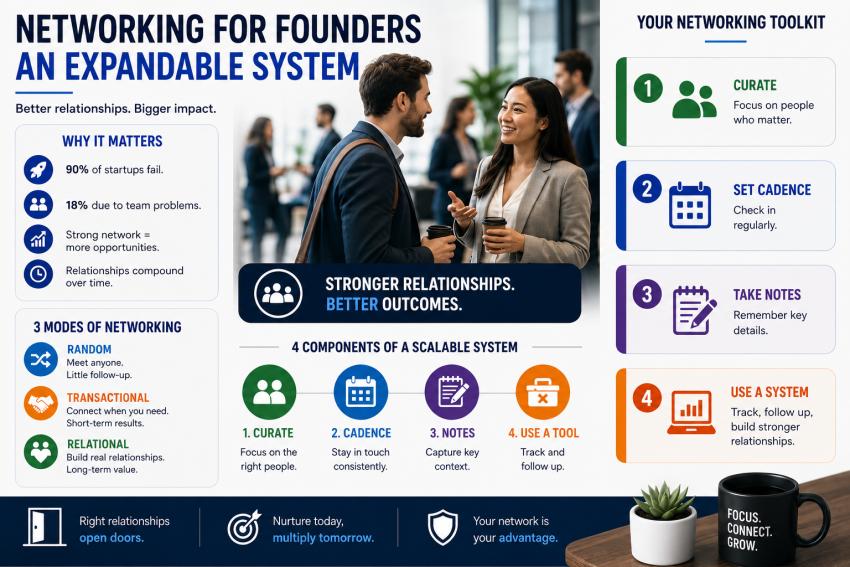
Startup success rates are shocking. According to the most recent data, just 10% of startups succeed over the long term, while the global failure rate is 90%. First-time founders have an 18% success rate, whereas founders with prior startup experience have a slightly higher 20% success rate. But those numbers change depending on the founder's finances and who you ask.
One often-overlooked resource is the network itself. While the research clearly identifies product-market fit (34% of failures) and team problems (18%) as top failure drivers, what often gets missed is how a strong network prevents or mitigates those failures in the first place.
Before spending months on the wrong route, a founder with close ties to other founders can test their product assumptions. Without having to start cold pitching, the founder with investor ties can handle fundraising discussions. An introduction, not a job board, is how the founder, who is part of a robust peer community, discovers that crucial early hiring. The network reduces the costly learning cycles that precede failure, but it doesn't directly solve it.
One important fact is that successful startup founders are typically 42 years old, not 22. It's not a coincidence. The contacts that older entrepreneurs have cultivated over the years are increasingly valuable. Despite making up only 14% of the US population, 55% of US unicorn companies were founded by immigrants or first- or second-generation founders. Part of the reason for their success is need. Creating networks across communities and boundaries opens up new avenues for access and perspectives. They rely on relationships because they are frequently unable to rely on inherited institutional resources.
This is important since you are at a disadvantage whether you are a young founder, a first-time founder, or someone without a well-established network. However, with a purposeful system, you may swiftly close that deficit. Being an experienced founder gives you an advantage, but if you approach networking as a one-time event rather than a continuous activity, that advantage vanishes.
The Three Modes of Founder Networking (and Why Only One Scales)
Networking for founders operates in three modes, and most founders bounce between them chaotically.
Mode one is random. You go to events, meet people, exchange cards, and send a message three weeks later that says "great to connect!" Nobody's impressed. The relationship goes nowhere. This works when you're desperate for anything (early fundraising, the first customers), but it doesn't scale, and it's exhausting.
The second mode is transactional. You have a specific goal to complete: I need a developer; I need to locate beta clients; I need to know someone in the insurance industry; and you activate your network for that particular issue. This is effective in the short term and produces tangible outcomes, but it teaches your network that you should only interact when necessary. The focus of the connection is extraction rather than mutual value, and you vanish as soon as you acquire what you want. People take notice.
Relational is the third mode. You maintain a carefully chosen list of individuals who are crucial to your company's success or your own development as its creator. You maintain regular communication—not excessively, but steadily. Before requesting assistance, you provide background, reply to their inquiries, and seek out opportunities to contribute even when you are not in need. This method is effective since it is methodical rather than dependent on your emotions or recollections. It is the only mode whose value increases with time.
Building founder networking for mode three requires treating it as a repeatable system, not an organic process you'll remember to do.
Building Your Founder Networking System
The system has four components: a curated list, a regular cadence, a note-taking discipline, and a tool to make it all stick together so it doesn't rely on your brain.
Step 1: Curate Instead of Collecting
Determine who matters and why first. Not every person you've met should be on your list, because that would be noise. Investors or prospective investors, peer founders at comparable stages, advisers or mentors, clients or prospects, early hires or prospective team members, strategic partners, and subject matter experts in areas that are important to your company should all be included.
Next to each name, write down one sentence about why they matter and what they're working on. This isn't creepy surveillance. This is you acknowledging: this person has something to teach me, or they might be someone I hire someday, or they're solving a related problem, and we should stay loosely connected. The sentence keeps you from treating everyone the same way.
Step Two: Set a Rhythm
The mistake most founders make is assuming they'll network constantly, then never doing it. Instead, decide on a realistic schedule. That might be: five coffee chats a month with people from different buckets, one peer founder group call a month, follow-ups sent every two weeks with people you talked to recently.
These aren't large numbers. But they're consistent. A founder who has five meaningful conversations a month and stays in touch with 30 key people is in a different position than a founder who goes three months quiet and then panic-networks when they need something.
Step Three: Take Notes That Matter
After every real conversation with someone on your list, or someone who should be, write down three things: what you learned, what they’re working on or care about, and what you might do next. “Great chat, let’s stay in touch” isn’t a useful note. “Mentioned they’re hiring for backend engineers and struggling to find them in their network, considering an advisory relationship with two companies in parallel, concerned about funding runway through Q4” is a useful note.
These notes aren't for them; they're for you after six months, when someone inquires about that individual after you've spoken to forty other people. Not only does the note assist you recall their name, but it also helps you remember the context.
Step Four: Use a Tool So the System Doesn't Depend on Your Memory
This is when a relationship management tool becomes essential. Once your network grows beyond 50 carefully tracked people, keeping everything in notes or a spreadsheet starts to fall apart. You’ll miss follow-ups, forget who’s hiring, or not remember promises to make introductions. The system breaks down not because you’re bad at networking, but because you’re trying to manage a contact database in your head.
Research shows the real cost: 88% of business cards are lost within a week, and 50% of leads from events are never followed up with. That’s not laziness; it’s a sign that the system isn’t working. For founders, the stakes are even higher because your network is your moat, and losing a contact means missing an opportunity.
How RoloScan Fits Into Your Founder Networking System
This is exactly what RoloScan does for founder relationship management. Rather than asking you to log every connection or rely on scattered notes, RoloScan automates capture and follow-up so your network never falls through the cracks.
This is how it operates: You run into someone at an event, conference, coffee shop, or demo day. You use the RoloScan app to scan their business card rather than attempting to recall their information or hastily making notes. A team member can scan a badge or QR code. Using AI-powered OCR, the platform quickly obtains their contact details and automatically adds their LinkedIn profile information, company title, and other context. There is no need for manual data entry.
From there, RoloScan syncs that contact directly to your CRM — whether that's Salesforce, HubSpot, or wherever else you store relationships — without creating duplicates. This alone solves a massive founder problem: you don't have 15 different records for the same person scattered across tools and emails.
But the real power is what happens next. After you capture the contact, RoloScan generates AI-drafted follow-up messages tailored to your style and the specific conversation you just had. It's not a generic template. It references what you actually discussed, creates a prompt that sounds like you (not a bot), and suggests the right timing to reach out. This is the momentum-killer that most founder networks lack — the fast, personalized follow-up that happens within 24-48 hours when the conversation is fresh.
Then RoloScan remembers for you, something that spreadsheets cannot accomplish. Your contacts are arranged according to priority, interest, and event. It keeps track of your most recent interactions with each person and promptly reminds you. For instance, if you haven't checked in with a key investor for 60 days or a peer founder for 90 days, you may receive a nudge. The technology determines who to contact next, relieving you of the mental burden.
For founders managing dozens or hundreds of relationships, RoloScan acts like an executive assistant. It captures context at events, auto-organizes your contacts, generates thoughtful follow-ups, and reminds you when relationships need tending. The system handles the friction so you can focus on the actual conversations and value-add, not administrative overhead. One founder captured the idea perfectly: instead of losing months of potential relationships to incomplete cards and forgotten commitments, RoloScan lets you spend your time on the conversations that actually matter.
The key insight is that your founder networking system only works if the tool you use makes things easier, not harder. RoloScan is designed for this purpose. It captures contacts from events in seconds, syncs them where they need to go, and automates reminders and follow-ups to keep relationships strong.
Step Five: Default to Generosity
The one habit that transforms networking from transactional to relational is leading with generosity. When you talk to someone, ask them what they're working on before mentioning what you need; when you can, make introductions without expecting reciprocation. Share things you've learned, even when it doesn't benefit you directly.
This doesn’t mean always asking for help, since that’s not realistic. Instead, it means making requests based on a real relationship, not just trying to get something. It also means being specific when you ask. “Do you know anyone in healthcare?” is too vague. “I’m looking for someone who’s led a product at a health tech startup, preferably someone who’s worked with claims processing—do you know anyone?” gives them a clear idea of how to help.
Step Six: Activate Your Network on Purpose
The goal isn't a big list. The goal is to activate that list when it actually matters. When you're fundraising, go back through investors and strategic contacts, refresh relationships, and ask who else they know. When you're hiring, tell your network. When you launch something new, share it first with people who get what you're doing, not as spam, but as context.
Although it may seem apparent, many founders build networks but never leverage them for anything significant. They do not view it as a resource, but rather as a contact list. I know a peer entrepreneur who discovered that twelve of the individuals on his advisory list had never participated in actual decision-making. He made appointments to speak with each of them, gave them a thorough update on the company, and asked targeted questions. The viewpoint, contacts, and counsel he gained were far more valuable than the time he spent.
Avoiding the Traps
Most founder networking systems fail for one of three reasons: they require too much effort, they go silent for too long, or they treat everyone the same way.
The too-much-effort trap happens when a founder tries to do “deep weekly networking,” reaching out to five new people, having coffee with two, and writing detailed notes for all of them. This isn’t sustainable. You’d need a networking manager to keep up. Instead, set a realistic goal for yourself: maybe two coffees a month, one weekly peer call, and follow-ups every other week. That’s more than enough.
A creative is thought to be in the "silence trap" if they participate in extensive networking during frantic moments, such as fundraising or hiring, and then vanish for six months. Relationships deteriorate, and people stop responding with the same warmth. Consistency is more important than intensity. It is better to have monthly check-ins with thirty people rather than infrequent interactions with one hundred.
When a founder maintains a large list without differentiating amongst contacts, they fall into the "everyone-the-same" trap. Is this individual a peer learning partner, an investor, a prospective employee, or a client reference? Setting priorities for your networking time is difficult without such clarity. You can concentrate your efforts where they are most important by creating a well-curated list with distinct duties for each individual.
Conclusion
For founders, networking is only truly advantageous when done methodically rather than haphazardly. Like any asset, your network needs maintenance and care in order to increase in value. Your network can be transformed from a memory problem into a true, scalable resource that expands over time with a robust networking infrastructure supported by the appropriate tools and practices. That's the difference between a network that helps you and one that vanishes just when you need it.