In an age dominated by fast-paced living and digital noise, more people than ever are turning toward intuitive practices to gain personal clarity and emotional balance. Among these ancient traditions, Tarot reading has emerged as one of the most accessible and profound frameworks for self-reflection and guidance.
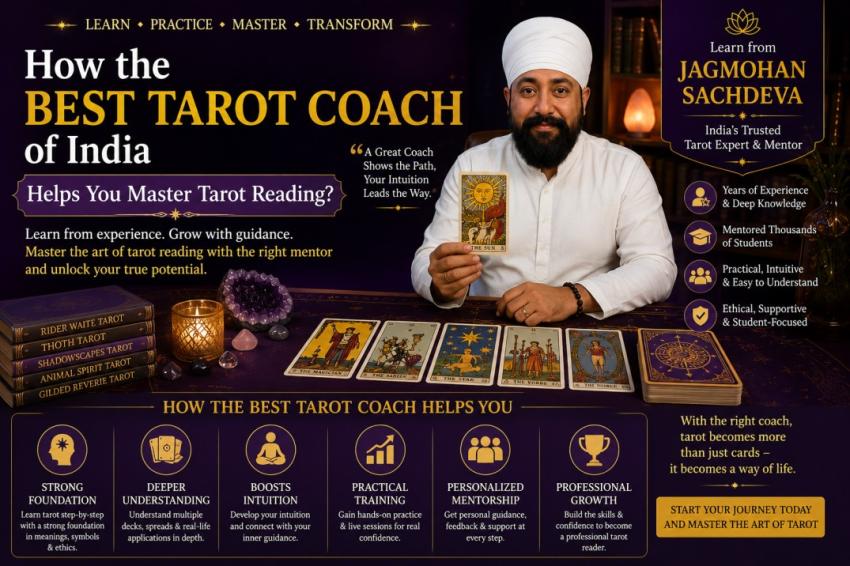
However, moving from a curious beginner who relies on guidebooks to a confident practitioner requires more than just memorizing 78 individual card definitions. Real mastery requires understanding energy, symbolism, and ethical counselling. This is where studying under a experienced mentor - such as learning from the Jagmohan Sachdeva- transforms a simple hobby into a meaningful, life-changing skill.
Here is a look at how professional coaching elevates a student's journey from basic card reader to intuitive master.
1. Decoding Beyond Textbook Definitions
The traditional 78-card Tarot deck is rich with complex visual imagery, color symbolism, numerology, and elemental associations. While beginner books provide standardized meanings, real-life client scenarios are rarely black-and-white.
A top-tier coach helps students move beyond rote memorization by teaching them to interpret how cards interact with one another in a spread. By understanding how the Major Arcana reflects broad life cycles and how the Minor Arcana addresses daily emotional or situational dynamics, students learn to synthesize whole narratives rather than reading isolated keywords.
2. Activating and Trusting Intuition
The greatest hurdle for new practitioners is second-guessing their initial instincts. Many beginners hesitate during a reading out of fear of being "wrong."
Professional mentorship provides structured energy work, grounding techniques, and intuitive exercises designed to build psychological confidence. A seasoned mentor teaches students how to quiet analytical mind chatter and tune into subtle energetic cues, allowing intuitive insights to flow naturally during live sessions.
3. Mastering Dynamic Spreads and Case Studies
Reading for oneself is vastly different from conducting a session for a client facing a complex personal or professional dilemma. High-quality Tarot training emphasizes practical execution over pure theory.
Through guided case studies and supervised practice sessions, students master a variety of techniques:
- Focused Decision-Making Spreads: Crafting 3-card or custom layouts to resolve specific dilemmas.
- Comprehensive Life Overview Spreads: Navigating complex 10-card Celtic Cross configurations for detailed long-term insights.
- Framing Constructive Questions: Teaching clients how to ask open-ended, empowering questions rather than seeking passive predictions.
4. Establishing Ethical Counseling and Professional Boundaries
Tarot is fundamentally a supportive tool, and readers often encounter clients dealing with heightened emotional vulnerability. An essential duty of a master coach is instilling a strong code of professional ethics.
Students learn crucial boundary-setting skills, including how to handle sensitive topics with empathy, maintain strict client confidentiality, and avoid fostering emotional dependency. Understanding how to deliver honest guidance without invoking fear is what separates an amateur hobbyist from a respected professional consultant.
Conclusion
Mastering Tarot is an empowering journey that bridges analytical structure with deep intuitive awareness. By seeking guidance from an established mentor, aspiring readers skip years of trial-and-error, gaining the technical knowledge, practical experience, and ethical grounding needed to provide clarity - both for themselves and for others.