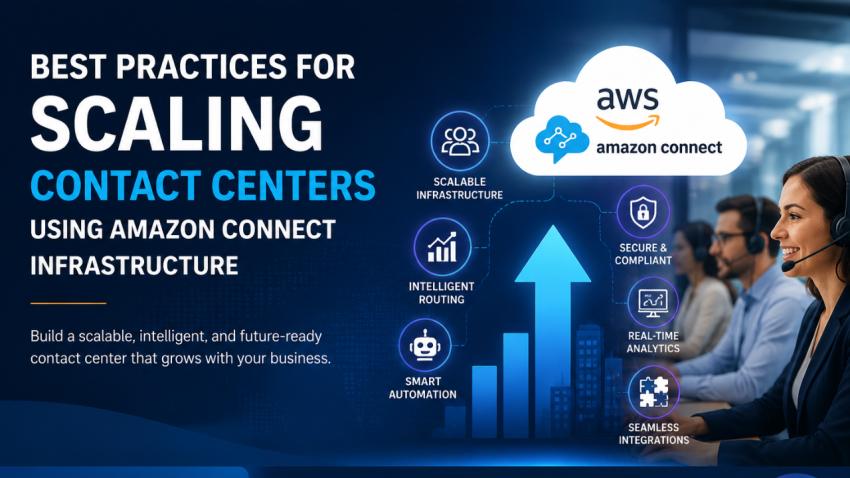
Customer expectations are rising faster than most contact centers can adapt. One viral promotion, seasonal rush, product launch, or service outage can multiply your contact volume overnight. The real challenge is not handling today's calls. It is building a contact center that continues delivering excellent customer experiences as demand grows.
Many organizations discover that scaling is not just about adding more agents. It is about creating an infrastructure that expands without sacrificing speed, reliability, security, or customer satisfaction.
That is where AWS Amazon Connect changes the conversation.
As a cloud native contact center platform, it gives businesses the flexibility to grow without the traditional limitations of on premises systems. But simply moving to the cloud is not enough. The real value comes from designing your infrastructure with scalability in mind from day one.
If you're planning to grow your customer support operation, these best practices will help you build a contact center that is ready for the future.
Why Contact Center Scalability Matters
Every customer interaction shapes your brand.
Long wait times, dropped calls, frustrated agents, and disconnected systems quickly turn loyal customers into unhappy ones.
A scalable Amazon Connect infrastructure helps organizations:
- Handle sudden spikes in customer demand
- Support remote and hybrid workforces
- Expand into new regions
- Add communication channels without rebuilding systems
- Control operational costs
- Maintain consistent customer experiences
Cloud infrastructure has shifted contact centers from fixed capacity planning to flexible, demand driven operations that automatically adjust as customer needs change. Amazon Connect is designed to automatically scale with customer demand while allowing organizations to pay only for the resources they use.
Start with a Scalable Architecture
One of the biggest mistakes companies make is designing for today's call volume instead of tomorrow's growth.
Think beyond your current team size.
Ask yourself:
- Will you support multiple locations?
- Will you launch new products?
- Will you expand internationally?
- Will you add chat, SMS, or email support?
Building modular architecture allows you to grow without redesigning your environment every year.
Instead of creating one large contact center, organize services into logical components that are easier to maintain, monitor, and improve.
Keep Routing Simple but Intelligent
Many organizations create dozens of queues as they grow.
Eventually, managing those queues becomes more difficult than handling customer interactions.
Instead of multiplying queues unnecessarily, build routing strategies around customer intent, business priorities, and agent expertise.
Smart routing ensures customers reach the most qualified agent quickly while reducing unnecessary transfers and improving overall efficiency.
Benefits include:
- Shorter wait times
- Better first contact resolution
- Higher agent productivity
- Improved customer satisfaction
Prepare for Unexpected Traffic Spikes
No forecast is perfect.
Weather events, product recalls, software outages, and marketing campaigns can instantly increase customer demand.
Scalable infrastructure should already have a response plan before the first call arrives.
Effective practices include:
- Dynamic staffing
- Callback options
- Automated self service
- Real time queue monitoring
- Flexible routing rules
- Overflow handling
Cloud based contact centers make it much easier to onboard additional agents quickly and adjust customer flows during periods of high demand.
Use Automation Wherever It Adds Value
Customers do not want to wait for answers to simple questions.
They want quick resolutions.
Automating repetitive interactions allows human agents to focus on more complex conversations.
Examples include:
- Order status requests
- Password resets
- Appointment confirmations
- Payment information
- Frequently asked questions
Automation improves response times while reducing operational costs.
The goal is not replacing agents.
It is allowing agents to spend more time solving problems that actually require human expertise.
Design Around the Customer Journey
Many contact centers optimize internal processes instead of customer experiences.
Customers think differently.
They only care about reaching the right person quickly.
Review every customer touchpoint:
- IVR menus
- Queue transfers
- Authentication
- Callbacks
- Agent handoffs
- Follow up communication
Remove unnecessary steps wherever possible.
A shorter customer journey usually produces higher satisfaction scores.
Build Data Into Every Decision
Scaling without visibility creates expensive mistakes.
Monitor metrics that actually influence customer experience:
- Average speed of answer
- First contact resolution
- Queue abandonment
- Customer satisfaction
- Agent utilization
- Contact volume trends
Real time analytics help managers identify bottlenecks before they become service failures.
Historical reporting also supports better workforce planning as demand grows.
Prioritize Security from Day One
Growth often increases security risks.
Customer conversations contain sensitive information that requires strong protection.
As your contact center expands, security should scale alongside it.
Best practices include:
- Identity and access management
- Multi factor authentication
- Role based permissions
- Data encryption
- Audit logging
- Compliance monitoring
Strong security builds customer trust while reducing operational risk.
Support Remote and Hybrid Agents
Modern contact centers are no longer tied to physical offices.
Many organizations now employ distributed teams across multiple cities, states, or countries.
Cloud infrastructure makes remote work far easier to manage.
Ensure agents have:
- Reliable internet connectivity
- Secure authentication
- Standardized equipment
- Performance monitoring
- Ongoing coaching
Consistent support tools help remote employees deliver the same experience customers expect from office based teams.
Integrate Your Business Systems
Customers dislike repeating information.
Disconnected platforms often force agents to ask the same questions multiple times.
Connect your contact center with systems like:
- CRM platforms
- Help desk software
- Billing applications
- Knowledge bases
- Marketing automation
- Business intelligence tools
Integrated systems reduce handling time while creating more personalized customer experiences.
Continuously Optimize Instead of Waiting for Problems
Scalability is not a one time project.
Customer expectations evolve.
Business priorities change.
Technology improves.
The best contact centers regularly evaluate:
- Routing performance
- Customer feedback
- Agent productivity
- Automation opportunities
- Infrastructure utilization
- Operational costs
Small improvements made consistently produce significant long term results.
How Tollanis Helps Organizations Scale Faster
Technology alone does not guarantee success.
Many organizations struggle with architecture planning, migration, integration, optimization, and ongoing management.
Tollanis helps businesses design scalable cloud contact center environments that align technology with operational goals.
From planning infrastructure to implementing intelligent workflows and optimizing customer experiences, Tollanis helps organizations build contact centers that grow confidently without unnecessary complexity.
Whether your business is supporting hundreds or thousands of customer interactions each day, the right strategy ensures your contact center remains reliable, efficient, and ready for future growth.
Final Thoughts
Scaling a contact center is no longer about purchasing larger phone systems or hiring more agents.
It is about building flexible infrastructure that adapts as customer expectations evolve.
Organizations that invest in intelligent routing, automation, analytics, security, seamless integrations, and continuous optimization position themselves for long term success.
With AWS Amazon Connect providing the cloud foundation and experienced implementation partners like Tollanis guiding strategy and execution, businesses can create contact centers that are prepared for today's demands and tomorrow's opportunities.
The organizations that scale successfully are not the ones with the biggest support teams. They are the ones with the smartest infrastructure.