These days, selling products online is very competitive. They want an uninterrupted shopping process from the instant they make a request to the moment it arrives on their doorstep. Fast shipping, accurate order processing and real-time tracking are no longer premium but standard expectations. To cater to those requests, a number of firms are now connecting their online shops with durable and also expert satisfaction providers across the USA.
Shipping integration is not only cost-effective, but it also automates your shipping. It integrates your store, stock, warehouse and carriers into one seamless system. It minimizes the need for manual efforts, enhances order accuracy, and offers an excellent customer experience. It doesn't matter whether your order fulfillment needs are tremendous or just for a small eCommerce business — as long as they align well, the suitable strategy can help to grow sustainably over time.
This guide walks you through how to connect your eCommerce business with U.S. fulfillment solutions, the advantages of automation and which things are most important as you decide on a logistics partner.
Why 3pl Services Are Essential for Online Stores
In fact, when volume picks up and sales increase, manual management of orders becomes a challenge. All that time spent packing products, updating inventory, and organizing shipments means less time focused on growing your business.
However, professional 3pl services use cutting-edge warehouse systems and an integrated shipping network that will help businesses to solve these problems automatically. So, rather than trying to take care of every touch point themselves, merchants turn to seasoned fulfillment experts to oversee storage, packing, shipping and returns.
The benefits include:
Faster order processing
Improved inventory accuracy
Lower operational costs
Better customer satisfaction
More time to focus on business growth
With online sales ever-growing, outsourcing fulfilment is a realistic solution for companies of all sizes.
Understanding Online Store Integration
Most online store integrations tie your eCommerce platform directly to your fulfillment provider.
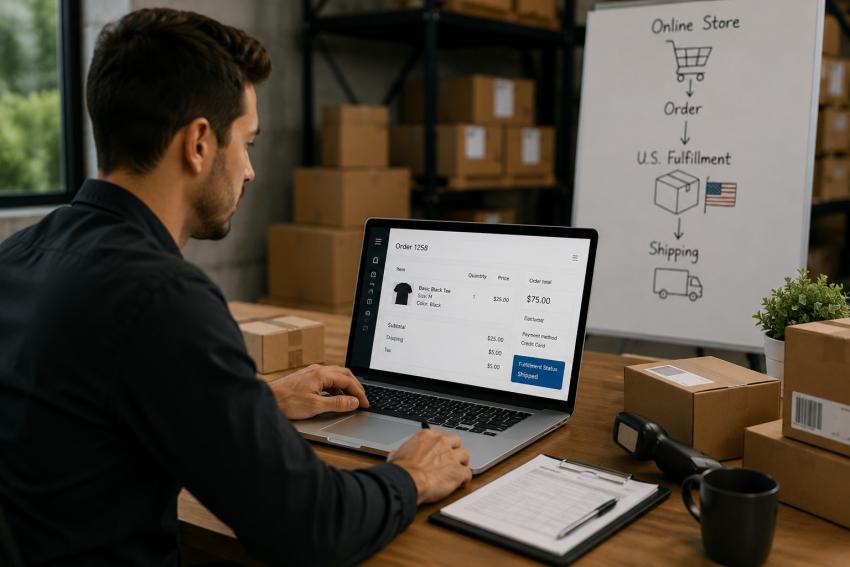
When connected, information flows automatically between the two systems. There is no manual input as all orders are sent to the warehouse, inventory is synced every second and customers are notified directly after dispatch with the shipping tracking.
This automation also avoids many common fulfillment errors while shortening wait times.
Integrated systems ensure your business runs smoothly day to day and provides visibility across the supply chain.
Choosing the Right eCommerce Platform
The majority of modern fulfillment providers support integration with mainstream online selling platforms.
Popular options include:
Shopify
WooCommerce
BigCommerce
Magento
Wix
Amazon Marketplace
Make sure that the fulfillment provider directly connects to your current platform or has an API for it before you consider using one.
Having a compatible integration simplifies the setup process and avoids technical issues in the future.
Selecting Reliable 3pl Solutions
Not all logistics service providers will have the same capabilities. Picking the appropriate partner is not straightforward, however.
Reliable 3pl solutions should provide:
Warehouse Network
Having multiple warehouse locations places products nearer to customers which helps bring down the shipping time.
Technology Integration
Modern software should automatically synchronize orders, inventory and shipment tracking too.
Inventory Management
Real-time stock visibility prevents overselling and inventory shortage.
Shipping Flexibility
Multicarrier functionality allows giving the most delivery options while keeping expenses healthy.
Assessing these features prior to reaching a contractual agreement brings positive operational outcomes for the long haul.
Preparing Your Product Data
Achieving a prosperous integration is heavily reliant on precise product details.
Get your house in order before connecting your online store:
Product names
SKU numbers
Product dimensions
Weight
Packaging requirements
Inventory quantities
Improved warehouse accuracy and fewer mistakes made when fulfilling an order with high-quality product data.
Regular Data Maintenance Also Helps Build Better Business Reporting and Inventory Forecasting
Connecting Your Store to 3pl Services
For any integrating application, if both systems have the option to connect directly, the integrations are generally uncomplicated.
Most providers follow these steps:
Create Your Fulfillment Account
Register your business and enter warehouse-related needs.
Connect Your Store
Approve the integration within your eCommerce platform.
Import Products
Import your product list into the inventory management system
Send Inventory
Send inventory to the designated fulfillment center.
Begin Order Processing
As we receive inventory, orders from our customers naturally flow to the warehouse.
Because of its minimal setup requirements, businesses can begin processing orders with limited interruptions.
Automating Inventory Management
A significant portion of customer satisfaction stems from inventory accuracy.
Inventory is automatically synchronized the moment products are sold, received and returned in integrated systems.
Automotion helps businesses:
Avoid overselling
Monitor stock levels
Plan future purchases
Reduce manual inventory updates
Improve forecasting
With real-time inventory visibility, merchants can make faster and informed decisions across their business.
How 3pl Order Fulfillment Improves Efficiency
Fulfillment encompasses all aspects of your logistics process from picking to packing to labeling, shipping and tracking.
Third-party order fulfillment operates on standard warehouse procedures that are expedited by modern tech and accurately created processes.
Key advantages include:
Faster shipping
Accurate order preparation
Professional packaging
Reduced human error
Improved tracking visibility
Customers like to get their orders correct and on time, engendering trust for further future purchases.
Integrating Shipping and Tracking
Consumers want visibility at each step of the delivery process.
Integrated fulfillment systems automatically generate:
Shipping labels
Tracking numbers
Delivery notifications
Order status updates
It helps with transparency and reduces the number of customer service inquiries that follow.
This enables businesses with real-time shipment visibility to act fast in case of shipping issues.
Managing Returns Efficiently
One big part of customer satisfaction is returns.
A systematic return process builds trust and prompts customers for a repeat purchase.
Effective return management includes:
Simple Return Requests
Instructions should be clear and easily visible for returning the product.
Fast Inspection
Quick Check-up on Returned Items After Arrival
Inventory Updates
Available inventory should be adjusted right away on accepting returns.
Prompt Refunds
Grabbing refunds quickly increases client trust and builds brand loyalty.
Returning orders can integrate these processes, and many professional fulfillment providers help simplify the process with dedicated return management systems.
Why Businesses Choose a Full Service 3PL
With operations scaling, logistics and supply chain management becomes progressively more complex to manage internally.
A complete logistics support offered by the one provider is called as full service 3 pl.
Typical services include:
Warehousing
Inventory management
Order processing
Shipping coordination
Returns management
Reporting and analytics
One provider means more streamlined communication and it leads to better operational efficiency.
For growing businesses, predictability of processes and response capability to scale up fulfillment is critical.
Using Data to Improve Performance
Integrated fulfillment systems yield buoyant operational intelligence.
Businesses can monitor:
Order volume
Shipping speed
Inventory turnover
Return rates
Delivery performance
Warehouse productivity
Such reports help in picking improvement areas as well as supporting improved planning.
In most cases, decision-making that scans from data results in either lowering operation costs or enhancing customer satisfaction.
Scaling Your Business with Professional Fulfillment
As the order volume rises, so does the need for fulfillment.
Through integrated logistics systems, they are able to expand without adding large fixed expenses for warehouse space, equipment and employees.
Seasonal Peaks & Promotional Campaigns: The reliable 3pl solutions offer the flexibility in capacity expansion during these.
This scalability enables companies to quickly meet changes in business conditions without affecting service delivery.
Common Integration Mistakes to Avoid
All it means businesses need to plan before implementing otherwise there will always be a possibility of having problems unnecessarily.
Common mistakes include:
Using inaccurate product data
Ignoring inventory synchronization
Choosing incompatible software
Delaying system testing
Failing to monitor fulfillment performance
Routine system reviews help to keep things running seamlessly, and prevent expensive interruptions.
Selecting the Right Fulfillment Partner
Selecting a logistics provider is not simply choosing the lowest quote in freight.
Important evaluation factors include:
Technology compatibility
Warehouse locations
Shipping speed
Inventory accuracy
Customer support
Reporting capabilities
Scalability
With industry-tuned knowledge, and tailored offerings that facilitate a more efficient warehouse and improved delivery performance across everyone in the chain, one such player is QS Global Logistics.
The Future of 3pl Services
Technology is on a course to change the online fulfillment landscape over the next few years.
Artificial intelligence, warehouse automation, predictive inventory management and real-time analytics will allow each part of the supply chain to operate with even greater speed and accuracy.
This means that the businesses which invest in integrated logistics systems today will set themselves up to be more capable of managing the growth and increasing customer expectations tomorrow.
This means that professional 3pl services will continue to be linked with effective eCommerce functions as they enable a better quality of delivery and control, all while helping businesses reduce manual work in favour of improving efficiency. With effective 3pl solutions, reliable order fulfilment and a seasoned full service 3pl in place, online retailers can formulate a sustainable operations structure that is scalable in the future.
Linking your stateside fulfillment services to your e-commerce store is more than just a technical upgrade. It's a wise choice that brings efficiencies in every aspect of the operation, enhancing customer relations and setting the tone for long-term sustainable business growth.