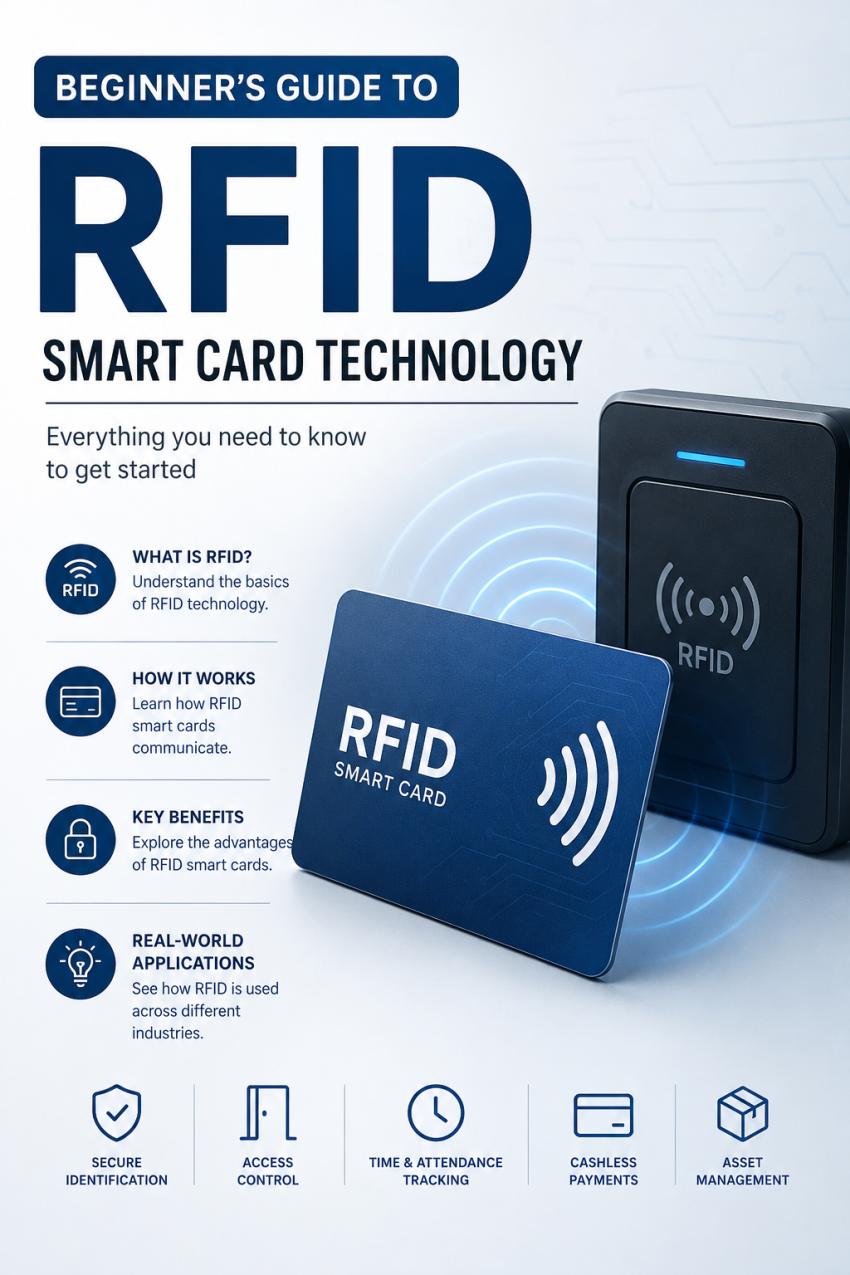
Organizations, businesses, schools, and hospitals are transitioning to smarter and more secure identification in today's digital world. RFID smart card technology is one of the most widely used ones that aid in this transformation. From attendance at school to cashless payments, public transport, and much more, we use RFID cards in a myriad of applications without realizing it, and it's no wonder they've become an integral part of our everyday lives.
For those who are new to the RFID technology and would like to know what RFID smart cards are, how they work and where and why are they being used.
What is the smart card technology RFID?
RFID is an acronym for Radio Frequency Identification. It's a wireless technology that uses radio waves to communicate information between a smart card and reader device. RFID smart cards do not require contact to work, unlike the magnetic stripe cards.
The RFID smart card has a small microchip and an antenna also within the card. As the card approaches an RFID reader, the reader broadcasts radio waves which will energize the card's chip and transmit reliable data back and forth.
This non-contact interaction makes RFID cards quick, secure and very convenient.
The operation of RFID smart cards.
The use of RFID cards is not as complicated as it may sound. The technology mainly involves three components:
RFID Smart Card
The card contains:
A small chip that contains information.
An antenna for sending out signals
Secure identification information
RFID Reader
The reader transmits RF signals to see if RFID cards are in the vicinity. It can read the information it stores and process it in a split of a second once detected.
Software System
The software can interact with the reader to verify identity and/or allow access, to record attendance or to complete a transaction.
For instance, upon tap of an RFID ID card at a school gate, the system could take attendance and send a text message to the parents.
Types of RFID Smart Cards
There are various frequency bands of RFID smart cards for various applications.
Low Frequency (LF)
Operates at 125 kHz
Short reading range
Familiar with some of the common features of attendance systems.
High Frequency (HF)
Operates at 13.56 MHz
Improved performance and safety.
Application of metro cards, payment systems and access control
Ultra High Frequency (UHF) is another name for high-frequency radio.
Longer reading distance
Inventories and logistics management
They are used for different purposes in relation to their speed, range and security needs.
The main advantages of RFID Smart Card Technology are:
The key benefits of RFID Smart Card Technology are:
The use of RFID technology has proliferated as a way to make processes more efficient, convenient and secure in various industries.
Contactless and Fast
Users tap or wave the card close to the readers. There is no need to swipe or insert the card physically.
Improved Security
Unlike conventional cards, RFID cards can be reused and encrypted information is stored.
Durability
Because they don't need to be touched, the RFID cards are less prone to wear and tear as time goes on.
Efficient Data Management
Integrated systems make attendance management, employee access, visitor records, and inventory management simple.
Multi-Purpose Usage
An RFID card can be used for multiple purposes like access control, attendance, library operations, cashless payments etc.
Some common applications of RFID smart cards.
Due to the flexibility and convenience of RFID technology, it has been widely used in various industries.
Schools and Colleges
RFID student ID cards are issued to students to be used in educational institutions for:
Attendance management
Library access
Transportation tracking
Campus security
Schools now tend to opt for RFID student ID cards as they reduce administration time and enhance safety.
Corporate Offices
RFID Access cards are used by businesses to manage access to employees in restricted areas and for access control.
Healthcare Industry
In the healthcare industry, RFID cards are utilized for employee identification, patient tracking, and secure access to patient records.
Retail and Hospitality
Commercial or retail applications include hotels (RFID key card access), inventory control and loyalty programs.
Transportation
Many tickets, such as metro cards and public transport passes, employ RFID to enable contactless, fast ticket validation.
How secure are RFID Smart Cards?
Among the top motivating factors for organizations to implement RFID are security. Today, the RFID card is also equipped with encryption and authentication mechanisms, which help to secure sensitive information.
But system set up is also a factor in security. Businesses should use:
Encrypted RFID cards
Secure card readers
Updated software systems
Controlled access permissions
Professional RFID card providers offers a higher quality and increased protection against cloning or unauthorized access.
How IVYPrints can Support RFID Smart Card Solutions.
Schools, college, offices, and businesses in India can avail of the custom-made RFID smart card printing solutions offered by ivyprints The company provides top-quality PVC RFID cards which are durable, professional and secure to perform.
The following are some of the more popular RFID card choices offered by IVYPrints:
Student ID cards
Employee access cards
Attendance cards
Membership cards
Visitor management cards
The ability to add custom branding, barcode, QR code, magnetic strip, and smart chip technology can also be included depending on the organization's needs.
Professionally printed RFID cards provide a sense of security and organization for institutions aiming to upgrade their identification processes.
Before selecting RFID Cards, there are some issues that you should keep in mind.
However, it is crucial to consider the requirements of your organization before choosing RFID smart cards.
Card Frequency
Select the appropriate card from the following options: LF, HF, or UHF, depending upon the distance you need to read and the application.
Compatibility
Make sure the RFID cards can be used in your current reader systems and software.
Printing Quality
Professional printing renders print durable and enhances brand image.
Security Features
If security is important, check for encryption, authentication and anti-cloning capabilities.
Customization Options
Many organizations like to have specially designed logos, pictures, QR codes, employee or student information, etc. on the cards.
Future of RFID Smart Card Technology
RFID technology is still developing at a rapid pace. With the business and institutional automation and digitization, RFID smart cards are likely to be used more prominently.
Future developments may include:
Enhanced mobile integration
Advanced encryption systems
Biometric-linked RFID cards
Cloud-based access management
Smarter IoT connectivity
Due to its convenience and reliability, RFID solutions are becoming common in all industries all around the world.
Conclusion
The past decade has seen the introduction and adoption of RFID smart card technology, which has revolutionized security, attendance, identification, and access control. It is contactless, fast and reliable – an ideal choice in schools, businesses, hospitals and public systems.
The first step to smarter identification systems is to understand RFID technology, which is the term for the new technology. From student ID cards to employee access cards to smart cards that are customized, RFID solutions are efficient and secure in the long term.
As trusted providers such as IVYPrints provide customizable RFID smart card printing solutions, companies can effortlessly execute expert and secure card systems to suit their requirements.