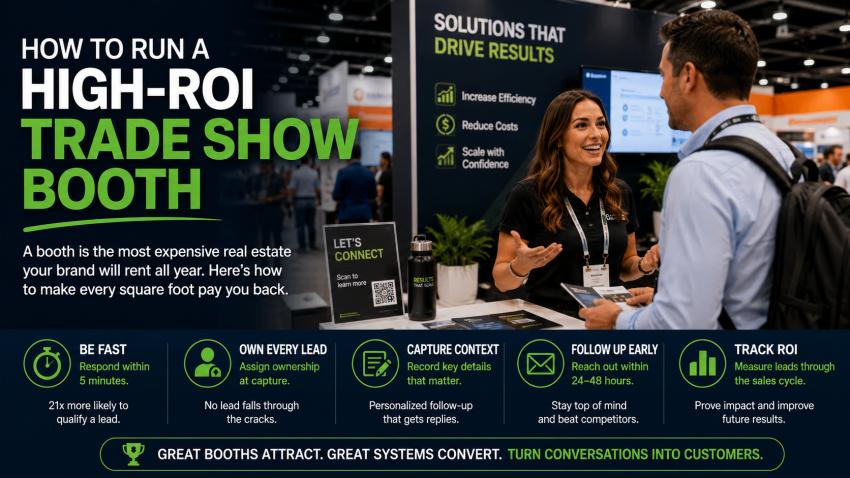
A booth is the most expensive real estate your brand will rent all year. Here’s how to make every square foot pay you back.
I’ve walked the floor of enough trade shows to notice a pattern that never really changes. Two booths, same size, same location, same industry. One team is exhausted but energized on day three, already talking about next quarter’s pipeline. The other is packing up a box of business cards nobody’s going to look at again. Same show. Wildly different outcomes.
The gap usually isn’t the booth. It’s rarely even the staff. Most exhibitors I’ve watched are perfectly capable of having a good conversation with a stranger. What separates the two teams is what happens in the ninety seconds after that conversation ends, and then again in the seventy-two hours after the show closes. That’s it. That’s the whole game.
Exhibitors typically spend somewhere between $10,000 and $30,000 to be at a show — booth, travel, staff time, the giveaways nobody asked for. That’s real money, and treating it as a marketing lottery ticket is how most of it gets wasted. Trade show booth ROI isn’t something that happens to you. It’s something you build, on purpose, before you ever step onto the floor.
The Uncomfortable Math Behind Trade Show ROI
The element that shocks people is that trade exhibitions do perform. According to CEIR's research, the return on investment is $20.98 for every dollar spent, and over half of corporate executives claim that events outperform all other channels. The cost per lead is about $112, which seems inexpensive when compared to a field sales call that costs $259. Exhibiting appears to be one of the simplest victories in the marketing budget if you just look at the headline figures.
Then you look at what actually happens after the badge gets scanned, and the picture gets uglier. Something like 94% of marketers admit their company doesn’t convert event leads into real opportunities. Roughly 80% of leads collected at a booth never get a single follow-up email or call. Not a bad email — no email. And this isn’t because the people walking the floor are tire-kickers; industry data consistently shows around 81% of trade show attendees actually hold buying authority.
So the leads are good. The ROI potential is real. What’s broken is almost always what happens between the handshake and the CRM.
A few more numbers make the picture painfully clear. Only 47% of exhibitors bother tracking a lead all the way through their sales cycle, so most companies genuinely don’t know which leads paid off. Only 6% say they’re confident they’re converting effectively. And close to 40% of exhibitors wait three to five days before reaching out — an eternity when your prospect meets four competitors that same week and one of them has already called.
None of that is a strategy problem you fix with a nicer banner stand. It’s an execution problem, and it’s fixable.
Speed Is the First Thing to Get Right
Picture the standard booth workflow, because it’s probably familiar. A staffer has a great five-minute chat, takes a card, jots “interested — follow up” on the back in handwriting only they can read, and drops it in a tote bag. By 6 p.m. that tote bag has forty cards in it. Nobody touches them again until the flight home, if then.
Prospects who are approached within five minutes of expressing interest are around 21 times more likely to qualify than those who are contacted thirty minutes later, according to nearly devastating data. Twenty-one times. Twenty-one times, not twenty-one percent. That's the distinction between a pipeline and a stack of cards, not a rounding error.
Therefore, even if it requires discipline to implement, the solution isn't difficult in theory. Instead of at the end of the day, capture must occur as soon as the conversation concludes. This entails avoiding the paper completely whenever possible. Instead of sitting in a pocket gathering lint, the contact can be entered into a system in a matter of seconds with a simple tap or badge scan.
And as soon as a lead is captured, it must be owned by someone. You wouldn't believe how many teams are affected by this. Everyone believes that someone else is managing a lead that is sitting in a shared inbox or spreadsheet tab. No one is. Assign ownership at the point of capture, such as "this rep, this lead, done," so that any uncertainty is eliminated before it has a chance to ruin the follow-up.
Why Leads Actually Die at the Handoff
Don't blame the leads if you want to discover why 80% of leads expire. The handoff is to blame. Three days following the performance, sales receives a spreadsheet from marketing. Sales believes that marketing has already made contact. Marketing believes that sales was working the list in real time. Nobody is particularly incorrect; everyone is courteous, and the prospect never receives a response. The majority of the leak can be fixed by fixing the handoff.
The Follow-Up Actually Lands Because of the Context
Half the difficulty is solved when you quickly get a name and an email. Recalling why that individual was important in the first place makes up the other half.
The majority of booth notes are worthless. A happy countenance, "interested," and "good convo" don't tell a sales representative anything three days later. Additionally, no one who spoke with five vendors that week is duped by a generic template email. They can distinguish between a message that was sent directly to a spreadsheet and one that mentions their real issue.
In the context of a booth shift, the extra twenty seconds each talk that the superior habit requires is nothing. Take note of what they actually said rather than a general statement: they're considering switching from their present vendor, their budget is roughly $50K, they need something live by Q3, and they're concerned about their team's learning curve. It's easy to write that down. Because everyone is currently preoccupied with the next person approaching, it is just rarely done.
There is a huge difference when a representative opens the lead a day later. They are picking up a specific conversation rather than cold-emailing a stranger. "Great to meet you at booth 42!" is entirely different from "You mentioned needing this live before Q3 – here's exactly how fast we can get you there."
Follow-Up Timing Decides Almost Everything Else
Here’s where most of the money that was already spent gets thrown away. Companies that follow up within 24 hours see roughly three times the pipeline value of those that wait. Three times, from the same leads, just by moving faster. And yet the average exhibitor still waits three to five days, which by trade show standards is close to forever.
The typical failure mechanism is as follows: a team gathers 150 cards over the course of three days, goes home on Friday fatigued, and on Tuesday of the following week, someone finally sits down and sends out a batch email to the entire list. From the student who requested the free t-shirt to the CFO who posed a pointed price query, the same subject line and body copy were sent to everyone. It barely moves the needle, is slow, and lacks personal connection.
Contrary to popular belief, what truly works is not as flashy. It's just quick and targeted; it's not a clever email. Before the show even begins, draft your follow-up scenes. Determine who owns what. Additionally, if at all possible, send that initial message within hours rather than days, mentioning the particular issue that the recipient was interested in. When you combine speed with context, you get compounding returns: the message appears to have been written by someone who was truly listening, and it lands when the memory is still fresh.
Where a Tool Like RoloScan Actually Helps
I’ll be honest — most of this article is about discipline, not software. You don’t need a tool to write a better note or assign ownership faster. But at a certain booth size, doing this by hand starts to fall apart, and that’s usually where something like RoloScan earns its keep.
The mechanics are straightforward. A staffer scans a badge or business card on their phone, RoloScan pulls the contact details and fills in company and title automatically, and it lands in your CRM without someone re-typing it that night. Whoever worked that conversation can drop in a quick note right there — what the prospect cares about, what they need, when they need it — and that note travels with the contact instead of getting lost on a scrap of paper. From there, it can draft a follow-up that references the actual conversation, so the rep isn’t starting from a blank page days later.
Good booth talks and a well-planned follow-up process are not replaced by any of this. It eliminates the elements that silently kill 80% of leads before a human has an opportunity to convert them, such as the misplaced card, the three-day wait, and the unreadable letter. That's the difference between hunting after cards on the plane home and leaving the floor with a neat, well-organized list ready to work on Monday morning if you're managing a five-person booth across three days and speaking to a few hundred individuals.
ROI for a Trade Show Booth Depends on What You Do After the Conversation
The size of the monitor behind the booth or the color of the carpet do not determine a trade fair winner. Three unglamorous things are done well by exhibitors who consistently receive a high return: they follow up while the memory is still fresh rather than after it has faded for everyone involved; they write down what really matters rather than a vague note; and they capture the lead the moment the conversation ends rather than at the end of the day.
That $20.98-per-dollar number is real, but it’s an average, and averages hide a lot of exhibitors who left most of that value on the table. The prospects walking your floor mostly do have budget and buying power. Most of them will make a decision within a few months of the show. Whether any of that ends up in your pipeline has almost nothing to do with luck, and almost everything to do with whether your booth has a system for what happens after the handshake.