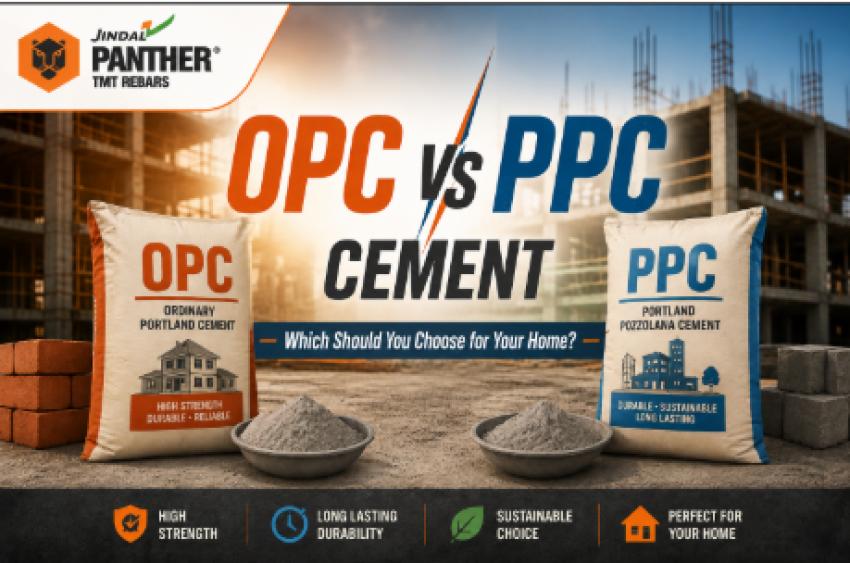
Choosing the right cement is one of the most important decisions when building a home. Cement acts as the binding material that holds the entire structure together, making its quality and type critical for the strength, durability, and longevity of the building. One of the most common questions among homeowners and builders is OPC vs PPC cement—which one is the better choice for residential construction?
Understanding the differences between OPC vs PPC cement can help you make an informed decision based on your project's requirements, budget, and environmental conditions. While both types of cement are widely used in construction, they differ in composition, strength development, durability, and applications.
In this detailed guide, Jindal Panther explains everything you need to know about OPC vs PPC cement, including their features, advantages, disadvantages, ideal applications, and how to choose the right one for your dream home.
What is OPC Cement?
Ordinary Portland Cement (OPC) is one of the oldest and most commonly used types of cement in the construction industry. It is manufactured by grinding a clinker with a small quantity of gypsum to control the setting time.
OPC is known for its high early strength, making it suitable for projects that require faster construction and early removal of formwork.
The commonly available grades of OPC are:
OPC 33 Grade
Suitable for plastering, masonry work, and non-structural applications.
OPC 43 Grade
Used for residential buildings, RCC structures, and general construction.
OPC 53 Grade
Preferred for heavy-duty construction, bridges, highways, and high-strength concrete.
What is PPC Cement?
Portland Pozzolana Cement (PPC) is produced by blending Portland cement clinker with pozzolanic materials such as fly ash or calcined clay. These materials improve the long-term durability and performance of concrete.
Compared to OPC, PPC develops strength more gradually but offers better resistance to moisture, chemicals, and environmental damage, making it a preferred option for many residential projects.
OPC vs PPC Cement: Key Differences
When comparing OPC vs PPC cement, understanding their characteristics makes it easier to choose the right option.
Feature
OPC Cement
PPC Cement
Full Form
Ordinary Portland Cement
Portland Pozzolana Cement
Composition
Clinker + Gypsum
Clinker + Gypsum + Fly Ash/ Pozzolanic Materials
Early Strength
High
Moderate
Long-Term Strength
Excellent
Excellent and improves over time
Heat of Hydration
Higher
Lower
Durability
High
Very High
Chemical Resistance
Moderate
Excellent
Crack Resistance
Moderate
Better
Environmental Impact
Higher
Lower
Best For
Fast construction
Durable residential construction
Composition of OPC and PPC Cement
One of the primary differences in OPC vs PPC cement lies in their manufacturing process.
OPC Cement Composition
OPC mainly contains:
Limestone
Clay
Clinker
Gypsum
These materials produce cement with rapid strength gain.
PPC Cement Composition
PPC contains:
Portland cement clinker
Gypsum
Fly ash or other pozzolanic materials
The addition of pozzolanic materials improves durability while reducing heat generation.
Strength Comparison
Strength is one of the most important considerations when comparing OPC vs PPC cement.
Early Strength
OPC gains strength rapidly during the first few days after casting.
This makes it ideal for:
Fast-track construction
Precast concrete
Projects requiring early formwork removal
Long-Term Strength
PPC gains strength gradually through continued hydration.
After proper curing, PPC often provides equal or even superior long-term strength compared to OPC.
Durability Comparison
Durability determines how well a structure performs over many years.
OPC Cement
Good durability
Suitable for normal environmental conditions
Performs well in residential construction
PPC Cement
Better resistance to moisture
Lower permeability
Superior resistance to sulfate attacks
Improved protection against corrosion
When discussing OPC vs PPC cement, PPC is generally considered the better option for long-lasting residential buildings.
Heat of Hydration
Heat generated during cement hydration can influence cracking.
OPC Cement
Produces relatively higher heat.
Suitable for:
Smaller structural members
Quick construction
PPC Cement
Generates lower heat during hydration.
Ideal for:
Large foundations
Thick slabs
Mass concrete
Residential structures requiring reduced thermal cracking
Workability
Workability affects the ease of placing and finishing concrete.
OPC Cement
Provides good workability for most construction applications.
PPC Cement
Generally offers better workability because of its finer particles.
Better workability results in:
Easier mixing
Better finishing
Improved compaction
Reduced segregation
Setting Time
Another important factor in OPC vs PPC cement is setting time.
OPC Cement
Sets comparatively faster.
Suitable for projects with tight construction schedules.
PPC Cement
Has a slightly longer setting time.
This provides additional time for transportation, placement, and finishing.
Environmental Impact
Modern construction increasingly focuses on sustainability.
OPC Cement
Produces higher carbon emissions because it contains more clinker.
PPC Cement
Uses industrial by-products like fly ash.
Benefits include:
Lower carbon footprint
Better utilization of waste materials
Reduced environmental impact
PPC is therefore considered a more environmentally friendly choice.
Applications of OPC Cement
OPC is commonly used in:
Residential RCC Structures
Suitable for beams, slabs, and columns.
High-Rise Buildings
Used where early strength is essential.
Bridges
Supports high-strength concrete requirements.
Roads
Ideal for projects requiring early opening to traffic.
Precast Concrete
Provides rapid strength gain for factory-made components.
Applications of PPC Cement
PPC is preferred for:
House Construction
Ideal for complete residential buildings.
Foundations
Provides better long-term durability.
Plastering
Produces smoother finishes.
Marine Structures
Offers excellent resistance to chloride attack.
Water Retaining Structures
Suitable for tanks and reservoirs.
Sewage Treatment Plants
Performs well under chemically aggressive conditions.
Advantages of OPC Cement
Choosing OPC offers several benefits.
High Early Strength
Allows faster project completion.
Quick Setting
Reduces construction time.
Easily Available
Available across India.
Suitable for Heavy Structural Work
Provides excellent compressive strength.
Advantages of PPC Cement
PPC offers numerous long-term advantages.
Better Durability
Provides longer service life.
Improved Chemical Resistance
Suitable for coastal and humid regions.
Lower Heat Generation
Minimizes cracking.
Better Finish
Produces smoother concrete surfaces.
Environment Friendly
Supports sustainable construction.
Disadvantages of OPC Cement
While OPC is highly popular, it also has certain limitations.
Higher heat generation
Greater shrinkage
Less resistance to chemicals
Higher carbon emissions
Disadvantages of PPC Cement
PPC also has a few disadvantages.
Slower early strength development
Longer curing period
Slightly slower construction progress
However, these limitations are often outweighed by its superior long-term performance.
Which Cement is Better for Home Construction?
When deciding between OPC vs PPC cement for your home, consider the following factors.
Choose OPC Cement If:
You need faster construction.
Early strength is important.
Formwork needs to be removed quickly.
You are working on precast elements.
Choose PPC Cement If:
You want better long-term durability.
Your home is located in a coastal or humid region.
You prefer sustainable construction materials.
Long-term maintenance costs are a concern.
For most residential projects, PPC is often preferred because it provides better durability and long-term performance. However, specific structural components may still require OPC based on the engineer's recommendations.
Why Jindal Panther Supports Quality Construction
Selecting the right cement is only one part of building a strong home. High-quality reinforcement steel is equally important.
Jindal Panther TMT bars are designed to complement both OPC and PPC cement by providing:
Superior Strength
Supports heavy structural loads effectively.
Excellent Ductility
Enhances earthquake resistance.
Corrosion Resistance
Protects reinforced concrete structures from rust.
Uniform Quality
Manufactured with advanced technology and strict quality standards.
Using premium cement together with Jindal Panther TMT bars helps create stronger, safer, and more durable homes.
Tips for Choosing the Right Cement
When comparing OPC vs PPC cement, keep these practical tips in mind.
Understand Your Project Requirements
Different projects require different cement properties.
Consult a Structural Engineer
Always follow professional recommendations.
Buy from Trusted Manufacturers
Quality cement ensures consistent performance.
Store Cement Properly
Protect cement bags from moisture and humidity.
Focus on Long-Term Performance
Avoid choosing cement solely based on price.
Common Mistakes to Avoid
Many homeowners make avoidable mistakes while selecting cement.
Buying cement without checking manufacturing dates.
Choosing cement only because it is cheaper.
Ignoring local environmental conditions.
Mixing different cement types without expert guidance.
Using poor-quality reinforcement steel.
Neglecting proper curing after concrete placement.
Avoiding these mistakes improves both structural safety and durability.
Conclusion
Choosing between OPC vs PPC cement depends on your construction goals, project timeline, and environmental conditions. OPC cement is an excellent choice for projects requiring rapid strength development and faster construction, while PPC cement offers superior durability, lower heat generation, improved resistance to chemicals, and long-term performance.
For most residential homes, PPC is often the preferred option because of its durability and sustainability. However, both cement types can deliver excellent results when used appropriately. Pairing quality cement with Jindal Panther TMT bars ensures a strong foundation, reliable reinforcement, and a home built to last for generations. By understanding the differences between OPC vs PPC cement, homeowners can make confident decisions that contribute to safe and high-quality construction.