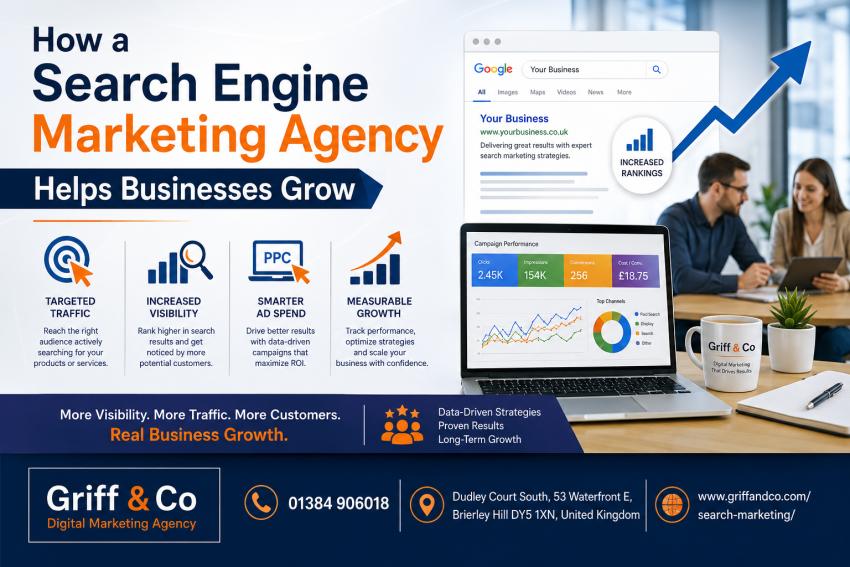
A business can have an excellent product, competitive pricing, and a well-designed website, yet still struggle to attract consistent enquiries. More often than not, the challenge isn't what the business offers but when potential customers discover it. Search engine marketing agency (SEM) helps close that gap by placing businesses in front of people who are actively searching for products or services.
Unlike advertising that interrupts people during their day, paid search appears when someone has already expressed interest through a search query. That difference matters. A person looking for "commercial cleaning services", "office refurbishment contractors", or "business insurance" isn't browsing aimlessly. They're actively looking for a solution, making those searches some of the best opportunities to connect with potential customers.
Why Search Engine Marketing Delivers Faster Business Growth
While organic traffic is still an important component of any digital marketing plan, it is not always achieved in an instant. It can take months to build authority, generate backlinks, and boost search rankings. When a business is starting a new service, entering a competitive market, or trying to generate extra enquiries, they may require the results more quickly.
Paid search marketing fills that gap and provides instant visibility for high-intent searches. The goal isn't to just get traffic - it's to get traffic that has a real chance of turning into a customer. Successful campaigns focus on attracting qualified visitors rather than simply increasing search volume.
The key to the success of a good search engine marketing firm is that it has to understand your customers first before it chooses keywords or makes any ads. Any advertising budget can be lost without this foundation.
Why More Clicks Don't Always Mean More Customers
The single biggest mistake in search advertising is to think that the more traffic, the more success. Experienced marketers regularly see the opposite.
Suppose two businesses spend the same amount of money per month. One campaign gets 2,000 clicks and gets just a handful of enquiries. Another receives only 500 visitors, but generates thirty qualified leads. The second campaign has a deliverable commercial opportunity as it targets people who are ready to take action rather than people who are only seeking information.
This is where metrics like CTR, CPA, and conversion rate gain far more significance compared to traffic numbers. By analysing more than just numbers, companies can determine if their ad investments are yielding real-world results or just driving website traffic.
Smart Keyword Targeting Goes Beyond Search Volume
Choosing keywords isn't about finding the phrases with the highest search numbers. It's about knowing how to recognise searches that indicate buying intent.
Let's take a manufacturer that is selling custom-built warehouse equipment. Using a broad keyword could attract students, researchers, or businesses that aren't ready to buy. More specific searches may generate fewer clicks, but may yield more meaningful inquiries.
Professionally managed Google Ads also encompasses the use of negative keywords, so that the ads don't show for irrelevant searches that cost money. When coupled with the right keyword match and bidding tactics, campaigns eventually become more focused, efficient, and profitable.
One of the reasons companies opt for a search engine marketing agency in the Midlands with experience in the regional market and commercial search behaviour is their attention to detail.
Small Campaign Adjustments Often Produce the Biggest Gains
Many underperforming campaigns don't require complete rebuilding. Small tweaks can make a big difference in the big picture.
These changes might sound like small tweaks, but refining advert copy, optimising targeting, optimising landing page speed, or tweaking bids during high enquiry times can all be crucial. They can work together to enhance the quality of leads and lower ad spending.
Google also takes into account advert relevance through Quality Score, which considers the relevance of the keyword, the assumed click-through rate and landing page experience. Improving ad relevance can lead to better ad positioning and lower cost per click.
These are not one-off jobs, but rather ongoing. Optimising campaigns is continuous, as search trends, competition and customer expectations are constantly changing.
Why Understanding Customer Intent Matters More Than Budget
While spending more on advertising is typically correlated with better campaign performance, spending more generally does not guarantee success. Increasing your budget won't fix campaigns with poor targeting or irrelevant adverts.
Think of a company that sells high-quality interior office products. A potential customer that's researching furniture suppliers is going to be looking for different things than one who is looking for cheap furniture or design ideas. If those differences are recognised, campaigns can then be aimed at commercial opportunities rather than curiosity clicks.
Search intent is also important in the design of landing pages. If the advert messages are congruent with the information visitors are looking for, they are far more likely to stay, explore and make an enquiry. This consistency helps to enhance the user experience and reinforce campaign effectiveness.
How Search Engine Marketing Supports the Entire Buying Journey
Very few customers make a decision after one search.
Someone researching accountancy services may visit three or four websites before requesting a meeting. A facilities manager sourcing commercial cleaning might compare reviews, pricing, and experience over several days. Larger purchasing decisions naturally involve more research.
Well-managed search advertising recognises this behaviour. Successful campaigns recognise that not every visitor converts immediately. Remarketing, audience segmentation, and thoughtful timing keep businesses in the spotlight without overwhelming potential customers.
This is especially effective in professional services, manufacturing, construction companies, healthcare organisations, and other businesses where purchasing decisions include several people.
Why Accurate Performance Tracking Shapes Better Decisions
Questions inevitably arise when enquiries begin to fluctuate. Has competition increased? Is demand changing? Have advertising costs become too high?
Taking a shot in the dark does not lead to accurate results.
Use accurate conversion tracking to gain clarity about which keywords, ads, devices, and landing pages are driving real business results. A keyword with a high cost per click may still be worthwhile if it consistently generates profitable enquiries. Another may generate high traffic but have low revenue.
Looking beyond click numbers enables businesses to make informed decisions based on measurable performance and not assumptions. It also shows seasonal changes, shifts in user behaviour, and ROI opportunities to maximise return on ad spend (ROAS) without spending more.
Choosing Professional Campaign Management Is an Investment, Not an Expense
It's not just about setting up adverts and reviewing their performance once a month.
Campaigns require ongoing leadership. Competitors tweak bidding strategies, customer search behaviour changes, and Google's advertising platform gets continuous updates. As a result of such changes, over time campaign efficiency can become reduced even with successful past campaigns.
This is why many organisations are opting to partner with a search engine marketing agency that has a proven track record in campaign strategy, audience targeting, bid management, landing page optimisation and continuous reporting. For businesses seeking local expertise, it may prove advantageous to hire a search engine marketing agency in the Midlands, especially if they aim to target local customers or expand their operations to nearby areas.
Successful campaign management is not about overnight success. It's about making strategic changes that will consistently enhance lead quality, minimise wasteful spending, and consistently generate long-term revenue.
Conclusion
Businesses rarely struggle because customers aren't searching. In most cases, they find it difficult because a competitor gets to them first with a more effective message, more relevant advertising, or a more effective user experience.
Search engine marketing offers a chance to reach customers just at the right time they are seeking a solution. However, successful results from those opportunities require careful planning, precise keyword targeting, insightful performance reporting, and long-term optimisation, not quick fixes.
With every campaign decision based on what customers want and real performance data, paid search is no longer just a channel of advertising. It turns into a reliable source of high-quality leads, better customer connections, and sustainable business growth.