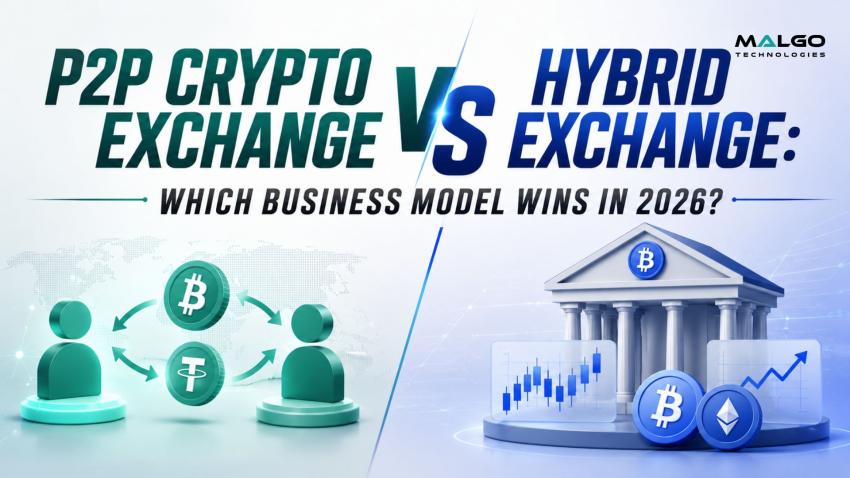
Cryptocurrency is developing at an accelerating pace, providing endless opportunities for startup businesses, fintech companies, and enterprises to establish trading platforms for digital assets. With increasing demand for cryptocurrency in all parts of the world and establishment of more regulatory bodies, entrepreneurs are seeking exchange models that can combine safety, convenience, scalability, and profitability.
Peer-to-Peer (P2P) crypto exchanges and hybrid crypto exchanges are two among many models of exchanges available today that show significant promise. Both models allow users to trade their cryptocurrencies successfully, but in terms of architecture, liquidity control, transaction management, and operation peculiarities, these models greatly differ from each other.
Selection of the right business model is one of the first tasks when planning the establishment of a crypto exchange. The perfect choice is based upon the specifics of your audience, budget, compliance policy, and goals.
Here, in this guide, we will discuss the main differences between P2P and hybrid crypto exchanges, their advantages, challenges, earning possibilities, and potential to choose the best model in 2026.
What Is a P2P Crypto Exchange?
Peer-to-Peer (P2P) crypto exchange refers to a type of marketplace where the customers make direct trades of cryptocurrencies without the platform serving as the counterpart for such transactions. In contrast to other types of platforms where transactions are carried out via a centralized order book, here the users create offers, agree on prices and choose payment options.
To provide security to transactions, the platform locks the cryptocurrencies of the seller in escrow until the buyer pays. Once the transaction is confirmed, the funds are automatically transferred. In this way, frauds are avoided and the users have additional freedom during the transactions.
The reason for the growing popularity of P2P exchanges is that they are convenient because they allow using various local payment options, have lower prices and make regional trading possible without keeping large liquid reserves.
For start-ups, the P2P approach appears to be a good way to get involved into the crypto currency exchange market.
What Is a Hybrid Crypto Exchange?
A hybrid crypto exchange combines the best aspects of a centralized and decentralized exchange. Such an exchange provides fast execution, good liquidity, and sophisticated trading instruments typical for centralized exchanges as well as many other security and transparency features that are common for decentralized exchanges.
Unlike conventional centralized exchanges where customers' funds are managed entirely by the platform, hybrid exchanges typically allow more flexibility in custody while providing high-speed matching engines, professional trading interface, and robust infrastructure.
Hybrid exchanges usually have several sources of liquidity, which means that traders can enjoy smaller spreads, faster execution, and better liquidity.
All these factors make hybrid crypto exchanges an ideal solution for companies that intend to attract professional traders and institutional clients.
P2P Crypto Exchange vs Hybrid Exchange: Key Differences
Although both exchange models facilitate cryptocurrency trading, they operate differently and serve different business goals.
Security Comparison: Which Model Is More Secure?
Security continues to be one of the main aspects that should be considered during the creation of the crypto exchange.
Peer-to-peer crypto exchanges concentrate on transaction security using escrow solutions, ID verification, reputational system, and disputes settlement. As all operations are made by users themselves, the platform usually holds less customer money which minimizes the effects of any potential breach of wallets.Hybrid exchanges use many security measures that include cold wallet holding, multisign authentication, encryption, monitoring, AI-based fraud detection, and security auditing. The structure of the business allows them to protect customers' money and trading systems from any modern cyber attacks.
When analyzing business from the perspective of security issues, it could be said that hybrid exchanges have better infrastructure security, and P2P platforms minimize the risks of custody by storing less cryptocurrency.
Liquidity and Trading Experience Compared
Liquidity is directly linked to user satisfaction and growth in the marketplace. The P2P platforms depend on the user to make trades through placing bids. Consequently, liquidity will be determined by the amount of participants that are actively taking part in the transactions. During periods of low participation, users will wait longer to conclude the transactions.
The hybrid platforms have incorporated professional liquidity providers in the trading system. This means that the trading process is completed in a shorter time. It leads to tighter spreads and improved order execution, hence making the transaction very convenient for traders. The businesses that target professional traders gain more from such liquidity.
Regulatory Compliance and Business Considerations
Regulations concerning cryptocurrencies are becoming stricter, and the need for compliance becomes a vital issue when developing any kind of exchange. Nowadays, most exchanges have to be equipped with such tools as KYC, AML systems, reporting, and risk management.
Peer-to-peer exchanges are prone to extra problems due to the large variety of local payment options available and direct transactions with users. Proper monitoring and automation of the verification process will help to minimize risks of fraud and comply with regulations.
Hybrid exchanges are usually more advanced in terms of compliance because they have to cope with bigger volumes of trades and institutional investors. Any exchange type you choose has to be designed in such a way that it could fit the changes in regulation.
Development Cost and Technical Complexity
Development complexities are quite different for each exchange model. Peer-to-peer exchanges usually need capabilities such as escrow services, identity authentication, disputes management, payments gateways, wallets and merchant ratings among others. The architecture of such exchanges is relatively simple when compared to trading platforms that operate at an enterprise level.
Hybrid exchanges need a much more advanced infrastructure. They integrate both centralized trading engine with decentralization while offering capabilities such as performance order matching, liquidity provision, advanced charting and API access, secure wallets and cloud infrastructure.
Even though hybrid exchanges have higher complexity than others, they offer better scalability for organizations that want to compete in global cryptocurrency market space.
Revenue Opportunities for Each Business Model
Each of these exchange models has several monetization options apart from transaction costs. P2P exchanges usually make money by means of collecting transaction fees, escrow services fees, merchant verification services, premium listings, advertisement space, withdrawal fees, and fiat payment processing services.
The hybrid model has even more sources of income that include spot trading commissions, futures trading fees, margin trading, staking services, token listings, liquidity partnership, API fees, institutional accounts, custody services, and white labeling. Since hybrid exchanges are able to work with more sophisticated financial products, their earnings prospects are higher than those of P2P exchanges.
Which Crypto Exchange Model Is Best for Startups and Enterprises?
There is no one-size-fits-all solution since each business has its own set of goals. For new businesses that wish to start in the crypto space using minimal resources, a P2P exchange can help them enter the market quickly and provide them with a scalable model of trade.
For businesses that want to create a complete ecosystem for digital assets, a hybrid exchange can provide them with better scalability options, professional trading opportunities, and increased liquidity. Many cryptocurrency firms that are successful today have started off from simple platforms.
Future Trends Shaping Crypto Exchange Platforms in 2026
The future for the cryptocurrency exchange industry appears to be intelligent, automated, and interconnected during 2026. Intelligence systems have been implemented for fraud detection, customer support services, transaction surveillance, and tailored trading information.
Cross-chain capabilities have become much better regarding the transfer of assets from one blockchain network to another, while solutions for decentralized identity have made the process of compliance easier while maintaining user confidentiality. There have been cases where businesses use automated market-making, blockchain analytics, tokenization of real-world assets, and mobile trading functionality on exchanges.
Why Choose Malgo Technologies for Crypto Exchange Development?
Constructing a cryptocurrency exchange is not simply about having technical knowledge. It is more about finding a partner that will create architecture which will be secured, scalable, regulatory compliant, and have a good user interface.
Malgo Technologies builds tailor-made cryptocurrency exchanges for various business models that can be Peer-to-Peer, Hybrid, Centralized, or Decentralized exchanges. Malgo approaches the development of a cryptocurrency exchange using state-of-the-art security, technology stack, scalable cloud infrastructure, multi-currency wallets, API support, architecture compliant with regulations, and platform performance. The choice of a good development partner will determine the further development of your cryptocurrency exchange.
Conclusion
There are plenty of reasons to embrace either P2P or hybrid cryptos exchanges in 2026, though each one meets different needs.
The first type is distinguished by its flexibility, accessibility, and reduced need for resources, which makes it suitable for young companies and those looking to operate in regions only. On the other hand, hybrid exchanges have everything you would need in terms of speed, liquidity, advanced trading options, and high-level security.
Think about your audience, your compliance policies, investments, and plans of expansion before choosing a model. This way, you can ensure the development of a strong crypto exchange.
Frequently Asked Questions (FAQs)
1. What is the primary difference between a P2P and a hybrid crypto exchange?
A P2P exchange enables direct trading between buyers and sellers, while a hybrid exchange combines centralized trading efficiency with decentralized security features.
2. Which exchange model is better for startups?
P2P exchanges are generally more suitable for startups because they require lower infrastructure investment and rely on community-driven liquidity.
3. Which model provides better liquidity?
Hybrid exchanges typically offer better liquidity through market makers, liquidity providers, and advanced matching engines.
4. Are P2P exchanges secure?
Yes. When built with escrow systems, KYC verification, AML compliance, and dispute resolution, P2P exchanges can provide a secure trading environment.
5. Why are hybrid exchanges gaining popularity?
They combine high-speed trading, strong liquidity, advanced security, and professional trading features while offering users greater flexibility over asset management.
If you'd like, I can also Expand this into a 1,800–2,000 word SEO pillar article with richer explanations, statistics, internal linking opportunities, and additional FAQs for better ranking potential.