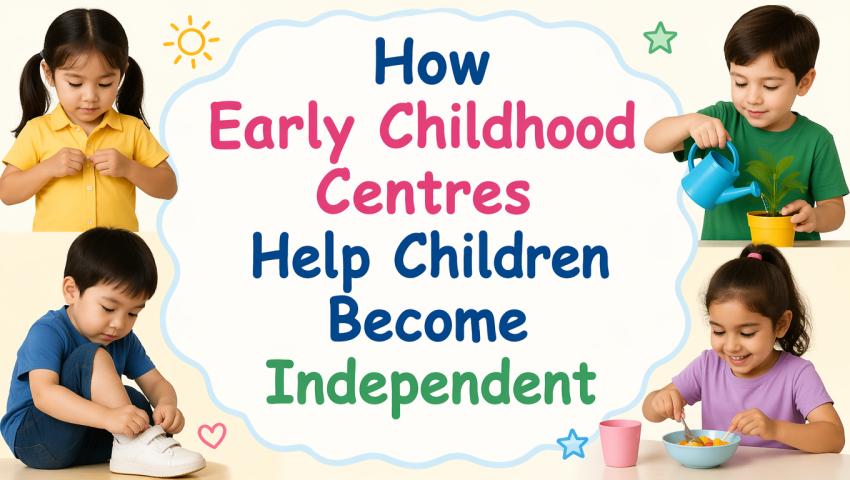
Consider how often you've seen a toddler attempt to put their shoes on. Patience, concentration and determination. They might have trouble with the straps, take a break and then end up getting it right, although not on their feet.
It's natural for parents to want to interfere and assist. Life is so busy and often times, it's easier to do things ourselves.
But all too often in a high-quality early childhood centre, the answer is rather different. An educator might not immediately assist the child, but sit beside the child, be gently encouraging and give the child the time they need to complete the task.
This is intentional and done purposefully. Helping children to become independent is one of the most crucial aims of early childhood education. The learning spaces are well structured to help children to take responsibility for themselves and grow in confidence in saying "I can do it myself.
Some of the ways early childhood centres foster independence from the early years.
1. A Child-Friendly Environment
Most homes are geared around adults and it's hard for little ones to access things in their daily lives without help.
Early childhood centres are not like that. All areas of the environment are planned and designed for the children.
- Low Shelves: Books, toys and learning experiences are positioned at a child's level so children can access them without having to ask an adult.
- Child-sized furniture: Small furniture enables children to engage in their daily activities comfortably and safely.
- Easy to Reach Storage: Coat hooks, cubbies and places of storage are located at a child's eye level, allowing the children to manage their own belongings.
Children will be more likely to make decisions and do things for themselves when they can get what they need themselves.
2. Everyday Activities Become Learning Opportunities
Daily routine is considered as learning opportunity in an early childhood centre. Children learn to use everyday skills.
- Meal Times: Children to serve themselves food, drink water in their own cup and clear up after eating.
- Clean Up: Labels and pictures to help children put toys and learning materials away after play.
They are simple duties that develop the children's fine motor skills and coordination and help them to understand that everyone is a part of the classroom community.
Teachers also know that children learn best when offered just the right amount of help to accomplish a project, and not more. Children experience success on their own merits with gentle guidance.
3. Learning from Mistakes
Independence brings on the ability to face up to problems. Everyone makes mistakes when growing and learning.
Educators do not consider this as a failure if a child spills a drink or accidentally knocks over a block tower. Rather, they engage in a peaceful discussion about how the child can solve the issue.
If the child spills juice on the table, for instance, he or she can be allowed to use a cloth and demonstrated how to clean up the spills. This promotes a sense of responsibility while encouraging children to know that errors can be made right.
Children over time grow stronger, realising that setbacks are chances to improve, not to give up.
4. Emotional and social confidence building.
Independence also means knowing how to control feelings and how to come across to others.
Children start to make choices at an early childhood centre, not relying on parents for every choice. They can communicate their emotions, seek assistance from teachers, share with peers and resolve minor conflicts.
Educators facilitate dialogue and problem-solving with children rather than solving the conflict for them when it occurs.
The experiences build children's confidence, communication skills and positive relationships that help them to prepare for primary school and life.
What Parents Can Learn
It is common for parents to mark occasions when the child masters a new concept, like learning letters, numbers, or colours. These are good things, but independence is even better!
When children are able to make choices, solve simple problems, and manage daily activities, they have confidence which helps them learn in all areas of life.
It can be challenging for parents to let go and let their kids take risks. But it's good to give them a chance to do it on their own and fail and learn how to do it on their own, which is a good life skill.
Small successes, such as getting dressed, packing up toys or pouring a glass of water, help to create confidence for the future. These little steps are the building blocks to being independent and successful for life. Choosing the right Early Childhood Centre in Flat bush gives children the guidance and encouragement they need to grow into confident, capable, and independent learners.