You may have heard a lot about the advantages of non-destructive testing (NDT) if you are thinking about a career in this field. The jobs of NDT professionals are often competitive, in demand, hands-on and in industries like aerospace, oil and gas, manufacturing, and construction.
When deciding to attend an NDT training course, a common question many ask is, What will I learn during training?
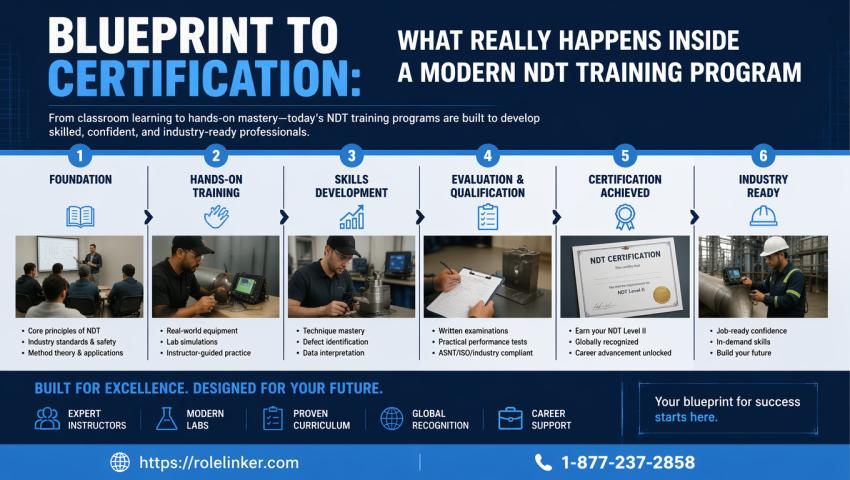
An NDT training program is much more than sitting in a classroom. It is a mix of science, engineering principles and experience to ready students for real work inspection.
Let's take a closer look at what a modern NDT Training Course entails and what you can expect throughout the process.
Step 1: Learn the Basics
All NDT techniques have scientific principles as their basis. The first step in the use of inspection equipment is to understand the behavior of various materials and the causes of defects.
The initial training comprises classroom learning. In this period, students learn about theory of different inspection techniques such as:
- Ultrasonic Testing (UT)
Understand the transmission of high-frequency sound waves in metal and other materials. You will learn how sound waves are reflected from internal defects that can be used to locate cracks or defects.
- Radiographic Testing (RT)
Know how industrial x-rays and gamma rays are used to examine the inside of materials without harming them. Image interpretation and proper radiation safety procedures will also be taught.
- Eddy Current Testing (ET)
Learn to use electromagnetic field to detect surface and near-surface defects in conductive materials.
No complex mathematics is required but you will learn to read equipment settings, understand material properties and adhere to industry standards and inspection procedures.
Step 2: Hands-on Training
Once students have gained knowledge on theory, they proceed to the hands-on training lab.
The application of classroom knowledge with real inspection equipment and test specimens is the place.
Common training labs have the following features:
- Welded pipes
- Steel plates
- Aircraft components
- Structural materials
Test specimens containing known defects
Instructors demonstrate how to use inspection equipment before allowing students to perform inspections independently.
Students practice:
- Conducting tests with ultrasonic test equipment
- The use of magnetic particle testing tools.
- Application of the liquid penetrant inspection methods
- Reading inspection results
- Adjusting equipment settings
- Identifying different types of defects
Practice improves student confidence and skills to conduct field inspections.
Step 3: Record Training and Experience
Passing a test is not the only way to become certified in NDT. Students are also required to have a certain amount of training and practical experience. Most training programs will begin to support the student in the process of documentation by documenting:
Classroom Hours
These include practical time spent under the guidance of an instructor, learning theory and doing practical exercises.
Hands-on Experience
Students also start preparations for hands-on experience needed prior to certifications. This is a hands-on experience that takes place under the guidance of qualified NDT personnel.
Providers also describe how to keep suitable records in accordance with industry-specific requirements like SNT TC 1A or NAS 410.
Step 4: Exam Prep for Certification Exams
The last part of an NDT training program is on preparation for certification.
There are three exams in most certification programs.
- General Exam: This is a written examination based on the principles used for each inspection method.
- Specific Exam: Assesses your understanding of relevant codes, standards, procedures and inspection requirements in the industry.
- Practical Exam: In the practical exam students will have the opportunity to show their inspection skills.
You will:
- Set up inspection equipment
- Calibrate instruments properly
- Examine a test specimen
- Find and recognise faults
- Record inspection results
- Create a professional inspection report
- Make decisions on whether the component is acceptable or not
Failing any of the three exams means you do not have the knowledge and practical skills needed for certification.
Developing a Career After School
An NDT training program offers much more than classroom training. It equips you with practical skills that are desired by employers in various industries.
Graduates know how to operate professional inspection equipment, detect material defects, follow safety measures, and write inspection reports.
These competencies can be applied to a variety of career paths including aviation, oil and gas, manufacturing, power generation, transportation, construction and many others where quality and safety are critical.
Final Thoughts
An NDT training program is a blend of classroom instruction, lab practice, and exam preparation. Students develop a sense of confidence in conducting scientific and practical tests in the field.
While you may be beginning your first career or just entering a new technical field, a good NDT training program can help you get the knowledge, experience and skills you need to start your road to becoming a certified NDT professional.