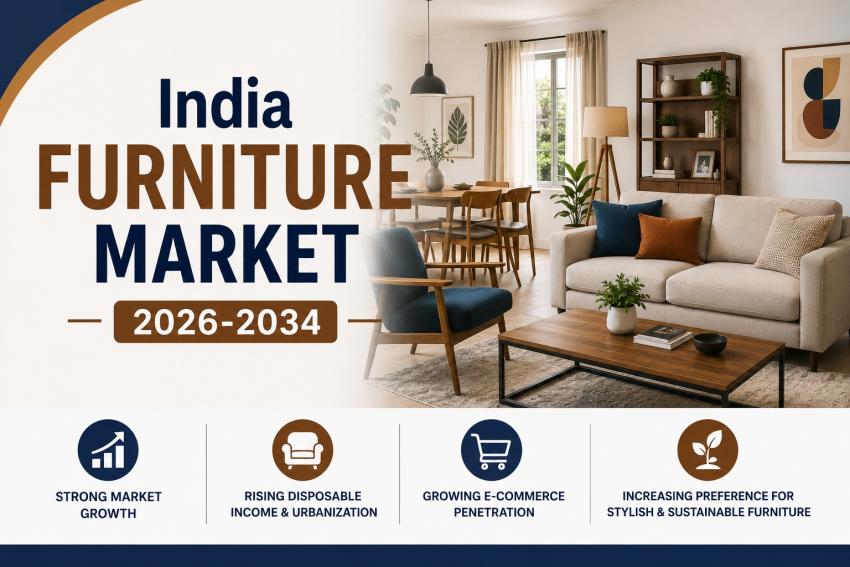
How Is the India Furniture Market Performing?
The furniture industry in India is undergoing structural transformation driven by rapid urbanization, a booming residential real estate sector, rising disposable incomes, and accelerating digital retail adoption. The market is shifting from a fragmented, unorganized cottage industry into an increasingly branded, omnichannel ecosystem, reshaping how Indian households and businesses buy, use, and replace furniture.
As consumers transition from generic carpenter-made products to designer, modular, and smart furniture, the market is evolving into a sophisticated lifestyle and design-led industry. The market was valued at USD 25.38 Billion in 2025 and is projected to reach USD 44.30 Billion by 2034, growing at a CAGR of 6.38% during 2026-2034.
Growth is being driven by government housing programs including the Pradhan Mantri Awas Yojana (PMAY), rising e-commerce penetration through platforms such as Wakefit and Pepperfry, and increasing premiumization across urban Tier-1 and Tier-2 markets, positioning India as one of Asia's most dynamic furniture markets.
Market Snapshot
- Market Size (2025): USD 25.38 Billion
- Forecast Value (2034): USD 44.30 Billion
- CAGR (2026-2034): 6.38%
- Leading Segment by Material: Wood (59.8% share)
- Leading Segment by End Use: Residential (70.6% share)
- Leading Region: North India (33.2% share)
Evaluate Market Opportunity with the Business Sample Report
What Growth Factors Are Driving the India Furniture Market?
- Real Estate and Housing Sector Expansion:
India's housing sector remains the primary demand driver, with 4,12,520 units launched across the top seven cities in 2024, sustaining steady furniture demand from rising homeownership. PMAY's 11.2-million home construction commitment provides a multi-year demand foundation for residential furniture across all price segments.
- Rising Disposable Incomes and Middle-Class Consumption:
Per capita income has steadily increased, boosting spending on home improvement and premium furniture among urban and semi-urban consumers. Lifestyle aspirations in Tier-1 metros are converging with global design sensibilities, accelerating premiumization and demand for branded furniture.
- Urbanization and Commercial Infrastructure:
Expanding urbanization and growth in office and commercial spaces across Bengaluru, Hyderabad, Mumbai, and Delhi NCR are driving demand for office and institutional furniture. India's real estate industry is projected to reach USD 5.8 trillion by 2047, ensuring sustained long-term commercial furniture demand.
- E-Commerce Penetration and D2C Growth:
Online furniture retail is expanding rapidly, supported by platforms like Wakefit, Urban Ladder, Pepperfry, and Amazon India. Augmented reality previews, 3D visualization tools, and customization engines are improving online conversion rates and accelerating organized market growth across Tier-1 and Tier-2 cities.
What Are the Latest Emerging Trends in the India Furniture Market?
- Smart and Multifunctional Furniture Adoption:
Shrinking urban apartment sizes — Mumbai's average flat fell to 645 sq. ft. in 2024 — are accelerating demand for convertible beds, fold-out tables, wall-mounted shelving, and modular storage. Smart furniture integrating USB charging ports and embedded sensors is emerging as a premium differentiator in metros.
- Sustainable and Eco-Certified Material Sourcing:
Environmental awareness is driving demand for certified wood, bamboo, and recycled materials. IKEA India's commitment to 100% renewable and recycled materials by 2030 is shaping consumer expectations and influencing industry-wide procurement practices toward sustainable sourcing standards.
- D2C E-Commerce and Online Customization:
India's D2C furniture segment is growing at a strong double-digit pace. Brands like Wakefit and Urban Ladder leverage 3D visualization and AR-based previews to improve online conversion, with customization tools enabling consumers to personalize finishes, dimensions, and configurations.
- Corporate Office Re-Design and Hybrid Workplace Transformation:
India's shift to hybrid work is driving office refurbishment, with companies replacing fixed desks with collaborative layouts, hot-desking infrastructure, and ergonomic seating, boosting demand for commercial furniture across Bengaluru, Hyderabad, Mumbai, and Delhi NCR.
What Opportunities Lie Ahead for the India Furniture Market in the Coming Years?
The India furniture market is positioned for robust, multi-decade expansion through 2034, supported by rising homeownership, expanding organized retail, and accelerating digital adoption. Tier-2 and Tier-3 cities represent a significant growth frontier given their currently lower organized retail penetration relative to Tier-1 markets, while rising urbanization, improving infrastructure, and e-commerce access continue to expand the addressable consumer base.
Companies and investors positioning themselves across smart and modular furniture, sustainable material sourcing, and Tier-2/3 distribution are well-placed to capture above-market returns. Godrej Interio's ₹300 crore expansion investment, IKEA's plan to more than double its India investment to approximately USD 2.2 Billion over five years, and Nilkamal's strong e-commerce-driven revenue growth all point to sustained investment flows through the forecast period.
How Is the India Furniture Market Segmented?
By Material
- Wood (leading at 59.8% share in 2025)
- Metal
- Plastic
- Glass
- Others
Wood dominates as the established preference in Indian furniture, underpinned by consumer demand for natural aesthetics, structural durability, and premiumization trends in urban housing. Metal furniture, at 18.4% share, primarily serves B2B applications such as offices, healthcare, and institutional use, making it relatively insulated from consumer sentiment cycles. Plastic (11.3%) and glass (6.7%) furniture cater to low-cost/outdoor and premium residential segments respectively.
By End Use
- Residential (leading at 70.6% share in 2025)
- Commercial
Residential furniture dominates as the primary demand category, underpinned by India's housing boom and PMAY's 11.2 million home construction target sustaining long-term demand. Commercial furniture, at 29.4% share, is supported by office fit-outs, hospitality, healthcare, and institutional demand tied to expanding commercial real estate.
By Region
- North India (leading at 33.2% share in 2025)
- West and Central India
- South India
- East India
North India leads the market, supported by Delhi-NCR's status as India's largest real estate market, with residential project launches in Gurugram, Noida, and Faridabad driving continued demand. West and Central India (26.4%) is anchored by Mumbai's premium housing market and Pune's corporate demand. South India (23.7%) benefits from Bengaluru's technology sector, while East India (16.7%) is an emerging market supported by Kolkata's urban housing growth.
Competitive Landscape
The India furniture market is characterized by a dual structure: a growing organized sector led by Godrej, IKEA India, Nilkamal, and Wakefit, and a large unorganized segment comprising local carpenters and regional manufacturers contributing an estimated 80-85% of production volume. Organized brands collectively account for approximately 15-20% of total market value in 2025, with the entry of Cello World and Supreme Industries into branded furniture signaling accelerating formalization in the mass-market plastic and institutional segments.
Investment & Growth Opportunities
- Smart, modular, and space-saving furniture development targeting urbanization-driven demand for compact living solutions
- Premium residential furniture expansion outpacing the overall market amid rising disposable incomes and lifestyle upgrades
- Tier-2 and Tier-3 city distribution networks capitalizing on currently low organized retail penetration outside metro markets
- D2C e-commerce platforms leveraging AR-based visualization and customization to drive conversion and average order values
- Sustainable and eco-certified material sourcing aligning with evolving consumer and regulatory expectations
- Export-oriented manufacturing under Make in India targeting USA, UK, and GCC markets, where India already ranks around 16th globally as a furniture exporter
India Furniture Market Recent Developments & News
- September 2025: Godrej Interio announced a ₹300 crore investment to accelerate expansion, targeting ₹10,000 crore in revenue by FY2029, with a refreshed brand identity and approximately 1,500 retail outlets nationwide including strong Tier-II/III focus
- January 2026: IKEA announced plans to more than double its India investment to approximately USD 2.2 Billion over five years, accelerating store expansion, digital capabilities, and local sourcing across urban and emerging markets
- March 2026: IKEA reaffirmed its expansion roadmap with approximately 25 new stores planned over 4-5 years across formats, deepening penetration into Tier-2 and emerging Indian markets
- November 2025: Nilkamal Furniture reported Q2 FY26 revenue rising 18% YoY to approximately ₹948-968 crore, with e-commerce sales surging approximately 23% and its @home retail footprint expanding to approximately 96 stores nationwide
Source: IMARC Group