Organizations involved in personnel certification are facing a new benchmark with the release of ISO/IEC 17024:2026. The updated personnel certification standard introduces refined requirements that strengthen the credibility, consistency, and impartiality of certification programs. Understanding why organizations should upgrade to ISO/IEC 17024:2026 is essential, as the revised standard not only supports ISO 17024 accreditation but also helps organizations improve certification processes, enhance stakeholder confidence, and align with evolving international best practices.
Whether your organization is seeking accreditation for the first time or planning the transition from the 2012 edition, adopting the latest ISO/IEC 17024:2026 requirements can help build a more effective and reliable personnel certification management system.
Why Upgrade to ISO/IEC 17024:2026?
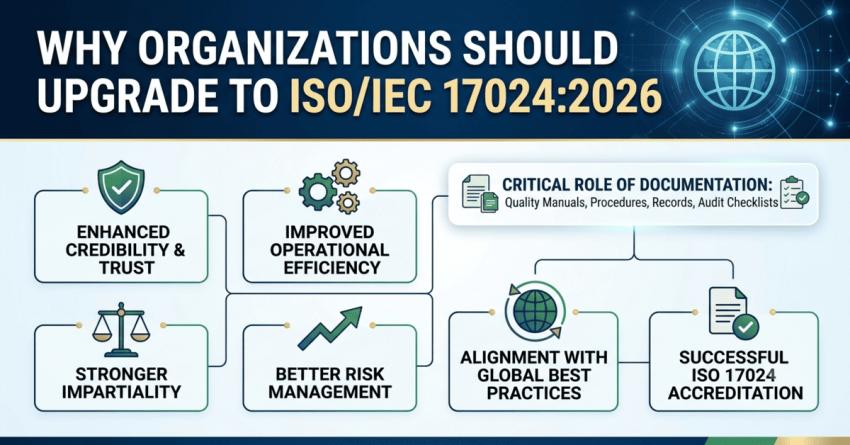
The latest version of ISO/IEC 17024 reflects evolving certification practices and international accreditation expectations. Upgrading enables organizations to strengthen governance, improve operational efficiency, enhance risk-based decision-making, and maintain a personnel certification management system that meets current global requirements.
Key benefits include:
- Improved consistency in personnel certification activities
- Stronger emphasis on impartiality and fairness
- Better risk-based management of certification processes
- Enhanced competence evaluation methods
- Greater confidence among regulators, employers, and certified individuals
- Improved readiness for ISO 17024 accreditation assessments
By implementing the updated requirements, organizations can ensure their certification programs remain relevant in an increasingly competitive and regulated environment.
Key Improvements in ISO/IEC 17024:2026
Compared to the previous edition, ISO/IEC 17024:2026 introduces improvements that help organizations maintain effective and reliable certification systems. Some of the major focus areas include:
- Clearer requirements for governance and impartiality
- Enhanced controls for examination development and administration
- Improved management of certification decisions
- Improved control of documented information and certification records
- Better monitoring of certified persons throughout the certification cycle
- Stronger emphasis on continual improvement through internal audits and management reviews
These updates help organizations reduce inconsistencies, strengthen compliance with ISO/IEC 17024:2026 requirements, and improve the integrity and credibility of their certification schemes.
Documentation Plays a Critical Role
One of the most important aspects of implementing ISO/IEC 17024:2026 is maintaining accurate and well-structured documented information. Quality manuals, procedures, work instructions, forms, records, and audit checklists provide the framework for implementing the standard consistently across all certification activities.
Organizations looking to simplify implementation can use professionally developed ISO 17024:2026 documents that include ready-to-use manuals, procedures, templates, forms, and audit checklists aligned with the latest requirements. Well-structured documentation helps standardize certification activities, improve consistency across processes, and support successful accreditation assessments.
Business Benefits Beyond Compliance
Upgrading to ISO/IEC 17024:2026 offers advantages that extend beyond meeting accreditation requirements. Organizations can expect to:
- Increase confidence among clients and certification candidates
- Improve operational efficiency through standardized processes
- Reduce errors caused by inconsistent documentation
- Strengthen international recognition of certification programs
- Support continual improvement through systematic internal audits and management reviews
- Simplify employee training using documented procedures
These benefits contribute to a more reliable personnel certification system and improve the organization's reputation in domestic and international markets.
Preparing for a Successful Transition
A successful transition begins with understanding the differences between the previous and current editions of the standard. Organizations should perform a gap analysis, review existing procedures, update ISO 17024:2026 documents, train relevant personnel, and conduct internal audits to ensure compliance with the revised standard before applying for ISO 17024 accreditation or reassessment.
A structured transition plan should include reviewing compliance with ISO/IEC 17024:2026 requirements, updating documented information, training personnel, and verifying implementation through internal audits. Organizations can further strengthen audit readiness by using an ISO 17024:2026 audit checklist guide to identify compliance gaps before accreditation assessments.
Conclusion
Upgrading to ISO/IEC 17024:2026 enables organizations to align with the latest international requirements while strengthening the effectiveness of their personnel certification management system. It also supports consistent certification practices, improves audit readiness, and enhances confidence among accreditation bodies and certification candidates.
By combining a structured implementation approach with comprehensive documentation, organizations can make the transition more efficient while building a certification system that meets current international expectations and supports long-term success.