Preparing for an ISO 9001 audit involves more than checking whether your documents exist. Auditors evaluate whether your documented information is accurate, up to date, controlled, and aligned with your organization's actual processes. A systematic documentation review before your next audit helps identify gaps, reduce nonconformities, and improve confidence during both internal and certification audits.
Why Reviewing ISO 9001 Documentation Matters
ISO 9001 requires organizations to maintain documented information that supports the effective operation of their Quality Management System (QMS). Outdated procedures, missing records, or inconsistent work instructions can result in audit findings and delay certification or surveillance audits.
A thorough review ensures that:
- Documents reflect current business processes.
- Employees follow the latest approved procedures.
- Required records are available and properly maintained.
- Document control practices comply with ISO 9001 requirements.
Start with your document register
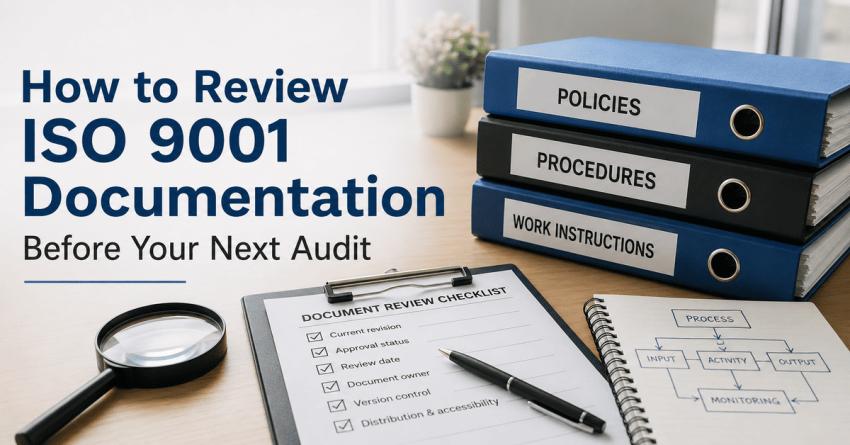
The first step is to verify that your document register contains all current documents. Review your quality manual (if applicable), procedures, standard operating procedures (SOPs), work instructions, forms, and records.
Check each document for:
- Current revision number
- Approval status
- Review date
- Document owner
- Version control
- Distribution and accessibility
Obsolete documents should be removed from operational use while remaining available for traceability when necessary.
Verify Mandatory and Operational Documents
Your documentation should adequately support every major business process. Confirm that documents related to quality objectives, risk management, internal audits, corrective actions, supplier evaluation, customer feedback, production or service delivery, and management review are complete and regularly updated.
If your organization discovers missing procedures or outdated templates during this review, using professionally prepared ISO 9001 documents can significantly reduce preparation time while helping maintain consistency across the QMS.
Compare Documents with Actual Practice
One of the most common audit findings occurs when documented procedures no longer reflect day-to-day operations.
Interview process owners and observe actual activities to verify that:
- Employees follow documented procedures.
- Forms and records match current practices.
- Responsibilities remain accurate.
- Process interactions are clearly defined.
Whenever business processes change, update the corresponding documentation promptly rather than waiting until the next audit.
Review Document Control
Effective document control is essential for ISO 9001 compliance. Ensure your organization has controls for creating, approving, revising, distributing, and retaining documents.
Review whether:
- Only authorized personnel approve documents.
- Previous revisions are archived appropriately.
- Employees can access the latest versions.
- Electronic and printed copies remain consistent.
Strong document control minimizes confusion and demonstrates effective quality management during audits.
Check Audit-Related Records
Auditors typically request evidence rather than procedures alone. Verify that records supporting your QMS are complete and easily retrievable.
Examples include:
- Internal audit reports
- Corrective action records
- Management review minutes
- Employee competency records
- Calibration records
- Customer complaint records
- Supplier evaluations
Missing records often create more audit concerns than missing procedures.
Perform an Internal Documentation Review
Before the certification or surveillance audit, conduct an internal documentation review using a checklist. This allows your team to identify missing information, inconsistent revisions, and opportunities for improvement before an external auditor evaluates the system.
Assign responsibilities for corrective actions and verify that all updates are completed before the audit date.
Final Thoughts
Reviewing your ISO 9001 documentation before an audit helps identify gaps, improve compliance, and ensure your Quality Management System reflects current business practices. Well-maintained documentation supports smoother certification and surveillance audits. If you want to simplify implementation and save time, professionally developed ISO 9001 documents can help you establish and maintain an effective, audit-ready QMS with confidence.