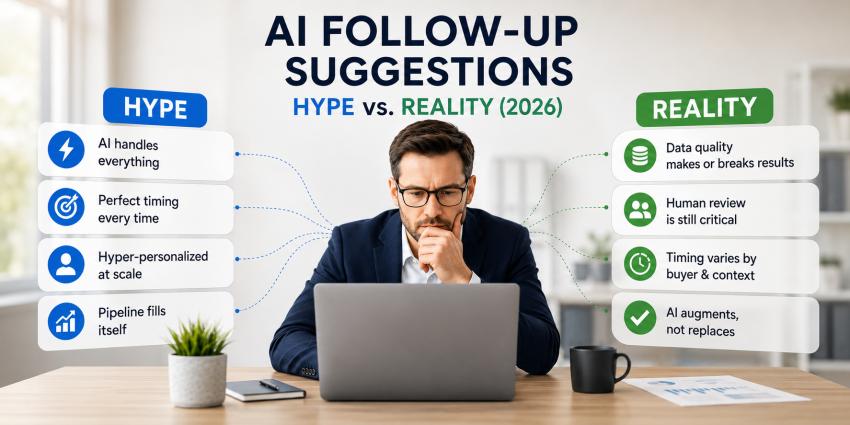
The same promise has been made to the majority of sales teams: let AI handle your follow-up and watch your pipeline fill up on its own. It seems like an intriguing pitch. While your salespeople concentrate on closing, AI examines behavior, identifies patterns, and delivers the right message at the right time.
The reality is more complicated. AI-powered follow-up tools have gotten genuinely impressive in certain areas, but the gap between vendor promises and actual performance is still significant enough to cost teams real opportunities. Understanding where the technology delivers—and where it doesn't—is one of the more useful things a sales or marketing professional can do right now.
What AI Follow-Up Actually Promises
Fundamentally, an AI follow-up system should be able to execute three tasks more effectively than a human: remembering to send the message, timing it appropriately, and personalizing it sufficiently.
The memory part is essentially solved. Automation handles sequencing well. The timing piece has improved considerably—AI can now analyze behavioral signals such as email opens, pricing page visits, and content downloads to recommend or trigger outreach at high-intent moments rather than on a fixed schedule.
But personalization—the thing that's supposed to make all the difference—is where the actual debate lives.
Generic AI follow-ups are visibly generic. Prospects can tell. A message that opens with “Hi [First Name], just circling back on my earlier email” isn’t personalization. It’s a mail merge with better technology underneath. And the consequences are measurable: according to research compiled by Sopro, AI-personalized outreach that uses real behavioral context achieves response rates of 15–25%, compared to 3–5% for generic outreach. That’s a meaningful difference, but it only materializes when the personalization is genuine.
Where the Hype Runs Ahead of Reality
The “Set It and Forget It” Fallacy
The most oversold idea in AI follow-up is full automation. Deploy the system, feed it leads, and let it run. Some vendors still push this narrative. The evidence says otherwise.
Teams that ignore manual evaluation of their AI follow-up sequences tend to burn through contact lists quickly and harm sender reputation in the process. Google identifies domains with a spam complaint rate above 0.1%, and a single improperly calibrated AI sequence can cause that rate to exceed the stringent email deliverability standards.
More broadly, AI assistants that draft messages are valuable. AI systems that send them, log them, update the CRM, and trigger the next step are in a completely new category—and most teams aren't there yet. According to practitioners who have thoroughly tested this, the honest approach is to begin with AI drafting while humans approve, then go to fuller automation if reply rates and tone consistency are confirmed.
The Generic Data Problem
AI personalization is only as good as the data feeding it. This is not a limitation that marketing copy typically highlights.
If your CRM is missing lead source, persona, last touchpoint, and pipeline stage for a significant portion of your contacts, no AI model will compensate for those gaps. It will produce generic output regardless of how sophisticated the underlying model is. Teams that invest in CRM hygiene before deploying AI follow-up tools consistently see better results than teams that bolt on AI to an existing data mess.
Another is the temptation of over-personalization. 71% of customers think companies now collect too much personal information, according to research on email recipient behavior. Extremely specific details, like a recent LinkedIn post or a personal life update, can quickly turn a message from "relevant" to "intrusive." To be effective, personalization must be both contextual enough to be relevant and professional enough to avoid appearing surveillance-related.
Time Claims Without Generalization
Optimal send-time forecasts based on aggregate behavioral data are promoted by numerous AI follow-up solutions. The issue is that individual accounts don't necessarily follow industry-level trends.
A procurement manager in manufacturing may not find what works for a SaaS candidate in another vertical. This subtlety is supported by the data, which shows that response rates differ greatly within industries, even within the same follow-up sequence. When compared to tools that create timing signals using account-specific behavioral data, those that use universal timing logic typically perform worse.
Where AI Follow-Up Actually Works
AI follow-up produces actual, quantifiable progress in certain situations, despite the overpromising.
Trigger-Based Workflows
The most obvious benefit of AI is the substitution of behavior-triggered follow-up sequences for calendar-based ones. A prospect who viewed your intro email three days ago needs a different message than one who visited your pricing page yesterday. It is not feasible to build that logic at scale by hand. If the behavioral data is fed in appropriately, AI can handle it successfully.
This is where agentic AI—systems that independently receive a signal, choose a response, and carry it out—shows real potential. When a prospect views a demo site twice without making a reservation, an agentic follow-up system may detect this, send a tailored message mentioning that particular interest, and escalate the matter to a representative if, after 48 hours, there is still no engagement. That's fundamentally different from a static drip process.
According to BCG research, 67% of enterprises already consider AI agents a crucial part of their digital transformation—and agentic follow-up is among the highest-ROI entry points for organizations that get the data foundation right first.
Scale Post-Event Monitoring
Post-event outreach is one area where AI follow-up greatly beats human effort. Human bandwidth creates a bottleneck at events like conferences, trade shows, and virtual events, which generate dozens or hundreds of new contacts in a compressed window.
Not remembering to follow up is the problem. It's a useful follow-up with sufficient context. "Great connecting at [Event Name]!" is an example of a generic post-event email that doesn't convert. However, a follow-up that references the particular subject of the conversation, links the lead's role to a pertinent product capability, and offers a sensible course of action? It does.
This is where tools designed specifically for event lead capture and structured follow-up workflows have an advantage over general-purpose AI email generators. When a system can pull the captured context from a booth conversation—the prospect's stated interest, their company's challenges, their timeline—and use that to generate a follow-up that reads like it was written by someone who was actually paying attention, the response rate difference is real.
Solutions like RoloScan, a badge-scanning and lead-capture tool built for events, address this problem practically by capturing structured lead data in the moment so that any downstream follow-up—whether AI-assisted or manual—has the context it needs. The tool doesn't promise to replace the rep; it makes sure the rep (or the AI drafting for them) is working from something concrete rather than a business card and a fading memory.
The underlying principle applies broadly: AI follow-up is only as contextual as the inputs it receives. A system fed rich, structured post-event lead data will produce significantly better follow-ups than one working from a name and a company.
Reliability at Scale
Simply not forgetting is one clear benefit AI offers for follow-up. Human-led outbound teams execute planned follow-ups about 45–70% of the time, with large variance between reps and deal stages. There are no terrible weeks or exceptionally full calendars in AI. It executes.
Most teams don't realize how important stability is. A single follow-up boosts conversion rates by 22% when compared to one-touch sequences, according to several studies on email outreach patterns. On first contact, most leads do not convert. Whether someone issues a follow-up communication often makes the difference between a deal that closes and one that stays cold.
What Good AI Follow-Up Actually Looks Like
A few standard procedures are shared by the teams that benefit most from AI follow-up.
They feed AI real behavioral signals, not simply name tokens. Any attempt at personalizing fails as soon as a message begins, "Hi [First Name], hope you're well."
They use AI to draft and humans to review—at least until the system has demonstrated consistent tone and relevance. The companies that rush past this step tend to create deliverability problems that they then spend months diagnosing.
Crucially, they correct the data prior to implementing the AI. Lead source, persona, interaction history, and pipeline stage are all necessary inputs. They are what distinguish a well-written bit of digital noise from a helpful AI follow-up.
The Final Thought on AI Follow-Up
The truth is that AI follow-up recommendations are neither the overhyped diversion skeptics often say nor the pipeline revolution they are sometimes billed as. The technique is useful in some circumstances, but it is genuinely unreliable in others.
Context-aware follow-up—where AI is working from real behavioral data, structured lead information, and defined escalation points to human reps—delivers measurable results. Generic automation dressed up as personalization does not.
The organizations that will get the most out of AI follow-up tools in the next few years are the ones investing now in the underlying data infrastructure, starting with structured lead capture and CRM hygiene before layering on automation. That sequencing matters more than which AI tool you choose.
The follow-up problem has always been about the right message to the right person at the right moment. AI can help with all three—but only when it knows enough to try.