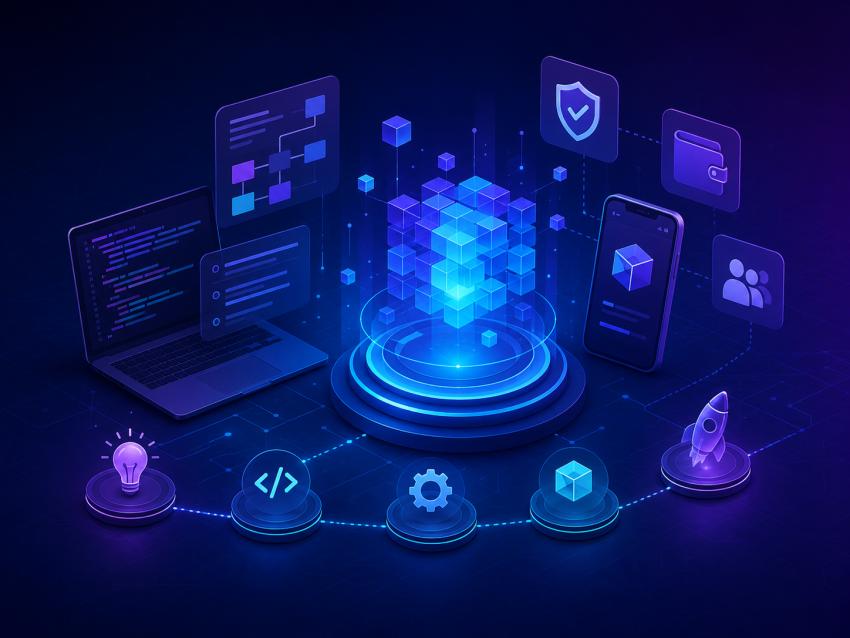
The decentralized applications (DApps) are revolutionizing the digital landscape by providing users with an environment that is secure, transparent, and trustless, without the need for centralized authorities. Businesses across a wide range of industries are recognizing the potential of blockchain technology in various applications, such as finance, healthcare, gaming, and real estate, to provide increased security, lower operational costs, and better user experience.
But to create a decentralized application, one must have a strategy to work with and be knowledgeable about blockchain technologies. This guide will delve into the process of developing a DApp, the technologies used, and the factors that impact the cost of DApp development.
So what is DApp Development?
DApp Development involves the process of creating decentralized applications that operate on the blockchain networks as opposed to centralized servers. Smart contracts are used in these applications to execute the business logic and to provide transparency, immutability, and security.
Different from traditional applications, DApps share the data among several nodes, making the data more distributed and eliminating single points of failure and dependence on intermediaries.
What are the reasons behind businesses investing in DApps?
DApps are becoming popular in modern organizations due to its several benefits:
Improved data security and transparency.
By cutting down on middlemen and low-cost operations, this reduces the expenses involved.This cuts out the middleman and low-cost operations, thereby lowering costs.
Immutable and tamper-proof transactions -
Enhanced user and stakeholder trust.
The use of smart contracts to increase automation.
More user-friendly, larger scale and more global access.
With the increasing adoption of blockchain, it has become crucial for businesses to collaborate with a professional DApp development company to create secure and scalable decentralized solutions.
The process of creating a DApp involves several steps.DApp Development Process has several steps.
There are several phases to building a decentralized application, ranging from validation to deployment and maintenance.
Requirement Analysis and Business Planning
The initial step is to grasp business goals and determine the potential applications of blockchain for addressing current business issues.
Key activities include:
Defining project goals
Identifying target users
Choosing the right blockchain network is crucial.
Evaluating business feasibility
Creating a development plan
Effective planning substantially minimises development risks and wasteful costs.
3. Selecting the Appropriate Blockchain Application Development Company
Choosing a suitable blockchain network is one of the most crucial phases of the development of a DApp.
Here are some of the most popular blockchain platforms:
Ethereum
Large developer community
Robust smart contract capabilities
Extensive ecosystem support
Solana
High transaction speed
Low transaction fees
Excellent scalability
Polygon
Ethereum-compatible
Lower gas fees
Faster processing
Binance Smart Chain
Cost-efficient transactions
High throughput
Strong DeFi ecosystem
The type of blockchain can impact the performance and development expenses of apps.
3. DApp Architecture Designing
The developers develop the technical blueprint for the application at this point.
The architecture generally consists of:
Frontend user interface
Smart contracts
APIs & Backend services
Wallet integrations
Database and storage systems
The development of a well-designed architecture is crucial for ensuring security, performance, and smooth user experiences.
4. Smart Contract Development
Smart contracts are self-executing programs that automate transactions and business processes.
Smart contracts are developed for:
User authentication
Asset transfers
Payment processing
Governance mechanisms
Data management
Strict coding principles and security measures are crucial, as smart contracts are immutable once deployed.
5. Frontend Development
The front end is the part of blockchain systems that users interact with.
Typical technologies employed are:
React.js
Next.js
Vue.js
HTML5
CSS3
JavaScript
Smart contracts are accessed via the frontend using blockchain libraries and wallet integrations.
6. Wallet Integration
To sign and verify transactions, DApps need cryptocurrency wallets.
Popular wallet integrations include:
MetaMask
Trust Wallet
Coinbase Wallet
WalletConnect
Wallet integration plays a crucial role in boosting user trust and accessibility.
Testing and Quality Assurance
The application is fully tested prior to its deployment.
Testing areas include:
Smart contract functionality
Security vulnerability assessments
Performance testing
UI/UX testing
Blockchain compatibility testing
Testing helps to reduce security threats and guarantee the performance of applications.
8. Deployment and Launch
Once tested, the developers deploy the smart contracts on the chosen blockchain network.
Deployment activities include:
Mainnet deployment
Server configuration
Node integration
Wallet connectivity verification
Performance monitoring
A stable and scalable decentralised ecosystem can be achieved by deploying it appropriately.
9. Continuing upkeep and enhancements.
Continuous monitoring and optimization of DApps is crucial.
Typical maintenance services are:
Security updates
Smart contract audits
Performance optimization
Feature enhancements
Blockchain upgrades
The majority of businesses opt for a reliable DApp development company to maintain and support their DApp over an extended period.
Application Complexity
Simple DApps are much cheaper than enterprise Dapp.
Blockchain Platform Selection
Higher transaction fees generally result in higher development costs.
Smart Contract Complexity
Advanced smart contract development and testing are needed for complex business logic.
UI/UX Requirements
Custom interfaces and the animation require extra development time.
Security and Auditing
Comprehensive security testing and third-party audits add to project budgets.
Integration Requirements
Payment gateways, APIs and wallet integrations impact total costs.
Development Team Location
The price difference is significantly influenced by the geographic distribution of blockchain developers.The geographic distribution of blockchain developers has a significant effect on pricing.
The estimated cost of DApp development
Approximate dapp Development Cost are dependent on the needs of the project:
DApp Type - Estimated Cost
Basic DApp $15,000 – $30,000
Medium Complexity DApp $30,000 – $80,000
Enterprise DApp $80,000 – $200,000+
Projects that have advanced DeFi, NFT, AI or multi-chain features could demand even significant investments.
Final Thoughts
DApps are revolutionizing digital transformation and are bringing transparency, security, and automation to various industries. Creating a successful DApp, however, depends on careful planning and choosing the right technologies and adhering to a proper DApp development methodology.
Each phase from blockchain selection, smart contract development, testing, to deployment is crucial in ensuring the application's success and the total cost of DApp development. Developing a DApp can be a complex task, and working with a seasoned DApp development company can help businesses overcome these challenges and create secure, scalable, and future-proof decentralized applications.