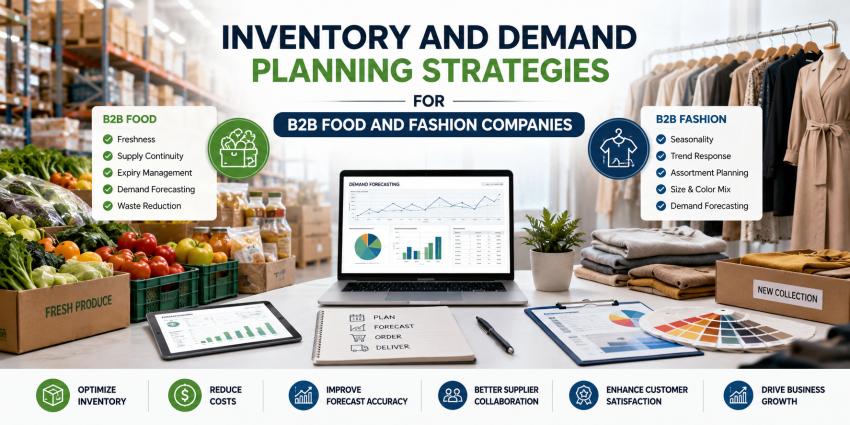
Smart Inventory and Demand Planning Strategies for Food and Fashion Companies
Inventory and demand planning matter a lot for B2B food and fashion businesses because both industries face fast changes, high cost pressure, and strong customer expectations. When planning is weak, companies end up with too much stock, too little stock, waste, late delivery, and lost sales. When planning is strong, they can keep products moving, protect cash flow, and serve customers on time.
This topic is especially important for B2B companies because they do not sell one item at a time in the same simple way as many retail businesses. They deal with bulk orders, repeat buyers, long lead times, seasonal demand, and different product lifecycles. Food businesses must also think about freshness and expiry. Fashion businesses must think about size, color, trend shifts, and seasonal collections.
The good news is that better planning is possible. With the right process, simple data habits, and clear team coordination, B2B food and fashion companies can reduce waste, improve service levels, and make smarter buying decisions. In this guide, I’ll explain the strategies in simple words so you can use them in real business planning, even if you are not a supply chain expert.
Why planning matters
Inventory planning is about deciding how much stock to keep and where to keep it. Demand planning is about predicting how much customers will order in the future. Both work together. If the demand forecast is wrong, inventory levels become wrong too.
For B2B food companies, a small forecasting mistake can lead to spoiled stock, missed contracts, or emergency reordering. For B2B fashion companies, the same mistake can create overstock, markdown pressure, and dead inventory. In both cases, bad planning affects profit very quickly.
Good planning does not mean predicting the future perfectly. It means making better decisions with the information available. The goal is to reduce surprise and build a system that responds quickly when demand changes.
The basic difference between food and fashion
Food and fashion may sound very different, but they share one big problem: demand changes often.
Food products are usually sensitive to shelf life, storage conditions, and customer replenishment cycles. A B2B food distributor may need to keep enough stock for restaurants, hotels, caterers, or retailers, but not so much that items expire. This makes rotation, freshness, and lead time very important.
Fashion products are highly influenced by changing trends, seasonal demand, and customer preferences, making inventory planning more dynamic than in many other industries. To manage product variations, categories, and buyer-focused collections effectively, businesses can learn from How Manufacturing Companies Can Rank Industrial Product Catalog Pages on Google, which highlights the importance of organizing large product catalogs in a way that improves visibility, user experience, and product discovery.
Demand planning in simple words
Demand planning means guessing future sales as accurately as possible using past sales, customer orders, market changes, and business knowledge. It is not just a math task. It is also a business process.
A good demand plan helps you answer questions like:
What will customers order next month.
Which products will move quickly.
Which customers may place repeat orders.
Which items will slow down.
How much safety stock should we hold.
When should we reorder.
In B2B companies, demand planning often includes contract orders, planned promotions, customer buying patterns, and bulk purchases. That makes it different from simple retail forecasting. The planning team must look at order history, account activity, market seasonality, and supply lead times together.
Inventory planning in simple words
Inventory planning means deciding how much stock to buy, store, and move. The goal is to keep enough inventory to serve customers without keeping too much cash locked in products.
In food, good inventory planning helps prevent spoilage and waste. In fashion, it helps prevent overstock and discount loss. In both cases, it supports better cash flow.
Inventory planning usually includes:
Reorder points.
Safety stock.
Lead time planning.
Warehousing.
Stock rotation.
Product classification.
Quantity planning.
When inventory planning is done well, the business knows what to buy, when to buy, and how much to hold. That creates stability and reduces pressure on operations.
Common planning problems
Many B2B food and fashion businesses face the same recurring problems.
One major issue is poor demand visibility. Teams may rely on old data or gut feeling instead of real demand trends. Another issue is too many manual spreadsheets, which makes mistakes more likely. Some companies also fail to connect sales, purchase, operations, and warehouse teams, so everyone works with different numbers.
In food, the biggest problems are expiry, temperature control, and uneven order patterns. In fashion, the biggest problems are seasonal drops, style mistakes, size imbalances, and slow-moving stock. Both industries also struggle when suppliers are inconsistent or lead times change suddenly.
The root issue is usually the same: planning is not connected enough to real customer demand.
Smart forecasting strategies
Forecasting is the heart of demand planning. The better your forecast, the easier it is to manage inventory.
Use historical sales data
Past sales are one of the strongest signals for future demand. Look at order history by product, customer, month, region, and channel. This helps you see patterns and repeat buying behavior.
Watch seasonality
Both food and fashion are highly seasonal. Food demand may rise around holidays, festivals, weather changes, or special events. Fashion demand changes with seasons, style drops, and buying cycles. A forecast that ignores seasonality will usually be weak.
Include customer order patterns
In B2B, many customers buy in regular cycles. Some order every week. Some order monthly. Some buy in large bulk only during special periods. Understanding these patterns improves forecast accuracy.
Add market signals
Past data alone is not enough for accurate forecasting, and even a B2B SEO Agency looks at external factors like customer trends, economic changes, and competition, because these directly impact demand and future decisions.
Reforecast often
Demand planning should not be done once and forgotten. It should be updated regularly. In fast-moving businesses, monthly or even weekly review may be needed. Reforecasting helps the team react before small problems become big ones.
Inventory strategies for food companies
Food companies need careful planning because products can expire or lose quality. Simple stock control is not enough. They need freshness-focused planning.
Use FIFO Discipline
First in, first out means older stock should always be used or sold before newer stock. This is especially important in the food industry, where products have limited shelf life and expiry risks are high.
A well-defined warehouse process, clear labeling, and proper stock rotation systems help teams follow FIFO correctly. When implemented properly, FIFO reduces waste, prevents expired inventory, and ensures better product quality for customers.
Track Expiry Dates
Every food business must have clear visibility of product expiry timelines. Inventory systems should track lot numbers, batch details, and expiry dates so stock can be used in the correct order.
Regular monitoring helps teams identify products that are close to expiry and take timely action. This is one of the simplest and most effective ways to reduce spoilage and avoid unnecessary losses.
Keep Safety Stock Carefully
Safety stock is important to handle sudden demand spikes or supplier delays. However, in food businesses, holding too much extra stock can lead to wastage.
The goal is to maintain a small and intelligent buffer based on real demand patterns and risk levels. Balanced safety stock ensures product availability without increasing the chances of expiry-related losses.
Plan for Fast Replenishment
Food products usually require faster replenishment cycles compared to other industries. If supplier lead times are long or inconsistent, inventory planning becomes more complex.
Proper replenishment planning helps maintain the right stock levels at the right time. It reduces the risk of stockouts while avoiding excess inventory that could go to waste.
Separate Fast and Slow Moving Items
Not all products move at the same speed. Some items sell daily, while others have lower or seasonal demand.
Classifying products based on movement speed helps businesses prioritize inventory management. Fast-moving items need regular replenishment, while slow-moving items require closer monitoring to avoid overstocking.
Inventory Strategies for Fashion Companies
Plan by Season
Fashion inventory is highly dependent on seasons, trends, and launch cycles. Planning must align with the right timeframes to maximize sales opportunities.
If products arrive too late, the selling window becomes shorter. If they arrive too early, they may remain unsold for longer periods. Proper seasonal planning ensures better inventory turnover.
Track Size and Color Mix
A single fashion product often comes in multiple sizes and colors. Managing this variation is critical for effective inventory planning.
Businesses need to maintain the right mix based on demand patterns. Otherwise, some sizes may sell out quickly while others remain unsold, leading to imbalance and lost revenue.
Watch Trend Speed
Fashion trends change rapidly due to social media influence, celebrity culture, and shifting customer preferences.
Planning teams should continuously monitor these trends and adjust forecasts accordingly. Staying updated helps businesses respond quickly and avoid stocking outdated styles.
Use Smaller Test Orders
For new or uncertain styles, it is safer to start with smaller test quantities. This allows businesses to understand customer demand before committing to large orders.
Testing reduces risk and provides valuable insights into which products are likely to perform well in the market.
Manage Markdowns Early
If certain products are not selling as expected, early action is important. Delaying markdown decisions can lead to larger losses later.
By identifying slow-moving stock early, businesses can plan discounts or promotions in a controlled way, reducing the impact on margins.
Data That Helps Planning
Good inventory planning depends on accurate and up-to-date data. Even simple data, when used consistently, can improve decision-making significantly.
Important data points include:
Sales history
Customer order frequency
Lead times
Supplier reliability
Expiry dates
Stock on hand
Seasonal demand patterns
Open orders
Promotions
Returns and cancellations
When this data is reviewed regularly, teams can identify risks early and make better planning decisions.
Team Coordination
Demand planning works best when multiple teams collaborate. It is not limited to a single department.
Sales teams understand customer demand and upcoming deals. Operations teams manage storage and processing capacity. Purchasing teams handle supplier timelines. Finance teams monitor budgets and cash flow.
When all teams share insights and communicate effectively, inventory decisions become more accurate. A simple monthly planning meeting can help align everyone and reduce risks.
Technology and Software
Manual planning may work for small operations, but as the business grows, it becomes difficult to manage everything efficiently. This is where software becomes essential.
Inventory and demand planning software provides:
Real-time stock visibility
Forecasting support
Reorder alerts
Expiry tracking
Purchase planning
Sales trend analysis
Warehouse visibility
Reporting dashboards
For B2B food companies, software helps reduce waste and improve replenishment efficiency. For fashion companies, it supports better assortment planning, seasonal alignment, and stock management.
The right technology does not replace human decision-making but enhances accuracy, speed, and overall operational efficiency.
A simple planning process
Here is a simple process that works for both food and fashion companies:
Review past sales.
Check customer buying patterns.
Look at seasonal trends.
Review current inventory.
Check supplier lead times.
Set reorder points.
Add safety stock where needed.
Review with the sales and operations team.
Reforecast regularly.
Track results and improve.
This process is simple, but if done consistently, it can improve planning a lot over time.
KPIs to watch
To know whether planning is working, you need to track the right measures.
Useful KPIs include:
Forecast accuracy.
Stockout rate.
Overstock rate.
Inventory turnover.
Days of inventory on hand.
Waste or spoilage rate.
Fill rate.
Order service level.
Markdown percentage.
Return rate.
These numbers show where the business is doing well and where it needs improvement. For example, a food company may focus more on spoilage and fill rate. A fashion company may focus more on stock turn and markdowns.
Practical examples
Imagine a B2B food distributor supplying hotels and restaurants. If the weather gets hotter, demand for certain beverages may rise. If the team sees this early, it can increase stock slightly and avoid missed sales. But if it overbuys too much, it risks spoilage. So the plan must balance speed and freshness.
Now imagine a B2B fashion wholesaler selling shirts and jackets to retailers. If a new style sells fast in one region, the team can use that data to shift future stock. But if they keep ordering the wrong sizes or colors, inventory will pile up. So the plan must balance trend response and assortment control.
These examples show that the principles are similar, but the execution is different.
How to improve over time
Better planning is a learning process. No company gets it perfect right away.
Start with basic data and simple reports. Then improve forecasting. Then tighten inventory rules. After that, improve team coordination and use software more effectively. The goal is continuous improvement, not instant perfection.
You can also review the reasons behind planning errors. Did demand change suddenly? Did a supplier delay shipment? Did the sales team miss a big customer order? Did the forecast ignore seasonality? These questions help the team learn and adapt.
Final thoughts
Inventory and demand planning are essential for B2B food and fashion companies because both industries depend on timing, accuracy, and fast response. Food businesses must protect freshness and reduce waste. Fashion businesses must manage trends, seasons, and assortment risk. In both cases, strong planning improves service, protects cash, and supports growth.
The best approach is simple: use better data, review demand often, coordinate across teams, and keep inventory aligned with real business needs. You do not need a complicated system to start. You need a clear process, discipline, and the habit of improving little by little.